Friday, February 18, 2022

Anniversary of Executive Order 9066, Incarceration of Japanese Americans During WWII

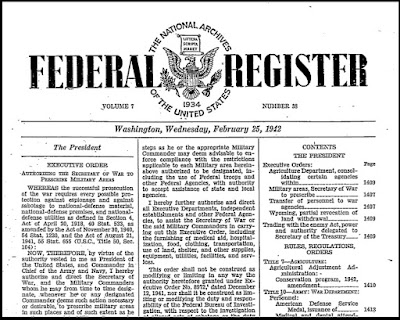
Tomorrow (Feb. 19) is Civil Liberties Day of Remembrance, the anniversary of Roosevelt's Executive Order 9066, which set in motion the removal of thousands of Japanese American families from their homes and their imprisonment in isolated camps. See this brief essay on OurDocuments.gov. Read the order as it was published in the Federal Register Feb. 25, 1942. (HeinOnline has PDFs of the Federal Register starting with its first issue, in 1936. For more about the collection see this guide.)

snip of PDF. Big heading: FEDERAL REGISTER. First item is executive order "AUTHORIZING THE SECRETARY OF WAR TO PRESCRIBE MILITARY AREAS.
PDF from HeinOnline of 7 Fed. Reg. 1407 (Feb. 25, 1942)

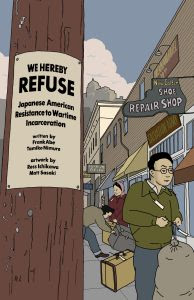
We Hereby Refuse cover - shows cartoon of Japanese Americans with bags and suitcases on a Seattle street
We Hereby Refuse: Japanese American Resistance to Wartime Incarceration (2021) is a graphic work presenting the history of three resisters. The law library's copy is in the Good Reads collection—but it happens to be checked out as I write this blog post. You can click on the link to request the book when it's available.

We Hereby Refuse was co-published by the Wing Luke Museum of the Asian Pacific American Experience. Take a look at the museum's interactive timeline showing the events in the book. 

Did you know that the Wing Luke Museum is named for a UW Law graduate? Wing Luke ('54) served as an assistant attorney general 1957-62, before becoming the first person of color on the Seattle City Council (and the first Asian American to hold any elective office in Washington State). He was killed in an airplane crash in 1965. In 2015, Attorney General Bob Ferguson established the Wing Luke Civil Rights Division.

Wing Luke's bio on the museum's site says that he fought back against high school bullying by drawing comic strips, eventually becoming so popular he was elected president of Roosevelt High School in Seattle. Wing Luke's teenage work in comics makes extra cool that the museum published a graphic novel. (For more on Roosevelt High, see this post from two weeks ago.)

In this YouTube video,Tom Ikeda, from Densho, interviews the two authors (Frank Abe and Tamiko Namura) and one of the illustrators (Ross Ishikawa) about how they researched and created this amazing work. Densho is an online resource with oral histories and other resources about the history of Japanese American incarceration.


Tuesday, February 15, 2022

Meet ProQuest Legislative Insight (and Remember HeinOnline's Legislative Histories, Too)

The University Libraries has subscribed to ProQuest Legislative Insight Major Laws (1789-present). 

ProQuest says that the content in the database has been "selected to support entry-level study of U.S. History, Political Science, and Government." But you know who else likes to research federal statutes? That's right: legal researchers!

ProQuest's editors have selected several hundred federal laws, from the Congressional Oath Act (June 1, 1789) to the American Rescue Plan Act of 2021. 


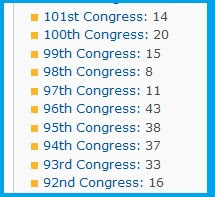
If you know when a law was enacted, you can browse by Congress. For example, if you're interested in the Copyright Act of 1976, Pub. L. No. 94-553, you know that it was enacted in the 94th Congress (that's the first two digits of the Public Law number).

screen snip lists Congress number and then number of laws - e.g., 94th Congress: 37
 Screen snip from ProQuest Legislative Insight Major Laws,
showing number of laws included from 92nd Congress through
101st Congress

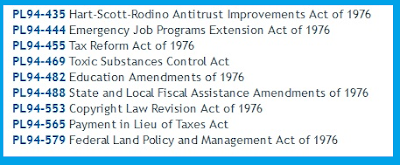
Skimming the laws from the 94th Congress, you'll see other topics the 94th Congress addressed, such as antitrust, tax reform, and pollution. You can quickly select 94-553. 

screen snip shows list of Public Law numbers and acts - e.g., PL94-435 Hart-Scott-Rodino Antitrust Improvements Act of 1976, PL94-553 Copyright Law Revision Act of 1976
Screen snip from ProQuest Legislative Insight Major Laws,
showing some laws from 94th Congress that are included in
the collection


If you don't know the public law number, you can browse an alphabetical list of laws.

screen snip showing portion of alphabetical list of laws
Screen snip showing alphabetical list of laws (Cooperative Research Act
through Coronavirus Aid, Relief, and Economic Security Act)

You can also search. For example, searching for laws with "copyright" in the title field turns up 10 laws, including the Copyright Law Revision Act of 1976.  (Those 10 aren't the only statutes with "copyright" in the title--just the 10 that the editors selected for the "Major Laws" collection.)

Once you get to the Copyright Act, you get a list of dozens of related bills, some as old as 1967. Then there are links to the Congressional Record, House and Senate committee reports, and hearings. 

You can search within this set of materials. 

For instance, I searched for "Xerox" and found 10 documents. I could click on each to see a PDF and read about how witnesses and legislators were wrestling with technological innovations like photocopies and microfilm. For example, a witness from the American Book Publishers Council, Inc. read into the record a Wall Street Journal story that characterized a street near Harvard University as "the Sunset Strip of copying." The president of a clothing store said that the store's Xerox 2400 was "an aid to education" because students could copy journal articles or book chapters. 4 Copyright Law Revision: Hearings Before the Subcomm. on Patents, Trademarks of the S. Comm. on the Judiciary, 94th Cong. 1109 (1967).


You can do this sort of research in HeinOnline's U.S. Federal Legislative History Library too. In fact, HeinOnline has three different compiled legislative histories of the Copyright Act of 1976!

Copyright Act of 197, Pub. L. No. 94-553 

HeinOnline has some convenient search features, as well as great content. If you're really into the Copyright Act, try the HeinOnline legislative histories, perhaps in addition to the ProQuest collection. 

Both collections had legislative histories of the Copyright Act of 1976, but there are lots of statutes that are included in one collection but not the other.  For example, HeinOnline doesn't have a compiled legislative history for Pub. L. No. 80-104, the Federal Insecticide, Fungicide, and Rodenticide Act and ProQuest Legislative Insight Major Acts does. The ProQuest collection doesn't have a legislative history of Pub. L. 80-129, the Housing and Rent Control Act of 1947, but HeinOnline does. 
 

It's not one-stop shopping, but these are two great resources!

Monday, February 14, 2022

Lawyers of Color - Snapshot from the 1970s, Plus Links for Today

The legal profession, which was almost entirely white, slowly began to crack open its doors to lawyers of color in the 1970s. The 1972-73 Prelaw Handbook (p. 9) noted that "the number of lawyers from minority groups is still disproportionately small" but there were "signs of change."   

👉Research tip: Back before prospective students researched law schools on the web, people relied on the annual Prelaw Handbook, which included profiles of all accredited law schools. The law library has a long run, so you can look for information about law schools over the decades. Classified Stacks KF285 .A83.

The Handbook noted: 

Large law firms and corporations which once were not open to Negroes now seek young black lawyers. . . . There has been a significant increase in government positions, with minority group lawyers serving in the offices of city attorneys, federal district attorneys and agencies of all kinds. Black judges sit on federal, state and municipal benches. In 1970 there were 3,845 black lawyers and 214 black judges. By contrast in the 1971-72 academic year, there were 3,732 Blacks, 881 Chicanos, and about 1,000 other minority group members enrolled in law schools. 

Think of that: there were almost as many Black law students that year as there were Black lawyers!

What was it like for those early lawyers of color?

One snapshot is in Minority Opportunities in Law for Blacks, Puerto Ricans & Chicanos (Christine Philpot Clark ed., 1974) [link to catalog record]. Its chapters include private practice, law teaching (by critical race theory pioneer Professor Derrick A. Bell, Jr.), politics and government, "community interest law," and the bench. It also has a chapter on the bar exam and one discussing the Black bar's role in Black people's struggle for social justice. 

The book had an interesting genesis. The Practising Law Institute recruited Christine Clark to edit a collection of articles about career opportunities for minority lawyers. She did, but PLI decided not to publish it. The official reason was that it was far too negative in tone, emphasizing obstacles rather than opportunities." Clark said that the real reason was that the book was "too radical." Joel Dreyfuss, The Verdict Was 'Too Negative,' Wash. Post, Sept. 30, 1973, at L1 [ProQuest Historical Newspapers link] The book was published the next year, but by Law Journal Press, not PLI. 

👉Research tip: UW users can search current and historic newspapers through databases that the University Libraries licenses. Start with this guide.

What about now? 

Today the United States has about four times as many lawyers as it did in 1970. 

1970: 326,842 lawyers

2021: 1,327,910 lawyers

Source: ABA National Lawyer Population Survey at 3. Perhaps 15% of lawyers are Black, Latinx, Asian, or multiracial. Id. at 4. 

👉Research tip: For statistics on the legal profession, a good place to start is the ABA Legal Profession Statistics page

  • Why did I give the vague number "perhaps 15%"? Because that column of the table was based on only 25 state bar associations or licensing authorities who reported the statistic. 

Research guide

Our guide, Diversity in the Legal Profession, includes lots of sources, such as studies of the profession, advice for employers, and advice for law students and lawyers. Take a look! (Black History Month is one of the best twelve months to learn about this topic!)


Thursday, February 10, 2022

Get Involved with the Gallagher Law Library!

The Gallagher Law Library is seeking UW Law Students to become members of the first Law Library Student Advisory Board (LLSAB).
 
LLSAB is a quarterly forum for law students to share direct feedback with the library and establish a platform for students to discuss how the library can continue to support their needs. All members must be willing to attend one meeting per quarter during lunchtime. All members will receive a complimentary lunch.
 
First Meeting: March 1, 2022
Time: 12:30 - 1:30 PM
Place: TBA

Interested in joining? Please send a 3-5 sentence message to oykc1@uw.edu. Tell us why you are interested.
 
If you would like to learn more about LLSAB click here!

New Books About Black Women on the Bench

Black History Month is one of the twelve best months to see new books about impressive Black leaders. These two just came in:

LaDoris H. Cordell, Her Honor: My Life on the Bench . . . What Works, What's Broken, and How to Change It (2021) (print)

Judge Cordell, the first African American woman to sit on the Superior Court of Northern California, knows firsthand how prejudice has permeated our legal system. And yet, she believes in the system. From ending school segregation to legalizing same-sex marriage, its progress relies on legal professionals and jurors who strive to make the imperfect system as fair as possible. Cordell takes you into her chambers where she haggles with prosecutors and defense attorneys and into the courtroom during jury selection and sentencing hearings. She uses real cases to highlight how judges make difficult decisions, all the while facing outside pressures from the media, law enforcement, lobbyists, and the friends and families of the people involved.--Provided by publisher.


Tomiko Brown-Nagin, Civil Rights Queen: Constance Baker Motley and the Struggle for Equality (2022) (ebook)

See  Karen Grigsby Bates, The Life of a 'Civil Rights Queen', NPR (Feb. 3, 2022)


Wednesday, February 2, 2022

Documentary Explores Race & Education, Right Here in Seattle—@4racialequity

Whether you grew up here or just moved here for law school, you'll learn a lot about race in Seattle by watching the new documentary, Roosevelt High School: Beyond Black and White.

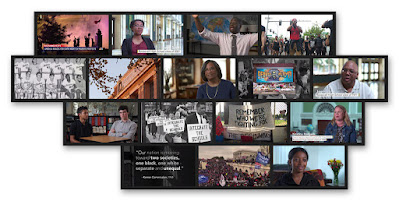
composite of images from documentary - people, buildings. One frame quotes Kerner Commission: "Our nation is moving toward two societies, one black, one white - separate and unequal."
Composite of images from Roosevelt High School: Beyond Black and White


Roosevelt High School is just under two miles north of UW Law. In the 1960s, it was almost entirely white, because of residential segregation shaped by redlining and other factors. See Segregated Seattle, by the Seattle Civil Rights & Labor History Project. 

In the late 1960s, the Seattle Busing Voluntary Racial Transfer Program (VRT) brought a few dozen students of color to Roosevelt. Fifty years later, as protestors went to the streets over police treatment of Black Americans (as well as other inequities), some members of the class of '71, of different races, began talking (over Zoom) about their experience and their city. Why were so many issues the same as decades ago? 

They formed a group, Roosevelt Alumni for Racial Equity (RARE), which has grown beyond Roosevelt and beyond alumni.

This week, RARE premiered a half-hour documentary, Roosevelt High School: Beyond Black and White (31:00), which looks at race and education. It is thoughtful and thought-provoking. It includes interviews with alumni from that first group of busing students, as well as students, teachers, and administrators from today. One of the key people behind the film is UW Law Professor Emeritus Lea Vaughn, a member of that RHS class of '71. 

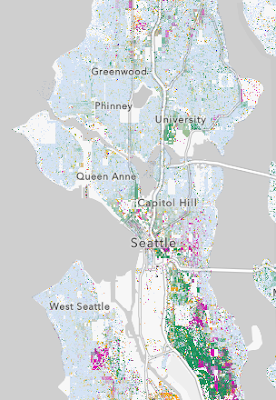
To explore racial patterns today, visit the 2010 and 2020 Census Map Viewer for Seattle and the Region. The interface lets you create different views of the city. For example, here is a map showing the racial make-up of Seattle. The area north of the UW is almost all light blue––the code representing people who identify as White. East of downtown and moving south, magenta dots represent Black or African American (not Hispanic or Latino) residents. And the green in the university district and south end represents Asian (not Hispanic or Latino).

map of Seattle area with colors indicating race

Seattle is not as segregated as it was in the 1960s, but it clearly has neighborhoods that are largely one race or another. In 2010, a Seattle Times analysis ranked US cities by percentage of White residents, and Seattle was fifth. Now Seattle has diversified a tiny bit (our city is now sixth) and it is diversifying at a faster rate than many other cities. Gene Balk, Seattle Ranks as Fifth Fastest-Diversifying Big City of the Decade, Seattle Times (Sept. 30, 2021). 

Take half an hour to watch the video. If you have a little more time, explore some of the other resources on RARE's website, which has a curriculum guide for using the film in classes. 

While you shouldn't limit your learning about these topics to one month, this is a good way to kick off Black History Month.


Friday, January 28, 2022

Doggone Paywalls! . . . But There's Good News: Libraries Provide Access!

Some of you find great stuff out on the web. And then you're frustrated because the publisher's paywall cuts you off from full access. That is disappointing, isn't it?

But wait a minute. Libraries subscribe to lots of databases to provide you with access to zillions of magazines and newspapers. We made a video explaining how you can find magazines and journals through the University Libraries:


Retrieving Magazine Articles: Tips for Source Gathering


While searching the web can turn up lots of great stuff, you might also consider starting with a database with advanced search features and links to the full articles. If you're looking for articles from say, psychology or sociology, using PsycInfo or Sociological Abstracts will focus your search much better than Google, Bing, or any other search engine. 

To get to those specialized databases, start with the University Libraries A-Z Databases list. If you don't know which databases might be useful, take a look at the terrific Research Guides prepared by the University Libraries' subject specialists. If you don't know where to start for computer science or East Asian studies, those guides will get you going. (If you're looking for legal topics, remember the Gallagher Law Library guides!)

Here's a tip for Google Scholar. You can set your preferences so it automatically connects you to sources licensed by the University Libraries. See these blog posts, with illustrations.

PS If you're reading this post and you aren't affiliated with the UW, check out what's available from your local public library. They also subscribe to databases!

Wednesday, January 5, 2022

Research Tribal Court Caselaw

Most legal scholarship focuses on federal and state law, with perhaps a quick nod to local government law. But what about the law of the 574 federally recognized tribal governments? 

Prof. Elizabeth A. Reese (Stanford Law) makes a persuasive plea for moving tribal law into the mainstream of American legal study in The Other American Law, 73 Stan. L. Rev. 555 (2021).  

UW Law has been taking tribal law seriously for a long time, notably through the work of the Tribal Court Public Defense Clinic and the Native American Law Center

But how are you going to study tribal law (or anything else?) if you can't find it? That's where your library can help. We have a research guide on Indian & Tribal Law. And in the last two weeks we've been updating the section on tribal court decisions, complete with a new video posted today.

Wednesday, November 24, 2021

Library Closed for Thanksgiving Holiday

Gallagher Law Library will be be unstaffed from Wednesday, November 24 at 5:00 pm until Monday, November 29 at 8:00 am for the Thanksgiving holiday. We will not be providing Info Desk staffing, reference services, or individual appointments during that time. The library facility will remain open to UW Law community members (see our 24/7 Access Policy for more information). 

Please use our online reference form to ask your questions while we are closed. We will return your message as soon as we are able when we reopen on Monday. 

Happy Thanksgiving!


Saturday, November 6, 2021

National Bison Day

Today is National Bison Day (S. Res. 441). It comes around on the first Saturday of November. Hats off to our National Mammal (Pub. L. 114-152)!

 American Bison, by Pelck's Scenic & Art Studio, circa 1906.
Source: Library of Congress
 

It's appropriate that National Bison Day falls during Native American Heritage Month because bison were and remain important to many tribes. 

To learn more about bison, see Andrew C. Isenberg, The Destruction of the Bison: An Environmental History, 1750-1920 (2000), available to UW users as either an ebook or a print book

What about bison and the law? Here's a selection of law review articles:

  • William Holland, Note, The Spirit of the Buffalo: The Past and Future of an American Plains Icon, 21 Animal L. 151 (2014) [HeinOnline]

  • Dean Lueck, The Extermination and Conservation of the American Bison, 31 J. Legal Stud. S609 (2002) [HeinOnline]

  • Erin Patrick Lyons, Note, Give Me a Home Where the Buffalo Roam: The Case in Favor of the Management-Function Transfer of the National Bison Range to the Conferederated Salish and Kootenai Tribes of the Flathead Nation, 8 J. Gender Race & Just. 711 (2005) [HeinOnline]

  • Peter Morrisette, Is There Room for Free-Roaming Bison in Greater Yellowstone?, 27 Ecology L.Q. 467 (2000) [HeinOnline]

  • Temple Stoellinger et al., Where the Deer and the Antelope Play: Conserving Big Game Migrations as an Endangered Phenomena,  31 Duke Env't L. & Pol'y F. 81 (2020) [HeinOnline]


(You might wonder why I link to HeinOnline, when you can also look up law review articles in Lexis or Westlaw. In fact, I did use Westlaw to find these articles--but I like HeinOnline's PDFs. Unlike Lexis and Westlaw, that are licensed only to UW Law users, HeinOnline is available to anyone at the UW.)

Friday, November 5, 2021

Native American Heritage Month on Your Screen

Check out these films and presentations during Native American Heritage Month.

Native Cinema Showcase, from the National Museum of the American Indian, will stream feature films and shorts from several countries, November 12 to 18. Check the schedule: the feature films are only available for 24 hours each. Four panels with indigenous filmmakers will be available during the whole week. 

Native Cinema Showcase 2021 on right; photos of people and film reels on left

The Burke Museum presents Historical Trauma and the Native American Boarding School Experience Thur. Nov. 18, at 5:30 pm. It's free, but you have to register.

You can also stream documentaries on PBS, including films about Natives in the military, the trauma of the adoption era, Natives in rock and roll, and Native women's influence on the suffrage movement.

Take you pick among dozens of video and audio recordings curated by the National Archives, the Library of Congress, and the Smithsonian.

Monday, October 18, 2021

Our Fastcase Now Includes WSBA Deskbooks

Did you know that Washington lawyers have access to Fastcase through the bar association? Fastcase has primary materials for federal and state jurisdictions. (There used to be another service called Casemaker, as well, but the companies merged this year, so now there's Fastcase.)

The Law Library subscribes to Fastcase for UW users. See the link under Washington on our homepage.

All WSBA members have access to the primary materials on Fastcase, but there are other modules. The Law Library also subscribes to a module with the incredibly useful WSBA deskbooks. If you want the scoop on estate planning, look at Estate Planning, Probate, and Trust Administration in Washington. If you have an ethics question, consult The Law of Lawyering in Washington. Real property, land use, or environmental law? Washington Real Property Deskbook

From Fastcase's home screen, click on "Browse Libraries." Then the WSBA materials are listed under Commentary. See the screen snips below.

screen snips showing Fastcase home screen (Browse Libraries) and Commentary menu


Monday, October 11, 2021

Indigenous Peoples' Day - Land Acknowledgments, Research Guide

Different groups and governments have started marking Indigenous Peoples' Day instead of (or in addition to Columbus Day). This year, for the first time, a Presidential proclamation recognizes the day. See today's stories from NPR and the New York Times.

black & white photo - about 5 long canoes pulled onto shore, with men and women occupied on shore; building in background 
Indian camp with canoes on the Seattle waterfront, Washington, ca. 1898.
Photograph by Anders B. Wilse.  Negative Number NA698, UW12293.
University Libraries digital collection.


 Many institutions have begun acknowledging that they are on indigenous peoples' land. For example, the Washington Law Review states
Washington Law Review (WLR) acknowledges the Coast Salish peoples’ original ownership of the land on which the University of Washington sits, the traditional territory of all tribes and bands within the Suquamish, Tulalip, Duwamish, and Muckleshoot nations. WLR further acknowledges the state’s continuing obligation to fulfill promises made in the Treaty of Point Elliott.

The editors consulted with former Professor Emeritus Robert Anderson, then  Director of UW Law's Native American Law Center, in crafting the statement. Anderson was recently confirmed to be Solicitor of the United States Department of the Interior (although his agency profile still lists him as Principal Deputy Solicitor). (Other agency work might be higher priority than updating web profiles. Browse recent press releases to learn more about Interior's activities.)

Land acknowledgments can be controversial. In some cases, they might seem like mere lip service. Or they might give the mistaken impression that the indigenous people who once occupied the land are simply part of a mythic past. This essay by three anthropologists 2021 explores the topic (The Conversation, Oct. 7). 

Would you like to learn more about treaties with local tribes, federal Indian law, and tribal law? Check out our guide, Indian & Tribal Law.


Thursday, October 7, 2021

Neat Trick: Search Law Firm Websites for Practice Tips, Legal Updates

You've probably stumbled across law firm newsletters or blogs that have helpful guidance about some area of the law.

Without counting on the lucky stumble, how can you find these gems? If you just use Google or another search engine, you might all sorts of stuff—newspaper articles, personal blogs, etc., in addition to law firm documents. Instead, try the Law Firm Search Engine, which uses a custom Google search to focus on law firm sites.

screen snip - Law Firm Search Engine - tagline: Search law firm websites. Find law firm memos. Free legal research.

This can be really helpful. For example, I entered nonprofit incorporation washington state and found a post from Davis Wright Tremaine from May 2021: David A. Lawson, Washington's New Nonprofit Corporation Act: Is Your Nonprofit Ready?  What? There's a new statute? It goes into effect in less than three months?? Tell me more!

When I searched for covid vaccine mandate, I found a post from Littler, a big employment law firm, from today: Mandatory Employee Vaccines – Coming to A State Near You? (Oct. 7, 2021). If you just used Google (or another search engine), you'd find lots of documents, but you'd probably have to wade through a lot of news and opinion (not to mention a dose of misinformation) before getting to a legal analysis from a law firm.

This handy site was developed by Jeffrey Buckley, a law librarian in New York and graduate of the UW's iSchool. Cool, right?


Wednesday, September 29, 2021

Good Reads in the Law Library

 You know that the Law Library has tons of great resources for research, such as practice manuals and treatises, not to mention all the study aids. And, golly, the databases! 

But there's more! The Law Library also has a collection of books that we think might appeal to you for leisure reading. This Good Reads collection is on the low shelving across from the Law Student Lounge. Recent additions include a memoir (The Watergate Girl), a novel (The Coyotes of Carthage), and a comic-book-style book about the Constitution (Constitution Illustrated). Take a look!

cover art for 3 books
Book jackets: The Watergate Girl,
The Coyotes of Carthage
, Constitution Illustrated


Friday, September 17, 2021

Library Reopening! Woo-hoo!

After a long closure for the pandemic, the Law Library is reopening to the UW Law community, Monday morning, September 20. We're excited to see you again, and we hope you'll be happy with the study spaces, collections, and services available.

neon open sign in window

Photo by Alex Knight on Unsplash


There's still a pandemic going on, though, so we all need to be careful.

  • UW Law students, staff, and faculty may visit the library in person. Just swipe in with your Husky card. 
    • One person at a time, please!
    • No guests allowed: just UW Law.
    • Your Husky cards will open the door 24-7. Remember that Gates Hall is closed 1-6 a.m., and of course you have to be in the building to open the library door.

  • Mask up! 
    • Beverages are allowed (in covered containers). You may pull down your mask to take a sip.
    • The only library space where food is allowed is the student lounge on L1. Obviously, you'll need to unmask to eat. But don't sit too close to others.

  • Socially distance!
    • You can now reserve your seat at a table or study carrel.
    • Tables in the Reference Area and soft seating are available to the first sitter.

  • Library staff will be here M-F, 8-5. You'll have remote reference service 9 am to 7 pm Monday-Thursday and Sunday afternoon.
     
  • Self-service Course Reserves
    • New check-out stations enable you to check out books to yourself with your Husky card.
    • Course reserves may be checked out for four hours at a time, for use in the library only.
    • Check them back in and reshelve them.

  • Self-service Checkout
    • You can check out books from anywhere (except the Reference Area and Reference Office) at the self-service checkout.
    • Return those books to book drops.
       
  • Contact us
    • Email lawref@uw.edu (UW Law community only)
    • Phone 206-543-6794
    • Chat (coming soon!)
    • Zoom--use the new terminal at the Information Desk to be connected directly to a reference Zoom Room!


What if you're not a UW Law student, staff member, or faculty member? We can serve you remotely. 

  • Ask Us! service (You ask a question via a web form and get an answer via email.)
  • Phone 206-543-6794
  • Chat (coming soon!)


Let's have a great school year!

Tuesday, September 14, 2021

Access to Justice Speaker Series (Sept. 21—Nov. 30)

Angélica Cházaro, UW Law

Sports fans know that the Pac-12 is an athletic conference of major universities in the West. But the universities are much more than their sports teams. Most of them also have law schools (all but WSU* and Oregon State). 

The law schools don't face off on the football field or volleyball court (although that might be fun to see). Instead, they've gotten together to plan a speaker series on access to justice, featuring big thinkers from around the conference. 

The series runs Tuesdays throughout the fall, and concludes on November 30 with Angélica Cházaro from UW Law.

Tuesday, September 21, 6 pm Pacific Time
Jody Armour
University of Southern California Gould School of Law
Negrophobia and Reasonable Racism: Race, Language, Unequal Justice, and the Law

September 28
David Oppenheimer

University of California Berkeley School of Law
Responding to the Humanitarian Crisis in Afghanistan 

October 5
Margaret Hagan
Stanford University Law School
Justice Innovation

October 12
Anna Carpenter
University of Utah S.J. Quinney College of Law
Judges in Lawyerless Courts

October 19
Stacy Butler and Christopher Griffin
University of Arizona James E. Rogers College of Law
Developing and Simulating Non-Lawyer Models of Medical Debt Advocacy

October 26
Scott Skinner-Thompson
University of Colorado Law School
Identity By Committee 

November 2
Laura Gomez
University of California Los Angeles School of Law
Inventing Latinos: A New Story of American Racism

November 9
Justin Weinstein-Tull
Arizona State University Sandra Day O'Connor College of Law
Title coming soon 

November 16
Kimberly Johnson
University of Oregon School of Law
This is My America: Stories, Storytelling and Access to Justice

November 30
Angélica Cházaro

University of Washington School of Law
Due Process Deportations? The Limits of Universal Representation for Immigrants

Right now, registration is only available for the first presentation. Check the series website for the following lectures' times and registration as they become available. 


————

* The legislature decided back in 1917 that only the UW would have a law program and only WSU would have programs in agriculture and veterinary science. 1917 Wash. Laws ch. 10, Regulating Courses of Instruction in State University, College, and Normal Schools. By now the list exclusive to UW includes law, medicine, forest products, logging engineering, library sciences, and fisheries. RCW 28B.20.060

Speaking of "library sciences": the UW Information School is home to a terrific program in law librarianship. If you're curious about this rewarding field, ask a law librarian, or start with this online essay.

Monday, May 17, 2021

Tax Forms Through History (#TaxForms)

Individuals' federal income taxes are due today. If you got yours in before the traditional April 15 deadline, good for you! If you're still not on top of it, an extension can give you till Oct. 15. 

Nearly everyone has filed a tax form, but how much have you thought about the forms? 

"For most taxpayers, the Internal Revenue Service forms are the only connection the have with the tax laws enacted by the Congress."

Rep. J.J. Pickle, introducing Development of Federal Tax Forms by the Internal Revenue Service: Hearing Before the Subcomm. on Oversight of the Committee on Ways and Means, 101st Cong. 5 (1989) [HeinOnline]

Tax forms can't just slapped together!

fans of typographic design should pause to appreciate just how difficult this project must be, which makes the result all the more impressive. These forms necessarily represent a collaboration between IRS lawyers (who have to make sure the forms are accurate relative to the ever-changing thicket of tax law), graphic designers (who have to create visual hierarchy & order while preserving an economical density of information), a warehouse of fact-checkers and proofreaders who have to make sure the forms are flawless before they head to the printer (can you imagine the costs of getting a form wrong?), and some chain of command that has approval over all of it.

Matthew Butterick, the best typography in the US federal government (May 13, 2021). (Haven't heard of Matthew Butterick? Don't miss out on his Typography for Lawyers (2d ed. 2015) [catalog record] [website].)

The IRS has posted an impressive collection of forms and publications. Sort by date to travel through history. For example, here are snippets for the tax years 1863 and 1918.

tax form 1863 


tax form 1918


Saturday, May 15, 2021

Check out a Book for #AAPI Heritage Month (or Perhaps for Summer Reading)

In honor of AAPI Heritage Month, I'm highlighting an assortment of books in the law library and the UW system. 

You can find hundreds of books about Asia or Asian Americans, using the scholarly lenses of history, sociology, or political science—not to mention novels, poetry, and plays. I looked for a legal connection, and selected memoirs, biographies, and histories that seemed engaging enough that you might want to pick one up, perhaps when exams are over. Many, but not all, are written by Asian Americans or Pacific Islanders.

This list doesn't include books about the Japanese American incarceration during World War II—not because it's not an important topic, but just the opposite: we already have several blog posts on it.

montage of book jackets from 13 books

Adrienne Berard, Water Tossing Boulders: How a Family of Chinese Immigrants Led the First Fight to Desegregate Schools in the Jim Crow South (2016) [ebook]

Joshua Takano Chambers-Letson, A Race So Different: Performance and Law in Asian America (2013) [ebook]

Robert Chang, Disoriented: Asian Americans, Law, and the Nation-State (2000) [print] [ebook]

 Yves Dezalay & Bryant G. Garth, Asian Legal Revivals: Lawyers in the Shadow of Empire (2010) [ebook] [print]

Andrew Gyory, Closing the Gate: Race, Politics, and the Chinese Exclusion Act (1998) [ebook] [ebook & HeinOnline] [print]

Robert Terry Hayashi, Haunted by Waters: A Journey Through Race and Place in the American West (2007) [ebook] [print]. "Using a wide range of materials that include memoirs, oral interviews, poetry, legal cases, letters, government documents, and even road signs, Robert Hayashi illustrates how Thomas Jefferson's vision of an agrarian, all white, and democratic West affected the Gem State's Nez Perce, Chinese, Shoshone, Mormon, and Japanese residents." 

Madeline Yuan-yin Hsu, The Good Immigrants: How the Yellow Peril Became the Model Minority (2015) [print]

Stephanie Hinnershitz, A Different Shade of Justice: Asian American Civil Rights in the South (2017) [ebook] [print]

Estelle T. Lau, Paper Families: Identity, Immigration Administration, and Chinese Exclusion (2006) [ebook]

Erika Lee, At America's Gates: Chinese Immigration During the Exclusion Era, 1882-1943 (2003) [ebook] [print][print]

Eric Liu, The Accidental Asian: Notes of a Native Speaker (1998) [print; temporary online access during COVID]

Michael W. McCann & George Lovell, Union by Law: Filipino American Labor Activists, Rights Radicalism, and Racial Capitalism (2020) [ebook] (Authors teach at UW and UPS.)

Chris W. Merritt, The Coming Man from Canton: Chinese Experience in Montana, 1862-1943 (2017)  [ebook] [print]

Kim Park Nelson, Invisible Asians: Korean American Adoptees, Asian American Experiences, and Racial Exceptionalism (2015) [ebook]

Jonathan Y. Okamura, Raced to Death in 1920s Hawaiʻi: Injustice and Revenge in the Fukunaga Case (2019) [ebook] [print]

Yung-Yi Diana Pan, Incidental Racialization: Performative Assimilation in Law School (2017) [print]

John P. Rosa, Local Story: the Massie-Kahahawai Case and the Culture of History (2014) [ebook]

David E. Stannard, Honor Killing: How the Infamous "Massie Affair" Transformed Hawai'i (2005) [print; temporary online access during COVID]. 

David E. Stannard, Honor Killing: Race, Rape, and Clarence Darrow's Spectacular Last Case  (2006) [print] (The paperback edition has a slightly different title from the hardback's.)

Jose Antonio Vargas, Dear America: Notes of an Undocumented Citizen  (2018) [print]

Michael Withey, Summary Execution: The Seattle Assassinations of Silme Domingo and Gene Viernes (2018) [print] (Author is a Seattle lawyer.)

John R. Wunder, Gold Mountain Turned to Dust: Essays on the Legal History of the Chinese in the Nineteenth-Century American West (2018) [ebook] [print

Bruce I. Yamashita, Fighting Tradition: A Marine's Journey to Justice (2003) [print]. The book's website includes a brief (4:26) documentary.

Kenji Yoshino, Covering: The Hidden Assault on Our Civil Rights (2006) [print] [temporary online access]

Monday, May 3, 2021

More on Data and Supreme Court Justice names

In 2012, this blog discussed the popularity of the names of the Supreme Court Justices at the time.  With several new members on the Court since then, it's time for an update.

The following charts (prepared by author) show the popularity (by rank) of the first name of each Justice in the year of their birth and in 2019, based on data from the Social Security Administration (SSA). Source for birth years is Supreme Court's About the Court page

bar graph shows popularity by rank of the first names of the U.S. Supreme Court Justices in their year of birth: John Roberts, born 1955, rank 5; Clarence Thomas, born 1948, rank 87; Stephen Breyer, born 1938, rank 74; Samuel Alito, born 1950, rank 62; Sonia Sotomayor, born 1954, rank 377; Elena Kagan, born 1960, rank 470; Neil Gorsuch, born 1967, rank 200; Brett Kavanaugh, born 1965, rank 132; Amy Coney Barrett, born 1972, rank 5
Popularity of Justices' first names in years born


bar graph shows popularity by rank of the first names of the U.S. Supreme Court Justices in 2019 if the rank is 1,000 or higher: John Roberts, rank 28; Clarence Thomas, not ranked 1,000 or higher; Stephen Breyer, rank 311; Samuel Alito, rank 22; Sonia Sotomayor, not ranked 1,000 or higher; Elena Kagan, rank 60; Neil Gorsuch, rank 636; Brett Kavanaugh, rank 820; Amy Coney Barrett, rank 203
Popularity of Justices' first names in 2019


As with any dataset, it's interesting to see what patterns the data indicate:

  • Everyone's name was in the mainstream in the year they were born.
  • Only "Samuel" and "Elena" are more popular now than they were when the Justices were born.

Understanding the data is also critical.

  • Does the highly ranked "John" include variations such as "Johnny"?
    • No. In the SSA data, "John" and "Johnny" are each ranked separately as different names. "Jon," "Johnnie," and "Johnie" are also each ranked separately as different names. For that reason, babycenter.com's list of most popular baby names combines spellings of similar names to reveal their "true popularity."

  • Do the name rankings reflect gender classifications?
    • Yes. The SSA data separates "male names" for those assigned or designated as male at birth and "female names" for those assigned or designated as female at birth in Social Security applications. For example, in 1972, "Amy" as a male name was ranked 952 and "Amy" as a female name was ranked 5.

  • How does the SSA collect this data?
    • The SSA explains the source of the data as follows: "All names are from Social Security card applications for births that occurred in the United States after 1879. Note that many people born before 1937 never applied for a Social Security card, so their names are not included in our data. For others who did apply, our records may not show the place of birth, and again their names are not included in our data. All data are from a 100% sample of our records on Social Security card applications as of March 2020."

  • How does the SSA rank the names? 
    • The SSA rankings for each year are based on the frequency of the male name or female name.  If two names have the same frequency, the SSA explains that the names are ranked in alphabetical order.  For example, in 2019, both "Alberto" and "Neil" had a frequency of 422, so "Alberto" received a rank of 635 and "Neil" received a rank of 636.

Here are some resources for understanding data:

Names can be powerful.  Here are some articles that discuss various implications of names:

Finally, for a fascinating look at how data and the law can intersect, see Making the Law Computable (2019) for a discussion of the Harvard Caselaw Access Project.


Monday, April 12, 2021

Gallagher Quarterly Newsletter (Spring 2021)

 Another quarter, another edition of the Gallagher Quarterly Newsletter! The Gallagher staff are still working hard from home to make sure library resources and services are still available in this remote environment. Check out our Spring 2021 newsletter for the latest recommended eBooks, databases, research guides, and more! In this special edition of the Gallagher Newsletter, we celebrated National Library Week by creating a Gallagher Puzzle Pack that is available for everyone to enjoy! 

As always, the library staff is still available to support you! If you have any questions, ask us! 


Thumbnail of the Spring 2021 edition of the Gallagher Quarterly Newsletter
Gallagher Quarterly Newsletter (Spring 2021) 
Contact us! 

Law Students

Law Faculty & Staff 

UW & Seattle Community, Ask Us! or view our Library Visitors page for more information. 


Review our past newsletters: 

Winter 2021 

 Fall 2020 


Monday, April 5, 2021

Try out Our National Library Week Puzzle Pack!

To celebrate National Library Week this year, our team has created a puzzle pack for you.  It has a variety of puzzles in favorite genres, including word search, crossword, and Jumble. (Don't be surprised if you see a hint of law library here and there in the puzzles.)

UW Law students: You can enter for a prize drawing we'll hold next Monday. Tell us what program you're in (JD, LLM, MJ, or PhD) and which puzzles you complete. You could win!

But the fun doesn't stop with a puzzle pack! Join us for a trivia game Friday afternoon at 3 pm. Details to come.

By the way, last year's National Library Week included a series of online escape rooms--look for them under this year's National Library Week info.

Thursday, April 1, 2021

Meet the Library's New Chatbot!

Chatbots have demonstrated success in banking, travel, and customer service generally. And now they're moving into libraries as well. Always innovative and forward-looking, the Gallagher Law Library has launched a chatbot of its own. We're calling her Ms. G.

photo of older white woman with white hair and glasses
Marian Gould Gallagher,
the original "Mrs. G."

The chatbot will expand your access to responsive, reliable assistance. Unlike librarians and library staff, Ms. G is happy to answer questions in the middle of the night and throughout three-day weekends. With just a slight decrease in speed, the chatbot can even respond to several students or professors at once.

Of course, everyone is pleased that this move will free up the money from a couple of salary lines.

Unfortunately, budget considerations preclude contracting for top-of-the-line AI from IBM Watson. Instead, Ms. G is running on a four-year-old PC that has been sitting idle since most of the staff started working at home. Ms. G might be a teensy bit slower than some other chatbots, but will still get the job done. (We'll miss hearing the inside story of Watson's Jeopardy! triumph, but we can still hang out with our friends who rock the Burke Trivia night each month.)

We're excited to share with you representative transcripts from the usability tests of our chatbot. 

 ⎯ ⎯ ⎯ ⎯ ⎯ ⎯

Test One


I need help formatting citations.


Use The Bluebook: A Uniform System
of Citation, 21st ed., 2020.


Yes, but I don’t understand it!


Understand what?


The Bluebook.


Use The Bluebook: A Uniform System
of Citation, 21st ed., 2020.


Need help with a white paper.


You can buy white paper at
officedepot.com


How do I cite a white paper from AI Now?


I am using AI now.


I give up.

Thank you for using our service.
Would you like to take a survey
about your experience?


Hello? Hello? 


⎯ ⎯ ⎯ ⎯ ⎯ ⎯

Test Two


I need USC.


University of Southern California or
University of South Carolina?

I want the federal code.

There are many federal codes.
The National Security Agency has
declassified some code-related
documents. See https://www.nsa.gov/
News-Features/Declassified-Documents/
NARA-Releases/


I need the statues.

Ah, an art lover. Do you want
a museum or a gallery?


Statutes! Statutes!
(Stupid autocorrect.)


No need to get agitated.
Autocorrect is a good friend of mine.


Oh, sorry. Where's the USC?


University of Southern California or
University of South Carolina?

Never mind. I'll figure it out.

Thank you for using our service.
Would you like to take a survey
about your experience?


Hello? Hello? 


⎯ ⎯ ⎯ ⎯ ⎯ ⎯

Test Three


When will I be able to visit the
library?


I don't know. That answer
is not in my database.


Can you be more specific?


Yes, chatbots, like all AI systems,
are limited to the data they have
been trained on.


Well, thanks for that.

Thank you for using our service.
Would you like to take a survey
about your experience?


Hello? Hello? 


⎯ ⎯ ⎯ ⎯ ⎯ ⎯ 


We are very pleased that not a single user in our pilot expressed dissatisfaction with the chatbot. One person who reviewed the study noted that comparatively few people chose to take the survey, but we believe that that is because they were so satisfied with the service. They certainly had every opportunity to comment.

And of course this is just the beginning. The beauty of machine learning is that Ms. G will continue to learn as she responds to more questions and becomes familiar with the UW Law community.