
Monday, January 11, 2016
Researching professional responsibility
Professional responsibility is one subject that affects every law student. You'll have to pass a test in professional responsibility to become a member of the bar—and then you'll have to live by those rules throughout your career. To help you with this important area, we have a new guide listing resources, both national and Washington State.


Tribes and Tribal Law in Washington State
There are currently 29 federally-recognized tribes in Washington State.
The concept of tribal sovereignty is recognized in the U.S. Constitution, perhaps most famously in the Commerce Clause (Article I, Section 8): "Congress shall have the power to regulate Commerce with foreign nations and among the several states, and with the Indian tribes." U.S. Supreme Court Chief Justice John Marshal fleshed out the legal concept of tribal sovereignty in the three seminal cases of Johnson v. M'Intosh (21 U.S. 543), Cherokee Nation v. Georgia, (30 U.S. 1), and Worcester v. Georgia (31 U.S. 515). Congress also protected the rights of federally-recognized tribes in the Indian Reorganization Act of 1934. As "domestic dependent nations," many federally-recognized tribes have their own constitutions, codes, and courts.
Map of federally-recognized Washington State tribes (Washingtontribes.org):

The concept of tribal sovereignty is recognized in the U.S. Constitution, perhaps most famously in the Commerce Clause (Article I, Section 8): "Congress shall have the power to regulate Commerce with foreign nations and among the several states, and with the Indian tribes." U.S. Supreme Court Chief Justice John Marshal fleshed out the legal concept of tribal sovereignty in the three seminal cases of Johnson v. M'Intosh (21 U.S. 543), Cherokee Nation v. Georgia, (30 U.S. 1), and Worcester v. Georgia (31 U.S. 515). Congress also protected the rights of federally-recognized tribes in the Indian Reorganization Act of 1934. As "domestic dependent nations," many federally-recognized tribes have their own constitutions, codes, and courts.
Map of federally-recognized Washington State tribes (Washingtontribes.org):

Tuesday, January 5, 2016
New Titles in the Gallagher Law Library
The first 2016 installment of the bimonthly New Titles List is now available.
Noteworthy additions include:
Climate change and human rights: an international and comparative law perspective / Classified Stacks (K3585.5 .C5497 2016)
Dying with dignity: a legal approach to assisted death / Classified Stacks (K3611.E95 L67 2015)
Enduring conviction: Fred Korematsu and his quest for justice / Classified Stacks (KF228.K59 B36 2015)
The guide to U.S. legal analysis and communication / Reference Area (KF250 .M377 2015)
Public spaces, marketplaces, and the Constitution: shopping malls and the First Amendment / Classified Stacks (KF4770 .M36 2015)
Check out these and other titles that have recently been added to the Library's collection.
Noteworthy additions include:
Climate change and human rights: an international and comparative law perspective / Classified Stacks (K3585.5 .C5497 2016)
Dying with dignity: a legal approach to assisted death / Classified Stacks (K3611.E95 L67 2015)
Enduring conviction: Fred Korematsu and his quest for justice / Classified Stacks (KF228.K59 B36 2015)
The guide to U.S. legal analysis and communication / Reference Area (KF250 .M377 2015)
Public spaces, marketplaces, and the Constitution: shopping malls and the First Amendment / Classified Stacks (KF4770 .M36 2015)
Check out these and other titles that have recently been added to the Library's collection.
Thursday, December 17, 2015
Library Hours During the Holidays
We are nearing the end of Fall Quarter and will be on our interim schedule. In addition, we're going to be closed for a few days.
Sunday, December 20: closed
Monday and Tuesday, December 21st-22nd: closed
Wednesday, December 23: The library is open 8 am to 5 pm. The Reference Office is open 9 am to noon; 1 pm to 5 pm
Thursday, December 24: The library is open 8 am to 12 pm. The Reference Office is open 9 am to noon.
Friday, December 25: closed for Christmas holiday
Sunday, December 27: closed for interim
Monday, December 28 to Wednesday, December 30: The library is open 8 am to 5 pm. The Reference Office is open 9 am to noon; 1 pm to 5 pm.
Thursday, December 31: The library is open 8 am to noon. The Reference Office is open 9 am to noon.
Friday, January 1: closed for New Year's Day
Sunday, January 3: closed for interim
Please see our hours page for additional hours information.
Tuesday, December 15, 2015
New Titles in the Gallagher Law Library, Dec. 15, 2015
The latest new titles is available. It includes works such as:
- The Bluebook uncovered: a practical guide to mastering legal citation / Reference Area (KF245 .A57 2015)
- Child-friendly justice: a quarter of a century of the UN Convention on the Rights of the Child / Classified Stacks (K639.A41989 C455 2015)
- Disappearing island states in international law / Classified Stacks (KZ3880 .G76 2015)
- Fighting fair: legal ethics for an adversarial age / Classified Stacks (K123 .H88 2015)
- Intellectual property and genetically modified organisms: a convergence in laws / Classified Stacks (K3927 .I58 2015)
- Of courtiers & kings: more stories of Supreme Court law clerks and their justices / Classified Stacks (KF8742 .O34 2015)
- Privacy law fundamentals / Classified Stacks (KF1262 .S665 2015)
For other great titles, see the complete list.
Thursday, December 10, 2015
Human Rights Day 2015
December 10 is Human Rights Day! It commemorates the adoption of the Universal Declaration of Human Rights on December 10, 1948.

The Universal Declaration of Human Rights was adopted by the United Nations General Assembly to serve as a comprehensive list of basic individual rights and freedoms that all nations should strive to protect. It is part of the International Bill of Human Rights, along with the more detailed and legally-binding International Covenant on Civil and Political Rights (1966) and International Covenant on Economic, Social and Cultural Rights (1966).

The Universal Declaration of Human Rights was adopted by the United Nations General Assembly to serve as a comprehensive list of basic individual rights and freedoms that all nations should strive to protect. It is part of the International Bill of Human Rights, along with the more detailed and legally-binding International Covenant on Civil and Political Rights (1966) and International Covenant on Economic, Social and Cultural Rights (1966).
Tuesday, December 8, 2015
Updated Guide on Court Briefs & Oral Arguments
The Gallagher Law Library's guide to finding Court Briefs & Oral Arguments has been updated.
This extensive guide identifies free websites, commercial services, and print and microfiche collections available in the Law Library. It provides comprehensive lists for the following courts:
This extensive guide identifies free websites, commercial services, and print and microfiche collections available in the Law Library. It provides comprehensive lists for the following courts:
- U.S. Supreme Court
- U.S. Court of Appeals for the Ninth Circuit
- Washington Supreme Court
- Washington Court of Appeals
Links are also available for many other federal and state courts.
If you are aware of other online collections of briefs and oral arguments, please contact Cheryl Nyberg with the information.
Tuesday, December 1, 2015
60th Anniversary of Rosa Park's Arrest
The U.S. Courts website features a short video of Rosa Park's arrest and how it led to several important civil rights decisions.
The video, drawing on interviews with U.S. District Judge Myron H. Thompson and lawyer Fred Gray, notes that Parks was not the first woman arrested in Montgomery, Alabama, for refusing to give up her bus seat to a white patron. But when Parks’ arrest—on Dec. 1, 1955—sparked a citywide bus boycott, Gray enlisted four previously arrested women to file a class-action lawsuit in U.S. District Court.
A yearlong boycott ended after the Supreme Court affirmed in Browder v. Gayle that segregated buses are unconstitutional.
The webpage also links to a theatrical re-enactment of Brown v. Board of Education.
The Law Library website has a guide on Brown v. Board of Education, with links to websites and books available in the Library.
The Place Where the Boy Got His Fingers Pinched
Today, the U.S. Supreme Court issued its first decision of the October 2015 term, OBB Personenverkehr AG v. Sachs. The case involved an attempt to sue the Austrian national railroad. However, I am not interested in discussing the nuances of sovereign immunity. I want to highlight one of the letters/books cited in Chief Justice Robert's unanimous opinion of the court: Holmes and Frankfurter: their correspondence, 1912-1934. Here's how it was used:
A century ago, in a letter to then-Professor Frankfurter, Justice Holmes wrote that the “essentials” of a personal injury narrative will be found at the “point of contact”— “the place where the boy got his fingers pinched.” Letter (Dec. 19, 1915), in Holmes and Frankfurter: Their Correspondence, 1912–1934, p. 40 (R. Mennel & C. Compston eds. 1996). At least in this case, that insight holds true. Regardless of whether Sachs seeks relief under claims for negligence, strict liability for failure to warn, or breach of implied warranty, the “essentials” of her suit for purposes of §1605(a)(2) are found in Austria.
OBB Personenverkehr AG v. Sachs, No. 13–1067, slip op. at 9 (U.S. Dec. 1, 2015).If you're interested in reading more of this letter or other letters between Justice Holmes and then-Professor Frankfurter, we have this book at the Gallagher Law Library. It's available in the Classified Stacks at KF8745.H6 A433 1996. Here's the publisher's description of the book:
Nearly four hundred previously unpublished letters capture the essence of an extraordinary and in some ways unlikely friendship between one of America's preeminent jurists and a younger, reform-minded colleague who would himself one day ascend to the Supreme Court. Oliver Wendell Holmes was seventy-one when he was introduced to fiery, effervescent Felix Frankfurter, who had come to Washington at age thirty to serve President Taft. The two couldn't have had more different backgrounds: Holmes was a Civil War hero of Boston Brahmin stock, while Frankfurter was a Jewish immigrant whose reformist views would lead him to help found the American Civil Liberties Union and act as key advisor to Franklin Roosevelt and his New Deal.
With an introduction that provides historical background and annotations that supply context for cases mentioned, this unique collection illuminates a strong and mutually satisfying personal and professional relationship between two men whose exchanges on the meaning of law in general and American law in particular, the editors write, "found expression in their work and influenced legal and political change in their own lifetimes and in ours as well."I'm not sure when Chief Justice Roberts, his clerks, or another member of the Court read the letter. It wasn't referenced in any of the briefs of this case. Maybe one read the book over the summer; the possibilities are endless. I could only find a couple references to the letter in law review articles, one from a book review of a Holmes biography (33 Wm. & Mary L. Rev. 1219) and the other from an article by Robert C. Post, Dean of Yale Law School. Here is the reference made in the latter:
Monday, November 23, 2015
Washington, the 42nd State
November 11 marks the anniversary of Washington joining the Union in 1889 as the 42nd state! Here are some resources related to this momentous event.
The United States Constitution outlines the legal process by which new states are created. Article IV Section 3 says: "New states may be admitted by the Congress into this union." You can find an official copy of the United States Constitution in Title 1 of the United States Code, which can be found in the Gallagher Law Library Reference Area at KF62. Or you can read the text on the National Archives and Records Administration (NARA) webpage.

Washington's origins can be traced to the Monticello Convention Petition of 1852. Settlers in the then massive Oregon Territory sent a letter to the federal government asking for the creation of a separate territory. You can find a copy of this petition in the Suzzallo-Allen Libraries Special Collections-Manuscripts collection. The Washington Secretary of State also has a webpage providing more information about this petition.

The United States Constitution outlines the legal process by which new states are created. Article IV Section 3 says: "New states may be admitted by the Congress into this union." You can find an official copy of the United States Constitution in Title 1 of the United States Code, which can be found in the Gallagher Law Library Reference Area at KF62. Or you can read the text on the National Archives and Records Administration (NARA) webpage.

Washington's origins can be traced to the Monticello Convention Petition of 1852. Settlers in the then massive Oregon Territory sent a letter to the federal government asking for the creation of a separate territory. You can find a copy of this petition in the Suzzallo-Allen Libraries Special Collections-Manuscripts collection. The Washington Secretary of State also has a webpage providing more information about this petition.

Wednesday, November 18, 2015
Terrorism and the Law: Books and Articles at the Gallagher Law Library
In 2005, United Nations Secretary General Kofi Annan stated at the International Summit on Democracy, Terrorism, and Security that terrorism is a direct attack on the core values of the United Nations: "the rule of law; the protection of civilians; mutual respect between people of different faiths and cultures; and peaceful resolution of conflicts." In fighting terrorism, he continued, "human rights and the rule of law must always be respected." (UN.org, Mar. 10, 2005)
Following the deadly attacks in Paris on November 13, 2015, news outlets worldwide have questioned the effectiveness of current international law in preventing and addressing terrorism. In the past several months, several nations have put forth new laws in attempts to counter these kinds of attacks, but many of these laws have been criticized as too broadly defining terrorism or too harshly treating perpetrators of these acts.
Following the deadly attacks in Paris on November 13, 2015, news outlets worldwide have questioned the effectiveness of current international law in preventing and addressing terrorism. In the past several months, several nations have put forth new laws in attempts to counter these kinds of attacks, but many of these laws have been criticized as too broadly defining terrorism or too harshly treating perpetrators of these acts.
Tuesday, November 17, 2015
A Law Library in your Pocket
Have you ever wanted to carry a law library in your pocket? Now you can!
LawLibe is a free app on the iTunes App Store available for your iPhone, iPad, and iPod Touch.

LawLibe is powered by the Legal Information Institute at Cornell Law School. LawLibe includes the U.S. Constitution, and you can download additional legal content such as the U.S. Code, Code of Federal Regulations, and State Statutes. You can then access these materials offline. Other features of this app include full-text searching, in-text highlighting, font-size adjusting, and frequent updating.
LawLibe is a free app on the iTunes App Store available for your iPhone, iPad, and iPod Touch.

LawLibe is powered by the Legal Information Institute at Cornell Law School. LawLibe includes the U.S. Constitution, and you can download additional legal content such as the U.S. Code, Code of Federal Regulations, and State Statutes. You can then access these materials offline. Other features of this app include full-text searching, in-text highlighting, font-size adjusting, and frequent updating.
Thanksgiving Library Closures
The library will be closed to the public at 5 pm on Wednesday, November 25, for the Thanksgiving holiday. The Reference Office will also close at this time.
The library will remained closed from Thursday, November 26 until 8 am Monday, November 30.
Please see our hours page for additional hours information.
The library will remained closed from Thursday, November 26 until 8 am Monday, November 30.
Please see our hours page for additional hours information.
Monday, November 9, 2015
Daylight Saving Time and the Law
On November 1, at the stroke of 2:00 AM, Washingtonian clocks collectively rolled back to 1:00 AM (providing many of us an extra hour of much needed sleep). The popular saying “spring forward, fall back” reminds us that it is once again Daylight Saving Time (DST) in Washington State. As we adjust to later sunrises and sunsets, we might reflect on the laws that make DST a reality, and on efforts to change those laws.
In 1960, Washington became the 15th state to adopt DST when 51.7% of voters approved Ballot Initiative 210. In the official voter pamphlet, the initiative promised “154 more hours of daylight each year.”
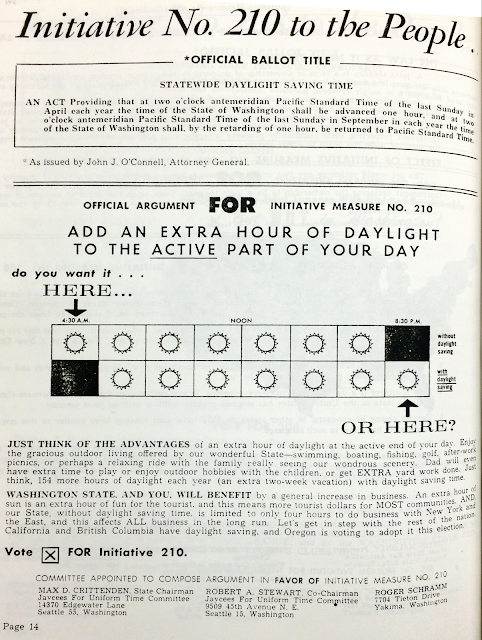
In 1960, Washington became the 15th state to adopt DST when 51.7% of voters approved Ballot Initiative 210. In the official voter pamphlet, the initiative promised “154 more hours of daylight each year.”

Thursday, November 5, 2015
Shortened Library Hours for Veterans Day
Wednesday, November 11 is Veteran's Day and is a University of Washington holiday. Gallagher Law Library will be open but with shorter hours.
The library will be open 8 am to 5 pm. The Reference Office will be open from 1 pm to 4 pm.
Please take a look at our hours page for more information.
The library will be open 8 am to 5 pm. The Reference Office will be open from 1 pm to 4 pm.
Please take a look at our hours page for more information.
Tuesday, November 3, 2015
National Love Your Lawyer Day

Wait - - - what? There is a National Love Your Lawyer Day?
Yes, the American Bar Association's Law Practice Division has declared the first Friday in November as a day:
- for the public to celebrate lawyers and express their gratitude to them for their affirmative contributions to the public good and the administration of justice
- for lawyers to help promote a positive and more respected image of lawyers and their contributions to society.
The resolution notes that the American Lawyers Public Image Association initiated the day in 2001.
An article in today's National Law Journal (subscription required) provides additional information about this commemoration, observing that the founder of ALPIA created the organization after hearing one too many nasty lawyer jokes. It also mentions a self-published book called Comebacks for Lawyer Jokes: The Restatement of Retorts ($9.95 from Amazon). The author, Malcolm Kushner, is quoted as saying: “The real thing about the lawyer joke isn’t so much they’re mean, it’s that they’re cultural carriers of bad images of lawyers.”
So plan to convey expressions of affection and appreciation for the lawyers in your life on Friday. And if you are a self-respecting lawyer or lawyer-to-be, give yourself credit for the work you do to promote justice.
Thursday, October 22, 2015
SCOTUS to Combat Link Rot
At the beginning of the October 2015 Term, the Supreme Court announced on its website's "What's New" section that it will host internet material cited in the Court’s opinions from the 2005 Term forward.

It's a good idea that the Court chose to do this. When we rely on something, we want others to know what we relied on. As the Court explains, “Because some URLs cited in the Court's opinions may change over time or disappear altogether, an attempt is made to capture, as closely as possible, the material cited in an opinion at the time of its release. Capture dates, when they appear on the material, may not match the ‘as visited’ date contained in an opinion's citation to that material.”
Below is a funny example of the potential trouble with citing to a website:

Below is a funny example of the potential trouble with citing to a website:
Tuesday, October 20, 2015
Thoughts on Legal Writing (#WhyIWrite)
To celebrate National Day on Writing, we took a look at the legal writing section of The Oxford Dictionary of American Legal Quotations. Here's a sampling:
In the third year of law school, they ought to teach English as a Second Language.Stephen Wermiel, quoted in Tom Goldstein and Jethro K. Lieberman, The Lawyer’s Guide to Writing Well 80 (1989). Read a later edition of the book as an e-book or in print.
Legal writing is one of those rare creatures, like the rat and the cockroach, that would attract little sympathy even as an endangered species.Richard Hyland, A Defense of Legal Writing, 134 U. Pa. L. Rev. 599, 600 (1986).
There are only two cures for the long sentence: (1) Say less; (2) Put a period in the middle. Neither expedient has taken hold in the law.
National Day on Writing (#WhyIWrite)
How are you marking the National Day on Writing?
The New York Times, the National Council of Teachers of English, and the National Writing Project others encourage people to share their reasons for writing by posting on Twitter with the hash tag #WhyIWrite. Here are a few of the many Tweets:
The New York Times, the National Council of Teachers of English, and the National Writing Project others encourage people to share their reasons for writing by posting on Twitter with the hash tag #WhyIWrite. Here are a few of the many Tweets:
#WhyIWrite
Because I'm a magician and words are spells. So to spellcast, I use terms and sentences to sentence you to terms of enchantment.
#WhyIWrite Because I want to read a story with a black space detective. Only 18 hours left. https://www.indiegogo.com/projects/cosmic-callisto-caprica-space-detective#/ …
“Either write something worth reading or do something worth writing.”
― Benjamin Franklin #WhyIWrite
To serve our clients #WhyIWrite #legalwriting
Dogs, Cats, and Numbers
Since this is both Adopt a Shelter Dog Month (ASPCA) and World Statistics Day, let's look at some numbers.
In March, the Census Bureau released the Where Are the Animal Companions? infographic below. Seattle is just above average among cities in percentage of households with at least one pet.

If you've been around Seattle awhile, you might have heard that we have more dogs than kids. Gene Balk, the Seattle Times's "FYI Guy" (and news librarian) checked the stats and discovered In Seattle, it’s cats, dogs and kids — in that order (Feb. 1, 2013). To see other interesting local stats, browse the paper's data page.
In March, the Census Bureau released the Where Are the Animal Companions? infographic below. Seattle is just above average among cities in percentage of households with at least one pet.

An accompanying press release explained that the American Housing Survey asked about pets for emergency preparedness.
If you've been around Seattle awhile, you might have heard that we have more dogs than kids. Gene Balk, the Seattle Times's "FYI Guy" (and news librarian) checked the stats and discovered In Seattle, it’s cats, dogs and kids — in that order (Feb. 1, 2013). To see other interesting local stats, browse the paper's data page.
Monday, October 19, 2015
World Statistics Day, Oct. 20

The second annual World Statistics Day will be recognized on Oct. 20, 2015.
The U.S. Census Bureau will join with the United Nations Statistics Division and other national statistics agencies to "highlight the role of official statistics and the many achievements of national statistical systems."

Infographic from U.S. Census Bureau. (Update, Oct. 3, 2019: that link is broken, but you can view it in the Internet Archive.)
Wednesday, September 30, 2015
Free CALI eBooks--Federal Rules, IP Statutes, and More
Nothing suits a thrifty student's budget better than CALI eBooks: they're free! Most are available in a variety of formats--e.g., PDF, Kindle, or Word (great for copying and pasting into your outlines).
CALI eBooks includes texts prepared by faculty for use in class (e.g., The Ethics of Tax Lawyering, by UW Law Professor Michael Hatfield), sets of statutes and rules, and some classics of law and literature.
CALI eBooks includes texts prepared by faculty for use in class (e.g., The Ethics of Tax Lawyering, by UW Law Professor Michael Hatfield), sets of statutes and rules, and some classics of law and literature.
Rules and Statutes
If you frequently need to refer to, say, the Federal Rules of Civil Procedure or the Copyright Act, download a set:- Federal Rules of Appellate Procedure
- Federal Rules of Bankruptcy Procedure
- Federal Rules of Civil Procedure
- Federal Rules of Criminal Procedure
- Federal Rules of Evidence
- United States Bankruptcy Code
- United States Copyright Law
- United States Patent Law
- United States Securities Law (statutes and regulations)
- United States Trademark Law
Constitution and Related Documents
- The Foundational Documents of the American Legal System (Constitution, Magna Carta, Declaration of Independence, and more)
- The Federalist Papers
Law and Literature
- Charles Dickens, Bleak House
- Fyodor Dostoyevsky, The Brothers Karamazov
- Franz Kafka, The Trial
- Herman Melville, Billy Budd
- William Shakespeare, The Merchant of Venice
- Sophocles, The Oedipus Cycle
Tuesday, September 29, 2015
Trouble Printing from Your Laptop?

Printing from Macbooks was most common problem I saw yesterday in the Reference Office. The solution was to download an additional software application, which you can find on the Creative Communications Printing Troubleshooting site.
UW Creative Communications is the campus-wide department who controls all of the Dawg Prints printers in the law library. The best place to start if you're running into technical issues with printing is this troubleshooting page.
Instructions for printing from your laptop.
Come to the Reference Office or the Circulation Desk if you have any questions!
Monday, September 28, 2015
C-SPAN Series: Historic Supreme Court Cases
Although the Supreme Court still does not allow cameras in its courtroom, this year the First Monday in October brings a TV series from C-SPAN and the National Constitution Center exploring "the personalities, people, and constitutional dramas" of twelve famous cases.
Landmark Cases: Historic Supreme Court Decisions will run live on C-SPAN Monday evenings (9 pm ET is 6 pm here), Oct. 5 to Dec. 21. "A video-rich website will offer the series on-demand along with classroom materials."
The cases:
Landmark Cases: Historic Supreme Court Decisions will run live on C-SPAN Monday evenings (9 pm ET is 6 pm here), Oct. 5 to Dec. 21. "A video-rich website will offer the series on-demand along with classroom materials."
The cases:
- Marbury v. Madison (1803)
- Scott v. Sandford (1857)
- The Slaughterhouse Cases (1873)
- Lochner v. New York (1905)
- Schenck v. United States (1919)
- Korematsu v. United States (1944)
- Youngstown Sheet and Tube Co. v. Sawyer (1952)
- Brown v. Board of Education(1954)
- Mapp v. Ohio (1961)
- Baker v. Carr (1962)
- Miranda v. Arizona (1966)
- Roe v. Wade (1973)
Tuesday, September 22, 2015
Upcoming Changes to Library Hours
It's that time of year again! The Library's interim hours end Friday, as the law school is back in session on Monday.
On Sunday, September 27, the library is open 11 am to 6 pm, and the Reference Office is open 1 pm to 6 pm. Please note that the Circulation Desk always closes fifteen minutes before the Library closes, so if you need to check out a book be sure to do so before 5:45.
Next week and until Veteran's Day, the Library is open Monday to Thursday, 8 am to 11 pm; Fridays 8 am to 8 am to 6 pm; closed Saturdays; open Sundays from 11 am to 6 pm. The Reference Office is open Monday to Thursday from 9 am to 6 pm; Fridays 9 am to 5 pm; closed Saturdays; open on Sundays from 1 pm to 6pm.
Please take a look at our hours page for more information.
On Sunday, September 27, the library is open 11 am to 6 pm, and the Reference Office is open 1 pm to 6 pm. Please note that the Circulation Desk always closes fifteen minutes before the Library closes, so if you need to check out a book be sure to do so before 5:45.
Next week and until Veteran's Day, the Library is open Monday to Thursday, 8 am to 11 pm; Fridays 8 am to 8 am to 6 pm; closed Saturdays; open Sundays from 11 am to 6 pm. The Reference Office is open Monday to Thursday from 9 am to 6 pm; Fridays 9 am to 5 pm; closed Saturdays; open on Sundays from 1 pm to 6pm.
Please take a look at our hours page for more information.
Subscribe to:
Posts (Atom)