
Wednesday, January 24, 2018
Library Closing at 5:50 on Friday, 1/26
The law library is closing ten minutes early on Friday, January 26. The Circulation Desk will close at 5:35 and the library itself will be closed at 5:50.


Tuesday, January 16, 2018
SSRN for Research & Getting Your Papers Out
SSRN (the Social Science Research Network) is a great tool for researchers and authors. We explain the system's features and offer some tips in our updated guide. Take a look!
Friday, December 15, 2017
New Hours of Operation for Winter Quarter
Starting January 3, 2018, the law library will be closing to the public at 8:00 pm Monday through Thursday, rather than at 11:00 pm as we have done in past quarters.
The library will remain open on Sundays from 11:00 am to 6:00 pm.
The Reference Office will be open Monday-Friday, 9 am to 5 pm. There are no Reference Office services on Sundays during Winter Quarter.
If you'd like to see all of our current hours, please visit our hours page.
Monday, December 11, 2017
Upcoming Interim Hours

The library is closed to the public from 6:00 pm on 12/15 until 8:00 am on Wednesday, December 20.
Here's our schedule during interim (12/20-1/1):
Wednesday, 12/20: 8-5 (Reference Office open 9-12; 1-3)
Thursday, 12/21: 8-5 (Reference Office open 9-12; 1-3)
Friday, 12/22: 8-5 (Reference Office open 9-12; 1-3)
Saturday, 12/23: CLOSED
Sunday, 12/24: CLOSED
Monday, 12/25: CLOSED
Tuesday, 12/26: CLOSED
Wednesday: 12/27: 8-5 (Reference Office open 9-12; 1-3)
Thursday, 12/28: 8-5 (Reference Office open 9-12; 1-3)
Friday, 12/29: 8-5 (Reference Office open 9-12; 1-3)
Saturday, 12/30: CLOSED
Sunday, 12/31: CLOSED
Monday, 1/1: CLOSED
Tuesday, 1/2: CLOSED
Wednesday, 1/3: Winter Quarter Starts
Wednesday, 1/3: Winter Quarter Starts
For all of our hours, see the law libraries Hours page.
Tuesday, November 28, 2017
Legal Issues with Pokemon Go
Pokémon GO is an augmented reality video game that lets players catch digital monsters that appear on an in-game map of the surrounding area. You might have heard about this recent unpublished study, which found that drivers playing the game were responsible for a dramatic increase in automobile accidents. This is just one example of the real-word consequences surrounding the game. While the game is not the cultural phenomenon that it was when it came out in July 2016, it is still one of the top grossing according to Google Play and sites like App Annie. The game's popularity and unique connection between game play and a player's surroundings have led to a number of legal issues, which this post will briefly discuss.


Tuesday, November 21, 2017
Native American Heritage Month
How are you marking Native American Heritage Month this November? This site brings together material from the Library of Congress, National Archives and Records Administration, National Endowment for the Humanities, National Gallery of Art, National Park Service, Smithsonian Institution and United States Holocaust Memorial Museum.
The Law Library of Congress blog traces Native American Heritage Month's history—via public laws and presidential proclamations—from American Indian Week in 1986 to its current name (1995). For statement from our executives, see Governor Inslee's proclamation and President Trump's proclamation.
We have recently updated our Indian & Tribal Law research guide, listing online and print resources for researching all aspects of federal Indian law and the law created by tribal governments.
The Law Library of Congress blog traces Native American Heritage Month's history—via public laws and presidential proclamations—from American Indian Week in 1986 to its current name (1995). For statement from our executives, see Governor Inslee's proclamation and President Trump's proclamation.
We have recently updated our Indian & Tribal Law research guide, listing online and print resources for researching all aspects of federal Indian law and the law created by tribal governments.
Friday, November 17, 2017
Upcoming Library Holiday Hours

The Reference Office is closed all day on Wednesday, November 22. The law library will be open until 3:00 PM that day.
The library will then be closed to the public from 3:00 PM on Wednesday until 8:00 AM on Monday, November 27. You can find all of our current hours on our Hours page.
We hope you have a pleasant and restful Thanksgiving break!
Monday, November 6, 2017
Happy Birthday to John Philip Sousa
John Philip Sousa was an internationally famous composer and conductor. He also was a copyright activist and was one of the founding members of ASCAP, along with Irving Berlin, James Weldon Johnson, and Victor Herbert. In honor of his birthday today, here's a telegram he sent:
The Chairman and Members of Congress, Committee on Patents, Washington, D.C.:
Earnestly request that the American composer receives full and adequate protection for the product of his brain; any legislation that does not give him absolute control of that he creates is a return to the usurpation of might and a check on the intellectual development of our country.
JOHN PHILIP SOUSA.
NORTHAMPTON, MASS., May 3, 1906
The Chairman and Members of Congress, Committee on Patents, Washington, D.C.:
Earnestly request that the American composer receives full and adequate protection for the product of his brain; any legislation that does not give him absolute control of that he creates is a return to the usurpation of might and a check on the intellectual development of our country.
JOHN PHILIP SOUSA.
That telegram is just one small portion of the six-volume Legislative History of the 1909 Copyright Act (1976), available in HeinOnline's Intellectual Property Law Collection.
By the way, the reason we Sousa fans can sing "Happy Birthday" to JPS today (his 163nd birthday) is that a court ruled that the tune was in the public domain. See Ben Sisario, Details of 'Happy Birthday' Copyright Settlement Revealed, N.Y. Times, Feb. 9, 2016. There's a limit to the protection composers receive for the products of their brains.
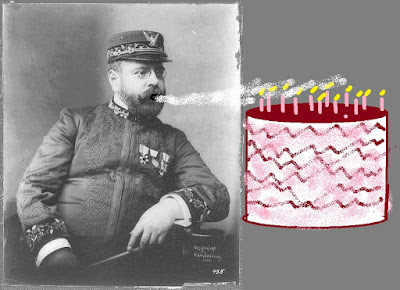
Graphic: photo of John Philip Sousa (circa 1900) from Library of Congress, with a little embellishment.
By the way, the reason we Sousa fans can sing "Happy Birthday" to JPS today (his 163nd birthday) is that a court ruled that the tune was in the public domain. See Ben Sisario, Details of 'Happy Birthday' Copyright Settlement Revealed, N.Y. Times, Feb. 9, 2016. There's a limit to the protection composers receive for the products of their brains.

Graphic: photo of John Philip Sousa (circa 1900) from Library of Congress, with a little embellishment.
Tuesday, October 31, 2017
#HalLAWeen Art: Gallows Humor

See Wordnik (defining "gallows humor"). See generally Gallagher Blogs series of #HalLAWeen Art posted Oct. 31, 2017.
Graphic: Mary Whisner
#HalLAWeen Art: Fruit of the Poisonous Tree

"the trial judge must give opportunity . . . to the accused to prove that a substantial portion of the case against him was a fruit of the poisonous tree."
Nardone v. United States, 308 U.S. 338, 341 (1939) (Frankfurter, J.), Google Scholar
Graphic: Mary Whisner
#HalLAWeen Art: Dying Declaration

-Giles v. California, 128 S.Ct. 2678, 2703 (2008), Google Scholar.
#HalLAWeen Art: Severability

-Alaska Airlines, Inc. v. Brock, 480 U.S. 678, 684 (1987), Google Scholar.
#HalLAWeen Art: Disgorgement

disgorgement, n. (15c) The act of giving up something (such as profits illegally obtained) on demand or by legal compulsion.
Black's Law Dictionary (9th ed. 2009)
dis-gorge : to empty whatever is in the stomach through the mouth
Merriam-Webster Dictionary App
Graphic: Mary Whisner
#HalLAWeen Art: Poison Pill

-Revlon, Inc. v. MacAndrews & Forbes Holdings, 506 A. 2d 173, 180 (Del. 1985), Google Scholar.
#HalLAWeen Art: Claw Back

"A new phenomenon has developed in recent bankruptcy proceedings in which trustees are 'clawing back' tuition payments made by debtor-parents on behalf of their children."
Andrew Mackenzie, Note, The Tuition "Claw Back" Phenomenon: Reasonably Equivalent Value and Parental Tuition Payments, 2016 Colum. Bus. L. Rev. 925 (2016)
Graphic: Mary Whisner
#HalLAWeen Art: Phantom Defendant

"...[A]nd that the 'phantom defendant' defense was not a viable alternative, given that the defendant's bloody fingerprints were found in the victim's apartment."
- Ex parte Brooks, 695 So.2d 184, 191 (1997), Google Scholar.
#HalLAWeen Art: Dead Hand

"Is reference to the Framers' intent majoritarian? To the contrary; it amounts to rule by the dead hand from the grave."
Barry Friedman, Dialogue and Judicial Review, 91 Mich. L. Rev. 577, 594 (1993)
Graphic: Mary Whisner
#HalLAWeen Art: Hung Jury

-Richardson v. United States, 468 U.S. 317, 311-312 (1984), Google Scholar.
#HalLAWeen Art: Judicial Hellhole

"The term 'judicial hellhole' appears to have been created by the American Tort Reform Association and was used extensively during the CAFA debates."
Emery G. Lee III & Thomas E. Willging, The Impact of the Class Action Fairness Act on the Federal Courts: An Empirical Analysis of Filings and Removals, 156 U. Pa. L. Rev. 1723, 1725 n.2 (2008).
See Am. Tort Reform Found., Judicial Hellholes.
Graphic: Mary Whisner
#HalLAWeen Art: Parade of Horribles

"The briefs present a gruesome parade of horribles."
Diamond v. Chakrabarty, 447 U.S. 303, 316 (1980) (Burger, C.J.)
Graphic: Mary Whisner
#HalLAWeen Art: Blood from a Turnip

-Esteb v. Enright, 563 N.E.2d 139, 142 (1990), Google Scholar.
#HalLAWeen Art: Brooding Omnipresence in the Sky

"The common law is not a brooding omnipresence in the sky but the articulate voice of some sovereign or quasi-sovereign that can be identified . . . ."
Southern Pacific Co. v. Jensen, 244 U.S. 205, 222 (1917) (Holmes, J., dissenting), Google Scholar
Graphic: Mary Whisner
#HalLAWeen Art: Possession is Nine Tenths of the Law

- Wilcox v. Stroup, 467 F.3d 409, 412 (2006), Google Scholar.
Monday, October 30, 2017
#HalLAWeen Is Coming!
Halloween is coming, and what better way to celebrate it than with some blog posts? Perhaps you've already read today's post, Ghosts and the Law. We're going to move on from there to present a gallery of some spooky or macabre legal terms, or what we call #HalLAWeen.
Now, we all know that law is serious business and affects real people's lives. This series of sketches takes a break from the seriousness to have what we hope is good-natured fun. If you see a guillotine or gallows illustrating "execution of remedies," please understand that we're just going for a visual pun and we aren't commenting on the appropriateness of different forms of capital punishment.
Be warned: spooky cartoons coming!
Now, we all know that law is serious business and affects real people's lives. This series of sketches takes a break from the seriousness to have what we hope is good-natured fun. If you see a guillotine or gallows illustrating "execution of remedies," please understand that we're just going for a visual pun and we aren't commenting on the appropriateness of different forms of capital punishment.
Be warned: spooky cartoons coming!
Ghosts and the Law
The courtroom is generally an area where facts are all that matter, and where anything that cannot be proven may as well not exist. This might lead one to the conclusion that the courts are largely silent on the topic of ghosts and the paranormal, but that assumption would be incorrect. This post will briefly discuss some legal cases revolving around the legal treatment of ghosts.
The most famous ghost-related case is Stambovsky v. Ackley. A woman named Helen Ackley lived in a house that she swore was haunted. She reported on paranormal incidents to local and national publications. Ackley decided to sell the house to a man from out of town named Jeffrey Stambovsky, but neither she nor her realtor disclosed the alleged haunting. When Stambovsky learned of the haunting, he attempted to withdraw from the agreement and sued Ackley.
The New York Supreme Court, Appellate Division ultimately found in favor of Stambovsky, ruling that the house was haunted as a matter of law. While the house may or may not have been haunted, the fact that Ackley had publicly treated the house as though it had been haunted meant that she was required to disclose the house's condition. While the decision is most famous for its ruling, the opinion became known as the "Ghostbusters Ruling" thanks to its numerous references to ghosts and spooky turns of phrase.

An ongoing copyright case addresses the existence of ghosts more directly. Horror fans might be familiar with Warner Bros.' Conjuring films. This franchise, which currently consists of four films, is based on the case files of paranormal investigators Ed and Lorraine Warren. The couple were involved with a number of high profile allegedly supernatural occurrences, including a murder trial where the defendant pled not guilty by reason of demonic possession. Gerald Brittle, the author of the Warren biography The Demonologist, has filed a nearly one billion dollar lawsuit claiming that the franchise infringes on his exclusive rights to the Warrens' stories.
Brittle argues that the cases that inspired both the book and the films did not occur. In essence, the incidents described by the Warrens were independent works of authorship, since they reflected the creative processes of the investigators rather than actual facts. U.S. District Court Judge John Gibney Jr. has declined to explore this argument at this stage in the process, and has allowed the case to move forward with a trial date in April of 2018. You can read more about the trial in this piece from The Hollywood Reporter.

The most famous ghost-related case is Stambovsky v. Ackley. A woman named Helen Ackley lived in a house that she swore was haunted. She reported on paranormal incidents to local and national publications. Ackley decided to sell the house to a man from out of town named Jeffrey Stambovsky, but neither she nor her realtor disclosed the alleged haunting. When Stambovsky learned of the haunting, he attempted to withdraw from the agreement and sued Ackley.
The New York Supreme Court, Appellate Division ultimately found in favor of Stambovsky, ruling that the house was haunted as a matter of law. While the house may or may not have been haunted, the fact that Ackley had publicly treated the house as though it had been haunted meant that she was required to disclose the house's condition. While the decision is most famous for its ruling, the opinion became known as the "Ghostbusters Ruling" thanks to its numerous references to ghosts and spooky turns of phrase.

The chain of ownership is a bit complicated, but one of the core issues in the case is whether the Warrens' case files were factual or not. Copyright law protects original works of authorship. Facts are in the public domain, and are therefore not generally protected by copyright. However, the compilation, arrangement, and selection of facts- those elements of a historical account that require creativity from the author beyond recitation of events- are protected through copyright law. You can learn more about the nuances of copyright in this FAQ from the U.S. Copyright Office.

As you can see, the law is an even scarier subject than you might think!
Subscribe to:
Posts (Atom)