The first Earth Day, April 22, 1970, was followed by important legal developments, such as President Nixon's reorganization plans setting up the Environmental Protection Agency and the National Oceanic and Atmospheric Administration (July 9, 1970), the Clean Air Act (1970), the Clean Water Act (1972). It was just a few months after the National Environmental Policy Act (Jan. 1, 1970).
Here are two short videos from PBS about Earth Day, from PBS Kids (if you like cute animation) and the American Experience documentary series (if you like news footage).
Of course, environmental law developments didn't stop in the 1970s. If you want to follow what's going on, check out Greenwire (E&E News). Using the law library's subscription, you can browse recent issues or search for key terms. You can also subscribed to email alerts, such as Climatewire.

Monday, April 22, 2019


Friday, April 19, 2019
Mueller Report on GovInfo, HeinOnline, Elsewhere
The Mueller Report (Report on the Investigation into Russian Interference in the 2016 Presidential Election, by Special Counsel Robert S. Mueller, III) has been archived by the the U.S. Government Publishing Office at https://permanent.fdlp.gov/gpo119242/report.pdf. It's important to have the official record.
Unfortunately, it's slow to load (demand seems to be high), and once you get it, it's not searchable: it's just a scan.
The folks at HeinOnline have posted it in the U.S. Congressional Documents database. AND they've run it through their character-recognition software so it's searchable.
For example, you can search for "collusion" to be within 10 words of "crime," or "flynn" within 25 words of "comey."
Once you find a page you want to share, click on the link logo at the top of the page. For example, here is a link to volume 1, p. 180, with its discussion of "collusion."
Unfortunately, it's slow to load (demand seems to be high), and once you get it, it's not searchable: it's just a scan.
The folks at HeinOnline have posted it in the U.S. Congressional Documents database. AND they've run it through their character-recognition software so it's searchable.
For example, you can search for "collusion" to be within 10 words of "crime," or "flynn" within 25 words of "comey."
 |
| Sample search: Mueller as Section Author collusion in Text, within 25 words of crime in text |
 |
| Passage in Mueller report (volume 1, p. 180) with "collusion" and "crime" highlighted. |
Once you find a page you want to share, click on the link logo at the top of the page. For example, here is a link to volume 1, p. 180, with its discussion of "collusion."
Your colleagues at other law schools and universities probably have access to HeinOnline, too. But for those who don't, Slate posted a searchable PDF you can download. You can also download a PDF from the Washington Post. The Post also offers The Mueller Report, Annotated (updated April 18 at 7:42 PM).
Wednesday, April 17, 2019
Law Librarian Research Hack: Go to Oxford for Help
Sometimes you want something more scholarly and deeper than Wikipedia—and yet you still want an accessible source to start with, rather than devoting several weeks to reading a shelf of books. Like Goldilocks, you want something just right.
For that certain set of information needs, I'm a big fan of Oxford Handbooks Online (available to UW users through the University Libraries).
- If you want to find a good introduction to what law-and-economics scholars say about medical malpractice, start with Ronen Avraham & Max M. Schanzenbach, Medical Malpractice, in 2 The Oxford Handbook of Law and Economics (Francesco Parisi ed., 2017). You'll find a 30-page PDF—21 1/2 pages summarizing the area, plus pages of references to lead you to important studies.
- Suppose you want to get a framework for comparative constitutional law. What are the themes that scholars look at? What are the big topics? Take a look at The Oxford Handbook of Comparative Constitutional Law (Michel Rosenfeld & András Sajó eds., 2012).
The Oxford Handbooks can be especially useful if you want to get an introduction to a concept from another discipline. The law library has licensed a lot of the law titles, but we also get the benefit of using the ones licensed by other campus libraries!
- If you come across a law review article that's talking about Foucault and you don't know Foucault from Kung Fu, you might try Andrea Mennicken & Peter Miller, Michel Foucault and the Administering of Lives, in The Oxford Handbook of Sociology, Social Theory, and Organization Studies: Contemporary Currents (Paul Adler et al. eds., 2014).
- What if you want to sample social psychologists' work on social justice? Browse The Oxford Handbook of Social Psychology and Social Justice (Phillip L. Hammack Jr. ed., 2016).
 |
| "Brasen Nose College, Radcliffe Library & Part of the Schools," from The Perambulation of Oxford, Blenheim, and Nuneham (1824), available in the British Library's Flickr photostream |
You can also run a general search and then filter by subject. And you can also search for words to be in certain fields, like an article's headings or summary.
How do you get to Oxford Handbooks Online if you don't have this link handy?
- Go to the University Libraries homepage.
- Choose Encyclopedias & Dictionaries.
- Choose Oxford Handbooks Online.
Now you try it. Search Oxford Handbooks Online for one of these:
- "star wars"
- "game of thrones"
- "hello kitty"
- seattle
Tuesday, April 16, 2019
Law Librarian Research Hack: Google Operators
This series of posts will include short explanations of some of our favorite legal research and writing short cuts and work-arounds. At the end of each post, we'll include a brief exercise so you can put your new skill into practice.
Google is powerful, but did you know that using advanced search operators allows you to harness that power to make your research more efficient? My favorite of these operators gives you the ability to search all of the content of a website (e.g. nytimes.com, law.uw.edu, usda.gov) or a particular top-level domain (e.g. .gov, .edu, .org). To use it, simply enter your search term(s) in the main Google search bar as normal, then type site:[website or domain you want to search] (make sure there is no space between "site:" and the website or domain).


Hack #1 - Using Google to search particular websites or domains
Google is powerful, but did you know that using advanced search operators allows you to harness that power to make your research more efficient? My favorite of these operators gives you the ability to search all of the content of a website (e.g. nytimes.com, law.uw.edu, usda.gov) or a particular top-level domain (e.g. .gov, .edu, .org). To use it, simply enter your search term(s) in the main Google search bar as normal, then type site:[website or domain you want to search] (make sure there is no space between "site:" and the website or domain).
So, for example, if you want to search all of the Seattle Times website (seattletimes.com) for articles about the proposed permanent daylight saving time, you would enter:

This trick can also be quite helpful if you want to search the content of a website that doesn't have a built-in search feature.
You can also make your searches broader than just one particular website. Let's say you are researching cannabis regulations and you want to find results from all government websites (.gov). You would enter:

Note that using just site:.gov will retrieve results from both federal and state government websites. If you want to narrow your search and only retrieve results from Washington State government websites, you would use site:wa.gov. If you wanted to be even more specific and only find results from the Washington State Liquor and Cannabis Board website, you would use site:lcb.wa.gov.
Practice exercise!
Find any government website that mentions Bigfoot. Now narrow your search just to your state's government websites. How about Bigfoot articles from your home town newspaper?
Need more?
There are many other Google advanced search operators and you can find articles (like this one) that list available operators and their function.
Wednesday, April 10, 2019
Setting the Section Symbol as a Shortcut in Word
As any law school student can tell you, the default settings in Word aren't optimized for legal writing. With a bit of tinkering, however, we can make our lives a lot easier. One way to get started optimizing Word for legal writing is to set the section symbol as a shortcut. This video will show you how.
If you're looking for more tips on getting the most out of Word as a legal writer, check out Gallagher's guide on Word Tips for Legal Writers.
Tuesday, April 9, 2019
Foreign Law Guide Japan Updated
I edit the Japan section of the online resource from Brill, Foreign Law Guide (FLG). Recently I completed a major update of this section, including repairing broken links and other fixes and improvements. The newly updated Japan section went online as of April 4th. A description and link to the Brill FLG Japan can be found on my Japanese Legal Research A-Z page, here:
https://guides.lib.uw.edu/law/eald/japan-az
For additional detailed information about East Asian legal research (China, Japan, Korea, or Taiwan), see the EALD page: https://guides.lib.uw.edu/law/eald/eald
--Rob Britt, Coordinator of East Asian Library Services, Gallagher Law Library
https://guides.lib.uw.edu/law/eald/japan-az
For additional detailed information about East Asian legal research (China, Japan, Korea, or Taiwan), see the EALD page: https://guides.lib.uw.edu/law/eald/eald
--Rob Britt, Coordinator of East Asian Library Services, Gallagher Law Library
Monday, April 1, 2019
Law Library Has Spring Break Makeover
Returning students were surprised to find that the Gallagher Law Library had replaced all of its carpet over spring break. "It was almost sixteen years old," noted library director Frank Johnson. "So when a generous alumnus approached us with an offer to replace it, we jumped at the chance. My staff sprang into action to organize the installation over break, to minimize disruption to students. They did amazing work."
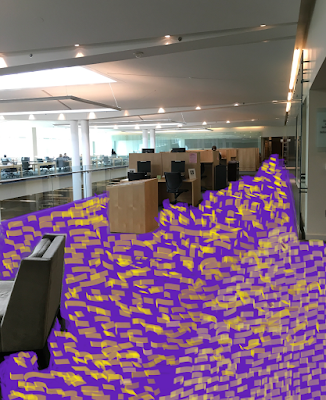 Joseph "Joe Husky" Johanson, class of '69, said he was motivated to give back to his law school, which had given him the foundation for his successful career as general counsel for a chain of carpet retailers. He also wanted to make sure everyone knew they were in Husky territory. "A strong dose of purple and gold always perks me up when I'm down," remarked Johanson. "I wanted to share that with the law students." He acknowledges that the print matches that of a certain shirt he wore throughout the 1968-69 school year.
Dean Claudio Stables expressed gratitude for the gift. "Alumni like Johanson help this school maintain its excellence. Carpet is just a part of the educational experience, of course, but we're creating committed, capable lawyers from the floor up."
Asked to comment, several students standing in line for coffee this morning had varied reactions:
"As a loyal cougar, I think it's a little in your face," said one. "I'm happy to be at this law school, that much purple and gold makes me queasy."
"We're all for it," said two students who seem to speak as one. "Go! Huskies!"
"It certainly makes a visual impact," said another student. "Perhaps it's not soothing, but I could use an energy boost when I'm hitting the books."
The final student approached about the carpet asked simply: "We have a library?"
Photo by Mary Whisner

Dean Claudio Stables expressed gratitude for the gift. "Alumni like Johanson help this school maintain its excellence. Carpet is just a part of the educational experience, of course, but we're creating committed, capable lawyers from the floor up."
Asked to comment, several students standing in line for coffee this morning had varied reactions:
"As a loyal cougar, I think it's a little in your face," said one. "I'm happy to be at this law school, that much purple and gold makes me queasy."
"We're all for it," said two students who seem to speak as one. "Go! Huskies!"
"It certainly makes a visual impact," said another student. "Perhaps it's not soothing, but I could use an energy boost when I'm hitting the books."
The final student approached about the carpet asked simply: "We have a library?"
Photo by Mary Whisner
Friday, March 1, 2019
20 Years of the Rome Statute
 |
| Source: International Criminal Court |
Last year marked the 20th anniversary of the Rome Statute which created the International Criminal Court (the “ICC”), a standing
judicial body which would try the worst crimes under international law –
namely, war crimes, genocide, crimes against humanity, and crimes of aggression.
The United States signed the Rome Statute under the Clinton Administration but never ratified it. The Bush Administration subsequently “unsigned” the treaty when then-Under Secretary of State for Arms Control and International Security John Bolton sent a note to the U.N. Secretary General stating that the United States has no legal obligations under the treaty and has no intentions of ratifying. Shortly thereafter, the American Service Members Protection Act 22 U.S.C. 7421-7433 (also known as "The Hague Invasion Act") was passed, which authorizes the President to use all means necessary to release U.S. personnel who may be detained by the ICC.
Now as National Security Adviser, Bolton has continued his criticism of the ICC. The situation may come to a head as the ICC contemplates opening a formal investigation into the war in Afghanistan, including the actions of U.S. military personnel and allies.
Monday, February 25, 2019
Visually Appealing Legal Graphics
Legal information can be complicated, but that doesn't mean it has to be boring or ugly. If you're looking for a break from page after page of double-spaced, 12-point Times New Roman / Courier briefs, or if you're starting to see ghost images of the blue Westlaw header everywhere you go, then feast your eyes on the following articles from the past year that have visually spiced up legal information in appealing ways.

Who says you have to compare the laws of different jurisdictions in an oversized, tortured table? Get inspired by the visual journalists at the New York Times, who present some of the most convoluted laws from drastically different countries and states in easily digestible infographics.
1. A How-To Comparison and Flow Chart from the New York Times

Who says you have to compare the laws of different jurisdictions in an oversized, tortured table? Get inspired by the visual journalists at the New York Times, who present some of the most convoluted laws from drastically different countries and states in easily digestible infographics.
In How to Buy a Gun in 15 Countries, a lightly annotated step-by-step how-to guide lets the reader compare the gun laws in fifteen different countries without getting bogged down by unnecessary legalese.
In What It Takes to Get an Abortion in the Most Restrictive U.S. State, side-by-side flow charts of the steps required to get an abortion in California and Mississippi visualize the many differences in legal restrictions you might face depending on what state you live in.


Can't get enough legal infographics and interactive visuals? Check out the examples at Open Law Lab's Visual Law Project and the Legal Design Labs' Visual Law Library.
For those looking for a more organized list of resources, Margaret Hagen has compiled a helpful Beginner's List of Links for Those Interested in Visuals + Law over at the Open Law Lab's blog.
2. A Colorful SCOTUS Graph from FiveThirtyEight

Rule 33 of the Rules of the Supreme Court of the United States might require a "clear, black image on white paper," but that shouldn't stop you from adding splashes of color to articles about our most distinguished court.
In How Kavanaugh Will Change the Supreme Court, bright turquoise, purple, and orange dots are used to represent various ideological "median" Supreme Court justices over the years based on their Judicial Common Space scores, with data collected from an article published in the Journal of Law, Economics, and Organization.
In How Kavanaugh Will Change the Supreme Court, bright turquoise, purple, and orange dots are used to represent various ideological "median" Supreme Court justices over the years based on their Judicial Common Space scores, with data collected from an article published in the Journal of Law, Economics, and Organization.
3. A Wall of Names from the Washington Post

While it can be easy to get lost in the sheer quantity of legal information, good visualizations will find a way to highlight important trends without neglecting the individual data components that make up the information.
In An Unequal Justice, the reader can scroll through the names of nearly 26,000 homicide victims whose murderers haven't been arrested, and sees highlighted the disproportionate number of those names that belong to the victims who are black. This interactive graphic brings out the human side of tens of thousands of criminal homicides without letting the reader overlook racial disparities in the data.
4. More Visualizations in Law!
Can't get enough legal infographics and interactive visuals? Check out the examples at Open Law Lab's Visual Law Project and the Legal Design Labs' Visual Law Library.
For those looking for a more organized list of resources, Margaret Hagen has compiled a helpful Beginner's List of Links for Those Interested in Visuals + Law over at the Open Law Lab's blog.
Friday, February 22, 2019
Policy Wonk Treasure on @HeinOnline
Isn't it great when you can find a good, fact-based non-partisan analysis of some issue or program?
HeinOnline just released a new database, GAO Reports and Comptroller General Opinions.

The General Accountability Office (formerly General Accounting Office) "is an independent, nonpartisan agency that works for Congress. Often called the 'congressional watchdog,' GAO examines how taxpayer dollars are spent and provides Congress and federal agencies with objective, reliable information to help the government save money and work more efficiently." The GAO is headed by the Comptroller General. Unlike many administrators, who come and go with presidential administrations, the Comptroller General has a 15-year term, giving the agency continuity.
In the HeinOnline database you can find reports on a wide range of topics, across many decades. E.g.:
While you policy wonks are exploring HeinOnline, take a look at the U.S. Congressional Documents library. It includes Congressional Budget Office documents, CRS Reports, and more.

The General Accountability Office (formerly General Accounting Office) "is an independent, nonpartisan agency that works for Congress. Often called the 'congressional watchdog,' GAO examines how taxpayer dollars are spent and provides Congress and federal agencies with objective, reliable information to help the government save money and work more efficiently." The GAO is headed by the Comptroller General. Unlike many administrators, who come and go with presidential administrations, the Comptroller General has a 15-year term, giving the agency continuity.
In the HeinOnline database you can find reports on a wide range of topics, across many decades. E.g.:
- Endangered Species: Past Actions Taken To Assist Columbia River Salmon [RCED-92-173BR] (1992)
- Federal Land Management: Information On Usage Of The Antiquities Act [RCED-99-244R] (1999)
- Illicit Opioids: While Greater Attention Given to Combating Synthetic Opioids, Agencies Need to Better Assess Their Efforts [GAO-18-205] (2018)
- 2017 Lobbying Disclosure: Observations on Lobbyists' Compliance with Disclosure Requirements [GAO-18-388] (2018)
-
- Death Penalty Sentencing: Research Indicates Pattern Of Racial Disparities [T-GGD-90-37] (1990)
While you policy wonks are exploring HeinOnline, take a look at the U.S. Congressional Documents library. It includes Congressional Budget Office documents, CRS Reports, and more.
Monday, February 18, 2019
Making Multiple Choice Easier
 |
| Photo by Ben Mullins, available at Unsplash |
It might be this quarter. It might be on the MPRE or on the bar exam, but at some point in the near future, you're going to be faced with yet another multiple choice test. Given all the multiple choice tests you've taken in your academic career up until now, you're probably a pro at process of elimination. Awesome! But what happens when you get down to two equally tempting answer choices? Or worse, when all of those answer choices look good?
Let's take a step back and think about how a multiple choice test works. For a multiple choice question to work, there must be a correct answer, even if that answer is "None of the above." Ambiguities have no place in multiple choice; that's for essays or short answers. What makes a multiple choice question difficult are those pesky three or four "trap" answer choices that seem to be saying all the right things. All of that noise slows you down and can make you second guess yourself. But what if you could side step those traps?
Try to articulate the right answer to the question before you look at the answer choices. You're smart. You studied for this test. Based on the information given to you in call of the question, you should be able to formulate what the correct response is without needing to refer to the answer choices. Once you know what the right answer should be, you will be more likely to spot it among the traps.
This method can take a little bit of practice since many of us are accustomed to diving right into the answer choices when taking a test. Try this strategy out on sample MBE questions or on a CALI lesson (login required) before your next to test to see if it works for you!
For more resources, check out our guides on Law School Exams and the Washington State Bar Exam.
Thursday, February 14, 2019
Happy #VaLAWntines Day
Did the snow keep you from shopping for Valentine's Day cards? Check out the law-related Valentines a few of our law library interns prepared last year. They're just as clever this year!


Monday, February 11, 2019
Game On, Lawyers?

This influx of attention and money (OWL has a prize pool of nearly 5 million dollars this season) in a fledgling industry means that there will be room for lawyers looking to specialize in the field. Esports law is on the rise and there will be a definite need for well rounded lawyers. Esports touches on a variety of traditional legal fields such as contracts, legal gambling, endorsements, mergers and acquisitions, collective bargaining and more. Already, major U.S. law schools are acknowledging the challenges of Esports law and looking to include it in their advanced degree offerings and conferences.
This fledgling legal specialty has room to grow alongside the games it's based around and law students can explore entering a new and developing specialty. And if all else fails, anyone can always try to go pro themselves.
*Photo by JESHOOTS.COM on Unsplash
Sunday, February 10, 2019
Thursday, February 7, 2019
Snow Closure Friday (2/8) - Sunday (2/10)
In anticipation of significant snowfall the Gallagher Law Library will be
closing early on Friday (2/8) at noon and will be closed through Sunday. Refer to UW alerts, the law
library home page, Facebook or the blog for any further updates on closures.
Thank you for your understanding.
Thursday, January 31, 2019
Are There Limits to the President's Emergency Powers?
Since the President has been talking about using emergency powers to build a wall without congressional authorization, you might be wondering just what these emergency powers are and whether there are limits to them.
This morning I saw an article on The Atlantic's website and then did a little looking around myself. Now there's a page about Emergency Powers—listing a variety of material from short articles to videos to books—in our Presidential Power guide.
 A great place to start learning about presidential power is The Limits of Presidential Power: A Citizen's Guide to the Law, by Professors Lisa Manheim and Kathryn Watts. Since it's aimed at the general public, it's more accessible than most law review articles and legal treatises. But since it's written by two top law professors, it's still totally accurate and reliable.
Flip through the Presidential Power guide to learn about a wide variety of issues related to the Presidency.
This morning I saw an article on The Atlantic's website and then did a little looking around myself. Now there's a page about Emergency Powers—listing a variety of material from short articles to videos to books—in our Presidential Power guide.
 A great place to start learning about presidential power is The Limits of Presidential Power: A Citizen's Guide to the Law, by Professors Lisa Manheim and Kathryn Watts. Since it's aimed at the general public, it's more accessible than most law review articles and legal treatises. But since it's written by two top law professors, it's still totally accurate and reliable.
Flip through the Presidential Power guide to learn about a wide variety of issues related to the Presidency.
Wednesday, January 30, 2019
Women Arguing Before the Supreme Court
As far as Supreme Court advocacy goes, you can safely assume that the nineteenth century pretty much belonged to men. But when did women first argue to the Court? Who appeared more than once? How have the numbers picked up?
Two articles by Marlene Trestman on the Supreme Court Historical Society's website give the answers:
Here's a graphic, showing how the numbers picked up in the mid-twentieth century, then took off after about 1970. The blip in 1880 is Belva Ann Lockwood.
 This project of looking at all women who argued before the Supreme Court was a side project for Trestman's biography of Bessie Margolin, the Assistant Solicitor of Labor, who argued 24 times between 1945 and 1965.
Two articles by Marlene Trestman on the Supreme Court Historical Society's website give the answers:
- Women Advocates Before the Supreme Court, from October Term 1880 Through December 2016
- First 101 Women to Argue at the United States Supreme Court.
Here's a graphic, showing how the numbers picked up in the mid-twentieth century, then took off after about 1970. The blip in 1880 is Belva Ann Lockwood.
 |
| Arguments by Women, chart from Women Advocates Before the Supreme Court |
 This project of looking at all women who argued before the Supreme Court was a side project for Trestman's biography of Bessie Margolin, the Assistant Solicitor of Labor, who argued 24 times between 1945 and 1965.
 Tuesday, January 29, 2019
Nuremberg Trial Documents, Here and Online
The International Military Tribunal (IMT) and the United States Nuremberg Military Tribunals (NMT) tried Nazi leaders for war crimes and crimes against humanity. Among other things, the tribunals produced papers—tons and tons of papers. Indictments, transcripts, and exhibits (and translations of indictments, transcripts, and exhibits).
The Gallagher Law Library has a large set of the transcripts. Why? Because one of the judges was Walter Beals, a graduate of UW Law's very first class (1901) and a justice of the Washington Supreme Court, who was called into service as an Army reservist to serve in Nuremberg. Later he arranged for a set of materials to go to his alma mater.
 |
| Some of the Nuremberg transcripts in Gallagher's Special Collections |
Friday, January 25, 2019
Federal Courts and the Government Shutdown

Photo by Bonnie Kittle on Unsplash
The government shutdown is about to extend to the federal courts. The courts actually have been impacted already--for example, some government litigation has been put on hold--but the effects are about to expand. The federal courts have announced that they only have enough funding to continue operations through the end of January, or February 1 at the very latest. That is just next week. If the shutdown stretches past next week, the Antideficiency Act kicks in and the courts will be limited to "essential" services, as determined on a court-by-court basis.
No one knows exactly what that will look like if the courts go into essential-operations mode. Criminal cases should proceed in every court. Civil cases will be impacted, but the effects will vary by court. We should expect to see backlogs in dockets. Judges and staff needed for essential services will have to work unpaid, the same as other federal workers. Though jury duty has never been a lucrative gig, jurors (at least temporarily) will have to go without jury pay and travel reimbursement. If the courts run out of money, these immediate effects are likely just the tip of the iceberg. For the 12 months ending September 30, 2018, the average time from filing to disposition of criminal cases was 7.0 months, and for civil cases was 9.2 months. For civil cases that went to trial, the average time to trial was 27.3 months. It will be interesting to see what happens to the length of legal proceedings.
For more on the consequences of a federal government shutdown, including but not limited to the courts, see this Congressional Research Service report issued last month.
UPDATE (1/25/2019 1PM): The White House just announced a (temporary) reopening of the government. It is being reported that President Trump has reached a deal with Congress that would restore funding through February 15. It looks like the courts have dodged a bullet, at least for now. It will still be interesting to see if the shutdown's initial effects will lead to a noticeable lengthening of dockets and pace of proceedings.
Thursday, January 24, 2019
Food Labeling Started Because of...The Jungle?
Have you ever read Upton Sinclair’s The Jungle? It’s a fictional work originally published in 1905 about the terrible conditions of the meat processing industry in the Chicago stockyard that effectively strong-armed Congress into taking action. The public outcry after the revelation of what went on in the Chicago factories led directly to the passage of the U.S. Pure Food and Drug Act in 1906. Originally, Sinclair's motive was to draw attention to the migrant workers' plight in the Chicago meat industry. He famously said "I aimed at the public's heart, and by accident I hit it in the stomach."*
 |
| Courtesy of Library of Congress |
Eventually, this legislation was superseded by the Food, Drug, and Cosmetic Act in 1938, which, though amended, still remains in effect today. Then later, in 1990, Congress passed the Nutrition Labeling and Education Act which required uniform nutrition labeling and regulated other labeling aspects, such as nutrition content or health claims.
Today, food labeling laws and regulation continue to evolve and expand, but who knew it all started in The Jungle?
*Lawrence M. Friedman, American Law in the 20th Century 61(2002).
Tuesday, January 22, 2019
FDA…USDA…Organic, Non-Organic? How Do You Know What’s In Your Food?
Ever wonder who actually regulates the labels that you (sometimes) read on the food you buy? One might assume it’s the Food & Drug Administration (FDA), but then all the organic products say “USDA Organic”….and even still the non-GMO products have a whole different stamp on them….Who does what?

Well, there are a few different Federal agencies that look after that. The idea about the FDA is good, because most food labels fall under their jurisdiction. However, the United States Department of Agriculture (USDA) governs food labeling requirements for meat, poultry, and eggs as well as what constitutes “Organic” for the purposes of that familiar little green and white circle. Additionally, the Bureau of Alcohol and Tobacco Tax and Trade within the Department of the Treasury has jurisdiction over, well, alcohol labels. On the international side of things, the Office of the United States Trade Representative (USTR) takes part in treaty negotiations regarding food labeling in international trade.
The Non-GMO Project, whose stamp often appears beside the “USDA Organic” symbol, is actually a non-profit organization dedicated to offering a third-party non-GMO verification program, and is therefore not a regulatory regime.
All that to say, it’s (not surprisingly) a little complex, but it helps to know where to start. If you want to know what “Cage Free” on your egg carton means, you’ll want to go to the USDA resources for that. On the other hand, for “major food allergens,” you’ll want to hunt down FDA offerings to get some guidance. Food labeling is increasingly becoming a topic of discussion in today’s society. It’s good to know where to go.
Monday, January 7, 2019
Trailblazing Women in Law—website and book
Wouldn't it be great to sit down for a chat with a woman who entered the legal profession 50 or 60 years ago and managed to achieve success as a judge, law professor, law firm partner, or government official? What was it like to be one of only a a few women in law school? How did she get her first job? What sorts of cases did she handle?
Justice Ruth Bader Ginsburg has become a pop culture figure—perhaps you have an RBG T-shirt or coffee mug of your own—but she's not the only one! The ABA and the American Bar Foundation started the Women Trailblazers Project a few years ago to capture oral histories of some women in this generation. In November, Stanford's Robert Crown Law Library launched a multimedia site with material from the project (including material that the ABA has never posted).
For different trailblazers, the Stanford site has photos, oral history transcripts, audiorecordings, videorecordings, and photographs. (A few subjects, including RBG, have restricted their material, to be released after their death.)
Here's a tip: After you click on an oral history, click on the download icon below it. That will give you a list of what's available (e.g., transcript, audiorecordings, photos).
For local interest, check out the pages for Judge Betty Binns Fletcher (UW Law 1956) and Ada Shen-Jaffe (long-time director of Columbia Legal Services and social justice advocate).

If thousands of pages of oral history and hundreds of hours of recordings overwhelm you, you can start with a book that curates highlights: Jill Norgren, Stories from Trailblazing Women Lawyers: Lives in the Law (2018) (publisher's page). The library has a copy in print. There also happens to be a great bargain on the Kindle version: it's just 99 cents this week (until Jan. 13).
(This is just one 99-cent deal NYU Press is offering. There are some interesting books on technology and society, women in the workplace, transgender kids, and more.)
Justice Ruth Bader Ginsburg has become a pop culture figure—perhaps you have an RBG T-shirt or coffee mug of your own—but she's not the only one! The ABA and the American Bar Foundation started the Women Trailblazers Project a few years ago to capture oral histories of some women in this generation. In November, Stanford's Robert Crown Law Library launched a multimedia site with material from the project (including material that the ABA has never posted).
For different trailblazers, the Stanford site has photos, oral history transcripts, audiorecordings, videorecordings, and photographs. (A few subjects, including RBG, have restricted their material, to be released after their death.)
Here's a tip: After you click on an oral history, click on the download icon below it. That will give you a list of what's available (e.g., transcript, audiorecordings, photos).
 |
| Download icon |

If thousands of pages of oral history and hundreds of hours of recordings overwhelm you, you can start with a book that curates highlights: Jill Norgren, Stories from Trailblazing Women Lawyers: Lives in the Law (2018) (publisher's page). The library has a copy in print. There also happens to be a great bargain on the Kindle version: it's just 99 cents this week (until Jan. 13).
(This is just one 99-cent deal NYU Press is offering. There are some interesting books on technology and society, women in the workplace, transgender kids, and more.)
Subscribe to:
Posts (Atom)