Tuesday, February 23, 2021

Diverse Voices - Social Justice Research Guides


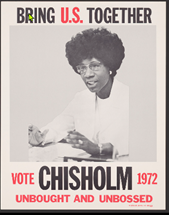
Election poster shows Black woman with headline "Bring U.S. Together." Below photo: "Vote Chisholm Unbought and Unbossed"
Presidential candidate and U.S. Rep.
Shirley Chisholm in 1972

Library research guides are always an incredible source of collected resources on a topic that you are interested in or just getting to know.

With the Web, you can access library research guides not only from your local library, but from around the world!  (Try using the Google Translate function on Chrome if you find a webpage that is not in a language you can read.)

The American Association of Libraries Research Instruction & Patron Services Special Interest Section recently created a webpage with links to research guides on diversity, equity, and inclusion and related topics.  These research guides provide information on legal and non-legal resources on anti-racism, critical studies, protest rights, social justice, and more.

Some research guides that I found useful were:

Please take a browse and see what interests you!  It’s also great to revisit the webpage periodically because research guides continue to be added as they are developed!

As we all know, people who are fortunate enough to be trained in the law have a unique ability to contribute to social change.

This post is part of the Gallagher Law Library's Diverse Voices Series for DEI Week at UW Law.

Image description: 1972 poster of presidential candidate and U.S. Representative Shirley Chisholm. 

Image from: Library of Congress Free to Use and Reuse collection (Images of African American Women Changemakers).


Monday, February 22, 2021

Diverse Voices - Databases for Social Justice Topics on HeinOnline

HeinOnline has some excellent curated collections for researchers interested in different social justice issues in American legal history. 

page of text in Cherokee alphabet
Page of Cherokee laws, in
Cherokee. The Cherokee syllabary
(not exactly an alphabet) was
developed by Sequoyah
(without using any other
writing system!) and introduced
to the Cherokee people in 1821.
Sequoyah Birthplace

Museum. The syllabary is still used.
See Cherokee Nation's Language page.


The American Indian Law Collection has thousands of documents from a variety of sources. Some are from the perspective of the federal government—the government reports, legislation, and treaties. But there are also tribal documents that Hein's editors have found, such as Acts of the Cherokee Nation from 1870-72, in Cherokee, as well as hundreds of other tribal constitutions, bylaws, and acts.  

Exploring further, you can find non-legal material, like Cry of the Thunderbird: The American Indian's Own Story, a collection edited by Charles Hamilton in 1950, and the recent collection, Why You Can't Teach United States History Without American Indians (2015).

The Civil Rights and Social Justice collection brings together scholarly articles, hearings, government reports, and briefs. Browsing the briefs, I saw many topics, including fair housing, marriage equality, affirmative action, health care, and employment discrimination. With one search you can pull up books, law review articles, briefs, and more.

Did you know that Langston Hughes wrote an illustrated history of the NAACP? I didn't. But Fight for Freedom: The Story of the NAACP (1962) is on HeinOnline!

Are you interested in slavery, which has been so important in shaping American law and society? Then make use of HeinOnline's collection, Slavery in America and the World: History, Culture & Law. Edited by legal historian Paul Finkelman, this collection has statutes, cases, scholarly articles, books (from University of North Carolina Press), and an extensive bibliography. 

cover art - Florynce "Flo" Kennedy - shows Black woman in cowboy hat and tank top, laughing


The Women and the Law collection (nicknamed Peggy, after a developer's mother) also has a wide variety of materials, from briefs to scholarly articles. It includes proceedings of a feminist legal theory conference that was held each year, 1985-2018. You can browse topics, such as abortion or suffrage. And it has a collection of biographies, from well-starched ladies from the nineteenth century to Florynce "Flo" Kennedy: The Life of a Black Feminist Radical, by Sherrie M. Randolph (2015).


Tip: When you follow a link to HeinOnline and are asked for authentication, choose Off-Campus/Remote Access. You'll want "University of Washington Gallagher Law Library," after which you'll be prompted for your UW NetID. I usually search for "gallagher" because that's faster than searching for "washington." (There's only one Gallagher in HeinOnline's list of subscribers, but there are several universities and law schools with "Washington" in their names.)


This post is part of the Gallagher Law Library’s Diverse Voices Series.


Diverse Voices Series

Presumption of Law by a Barrister &
a Lady (1891). Available from the
British Library's Flickr stream.
Leafing through a casebook or skimming a law journal, you could see a lot of upper-class white men of Northern European descent. But look again, and you might find much more diversity in the legal profession and in legal scholarship.

This week, we're going to highlight diverse voices in a series of blog posts, looking at books, databases, research guides, YouTube, and more!

Friday, February 19, 2021

Civil Liberties Day of Remembrance

Today is Civil Liberties Day of Remembrance, commemorating the anniversary of Executive Order 9066, which led to the removal and incarceration of over 110,000 Japanese Americans. 

To learn more, visit the Densho Encyclopedia, "a free and publicly accessible website that provides concise, accurate, and balanced information on many aspects of the Japanese American story during World War II." For thousands of photographs, letters, interviews, and other materials, pop over to the Densho Digital Repository. If you want to start locally, browse under Seattle. 

What happened to the hundreds of Japanese-American students at the University of Washington when the order was issued? You've probably heard of Gordon Hirabayashi, who challenged the curfew and then relocation, all the way to the Supreme Court.  (The injustice of the curfew struck him one night when he was studying late in Suzzallo Library. Why should he have to leave the library when his classmates didn't?) For more about the UW experience, see Interrupted Lives: Japanese American Students at the University of Washington, 1941-1942 from UW Libraries.

Last year's post on Civil Liberties Day of Remembrance highlighted a few books in our collection. Since Covid restrictions make it impossible to wander through the library, I updated the post to add links to ebook editions. Take a look! (One day, you'll be able to browse in the library again. We just don't know when.)