How many times have you seen a reference to a book and thought, “I’d like to look at that book, but not right now”—and then wondered how you’d find it again? Or maybe you’ve found several books that might be useful for your research project, but you haven’t decided which ones to look at first—how can you save all the maybes?
Great news! Our catalog has a feature that enables you to save catalog records (books, videos, ebooks—anything in the catalog) and tag them to make them easy to find later. It’s like a wish list in a shopping site.
How can you use this feature?
Spend a couple minutes with me and I’ll show you:

Tuesday, May 12, 2020
Wednesday, May 6, 2020
Using Google Scholar Off Campus
Google Scholar is a powerful research tool that allows you to search for academic articles using a simple, familiar Google search bar.
Using Google Scholar to access academic articles off campus requires a couple additional steps, however. This is because Google Scholar indexes articles but often does not have access to the full text of the articles. Instead when you click on a search result on Google Scholar, it redirects and relies on databases of articles paid for by Gallagher or UW Libraries. This happens automatically when you are on campus; Google and the subscription databases can tell you are on the UW campus and will automatically direct you to the article in a UW database if available.
When off campus, you need to manually tell Google you are affiliated with UW Libraries. For instructions on how to do that, see this Gallagher Research Hack from last year. If you have a Seattle Public Library account, you can follow the same process to affiliate yourself with SPL.
Once you've successfully added the UW Libraries to the Google Scholar Library links, when searching, you'll see a new option to the right of many of your search results that says "Full-Text @ UW."

Click this link to be redirected to a the article in the UW Libraries catalog. From there login with your netid using the link in the green box if you have not already done so and then access the article by following links to a database under the "View It" heading.

Not all articles are available using a "Full-Text @ UW" link. Unfortunately for legal scholars, this includes articles in some law reviews and legal journals on HeinOnline. To get access to these articles via Google Scholar links, you'll need Husky OnNet, UW's free VPN service for students, faculty, and staff. UW IT has instructions for downloading, installing, and using Husky OnNet. To use Husky OnNet to access library resources, you need to select the "All Internet Traffic" server when connecting.
- Public patron tip: Google Scholar also has a database of opinions from court cases, just choose "Case law" instead of articles under the search bar. This can be a great alternative to using print reporters or Nexis Uni to access case law while the UW Libraries are closed due to COVID-19. UW Students, Faculty, and Staff continue to have access to Nexis Uni off campus via the link on the Gallagher homepage.
Using Google Scholar to access academic articles off campus requires a couple additional steps, however. This is because Google Scholar indexes articles but often does not have access to the full text of the articles. Instead when you click on a search result on Google Scholar, it redirects and relies on databases of articles paid for by Gallagher or UW Libraries. This happens automatically when you are on campus; Google and the subscription databases can tell you are on the UW campus and will automatically direct you to the article in a UW database if available.
When off campus, you need to manually tell Google you are affiliated with UW Libraries. For instructions on how to do that, see this Gallagher Research Hack from last year. If you have a Seattle Public Library account, you can follow the same process to affiliate yourself with SPL.
Once you've successfully added the UW Libraries to the Google Scholar Library links, when searching, you'll see a new option to the right of many of your search results that says "Full-Text @ UW."

Click this link to be redirected to a the article in the UW Libraries catalog. From there login with your netid using the link in the green box if you have not already done so and then access the article by following links to a database under the "View It" heading.

Not all articles are available using a "Full-Text @ UW" link. Unfortunately for legal scholars, this includes articles in some law reviews and legal journals on HeinOnline. To get access to these articles via Google Scholar links, you'll need Husky OnNet, UW's free VPN service for students, faculty, and staff. UW IT has instructions for downloading, installing, and using Husky OnNet. To use Husky OnNet to access library resources, you need to select the "All Internet Traffic" server when connecting.
Monday, April 20, 2020
Yom HaShoah (Holocaust Remembrance Day) Begins This Evening
Yom HaShoah (יום השואה), or Holocaust Remembrance Day, begins the evening of April 20, 2020, which is the start of the 27th day of Nisan on the Jewish calendar, and ends in the evening of April 21, 2020. You can find more information about the Jewish calendar from Chabad.org. This day of remembrance has been observed worldwide by the Jewish people and their allies since the 1950's. Yom HaShoah commemorates the lives lost in the Shoah. Shoah is a Hebrew word meaning "catastrophe" or "utter destruction" and is used in this context to refer to the millions of Jews who perished in the Holocaust. This holiday serves as a reminder of the Holocaust and "the horrors that Jews and other persecuted groups faced: forced labor, starvation, humiliation, and torture, which often resulted in death." (from ReformJudaism.org). This day is a time for us to remember those who suffer(ed) directly and indirectly as a result of the Holocaust.
Despite the Covid-19 pandemic, there are many opportunities for you to gather virtually in remembrance of the lives lost, and to learn more alongside other members of your community:
1. Seattle's Holocaust Center for Humanity is hosting a Virtual Holocaust Remembrance Day Program on April 21, 2020 from 12:00 p.m. to 1:00 p.m via Zoom (https://zoom.us/s/98422030077) featuring Holocaust survivor George Elbaum.
2. The Israel State Ceremony (which was pre-recorded due to Covid -19 restrictions) was broadcast at 1:00 p.m. EDT (8:00 p.m. in Israel) and is available to watch online. It features stories, music, prayers,
and messages from the Israeli President and Prime Minister.
3. My Jewish Learning has a great website full of suggested online ceremonies and resources for Yom HaShoah.
Now, more than ever, it is important to reflect on the impact of unchecked hate in our society and to consider what our personal role is in preventing and taking a stand against everyday acts of intolerance and bias.
Never again.


Friday, April 17, 2020
Gallagher Videos for Research Skills and Bluebook Tips

Wednesday, April 1, 2020
Corvid Infestation Shuts Down Campus
 |
| Crow at Yosemite Photo by Casey Horner on Unsplash |
Corvids— a group that includes crows, ravens, jays, rooks, and magpies—are exceptionally intelligent animals, said Prof. John Marzluff, a renowned authority. For example, carrion crows in Japan learned to place walnuts in roads so that passing cars would crack them open. In an experiment, New Caledonia Crows figured out how to bend a wire to get food out of a jar. Crows can even recognize people and pass that information along to other crows.*
Stirrings of a corvid uprising began in February among crows nesting in a wooded area near Kirkland. By the end of the month, it was clear that they would have the whole city in their grip. President Ana Mari Cauce made the call to move classes online to protect humans from the awesome corvid onslaught. "The safety of people has to come first. By licensing Zoom for the campus, we can continue classes and minimize the risk of corvid interaction."
Students, faculty, and staff are now sheltering in their homes, while the campus is left to the corvids. Also some squirrels and rats. Just a few essential personnel are allowed in campus buildings.
The Ornithology Team at the Burke Museum (one of UW Law's closest neighbors) was unfortunately at a loss to repel the dreaded corvid menace. "We're very good with feathers and skeletons, even bird DNA," said one of the curators. "But we're not used to working with living birds. And those big black ones are scary!"
By now the corvid threat has spread across the country. New Yorkers, long used to insulting pigeons as "rats with wings" are rethinking their attitudes and giving birds a new respect—at least the corvids, if not the columbidae, or pigeons.
* I'm not making all this up. Prof. Marzluff is a renowned authority. The walnuts-in-the-highway example is from John M. Marzluff, Welcome to Subirdia: Sharing Out Neighborhoods with Wrens, Robins, Woodpeckers, and Other Wildlife 134 (2014). You can see the New Caledonia crow experiment in his TEDx talk. Crows recognized Marzluff when he wore the mask he wore to band them many years before.
Check out the Corvid Research blog by Kaeli Swift, Ph.D., who also tweets @corvidresearch
Tuesday, March 31, 2020
Accessing Databases Remotely
Databases for which students create individual usernames and passwords--including some of the most commonly used legal databases, Westlaw, LexisNexis, and Bloomberg Law--should continue to work as normal anywhere you have internet access; just log in with your username and password as usual.
Many other databases provided by the Gallagher Law Library or UW Libraries rely on IP authentication--which requires your computer or device to be on the UW network to gain access. This includes widely used databases like HeinOnline. Luckily there are workarounds to access these databases from home when you can't be physically on campus to connect to the network.
For most databases, the easiest way to access them remotely is to click on their link from the Selected Databases box on the Gallagher homepage or our Law Databases A-Z list or by searching and following links from the catalog. For databases from the main campus UW Libraries, access them via clicking links off of the UW Libraries homepage or searching the catalog. When you access databases and e-books from the library websites rather than searching for the database on Google or typing its URL into your browser, the library website will request you to log in with your NETID if you are not already logged in and will then automatically forward your request through a proxy server to make it appear to the database as if you are on the campus network.
For a couple of databases, you will need to set up UW's Husky OnNet VPN service, which is free for students, faculty, and staff. To use Husky OnNet to access library resources, follow the guide to download and set it up on the UW IT site. Before connecting to the VPN, make sure the server is set t to "All Internet Traffic" and not "UW Campus Network Traffic Only." This will allow access to the WSBA Deskbooks on Casemaker and Law360 (note: law students also have access to Law360 through their Lexis accounts). To access the WSBA Deskbooks, follow the link from the library's home page, then click the carrot next to "All Titles" near the search bar to see the books included in our subscription. Connecting via Husky OnNet will also allow students who want to create a Checkpoint account to do so, which normally requires physically being on campus.
Many other databases provided by the Gallagher Law Library or UW Libraries rely on IP authentication--which requires your computer or device to be on the UW network to gain access. This includes widely used databases like HeinOnline. Luckily there are workarounds to access these databases from home when you can't be physically on campus to connect to the network.
For most databases, the easiest way to access them remotely is to click on their link from the Selected Databases box on the Gallagher homepage or our Law Databases A-Z list or by searching and following links from the catalog. For databases from the main campus UW Libraries, access them via clicking links off of the UW Libraries homepage or searching the catalog. When you access databases and e-books from the library websites rather than searching for the database on Google or typing its URL into your browser, the library website will request you to log in with your NETID if you are not already logged in and will then automatically forward your request through a proxy server to make it appear to the database as if you are on the campus network.
For a couple of databases, you will need to set up UW's Husky OnNet VPN service, which is free for students, faculty, and staff. To use Husky OnNet to access library resources, follow the guide to download and set it up on the UW IT site. Before connecting to the VPN, make sure the server is set t to "All Internet Traffic" and not "UW Campus Network Traffic Only." This will allow access to the WSBA Deskbooks on Casemaker and Law360 (note: law students also have access to Law360 through their Lexis accounts). To access the WSBA Deskbooks, follow the link from the library's home page, then click the carrot next to "All Titles" near the search bar to see the books included in our subscription. Connecting via Husky OnNet will also allow students who want to create a Checkpoint account to do so, which normally requires physically being on campus.
Friday, March 27, 2020
Law in the Age of COVID-19
UW Law is going to have a special topics class on Law in the Age of COVID-19. To support that class—and anyone else who's curious about the legal impact of the pandemic—the library has put together a new research guide. It will grow over the next several weeks, but there's a good start now.
If you're the sort of person whom a pandemic inspires to read about great epidemics of the past, there's a page listing ebooks that are available through the UW Libraries.
If you're the sort of person whom a pandemic inspires to read about great epidemics of the past, there's a page listing ebooks that are available through the UW Libraries.
Thursday, March 19, 2020
Legal Response to #COVID-19 -- Guide from UCLA Law Library
Wouldn't it be handy to have in one place links to federal and state responses to COVID-19?
See Legal Responses to Coronavirus (COVID-19), from UCLA's Hugh & Hazel Darling Law Library.
See Legal Responses to Coronavirus (COVID-19), from UCLA's Hugh & Hazel Darling Law Library.
Friday, March 13, 2020
Celebrate RBG's Birthday with Five Facts You Never Knew About Your Favorite Supreme Court Justice
In times of uncertainty, it's important to remember to celebrate the big and small moments that make us appreciate life or that can at least give us some type of distraction from the global crisis. For me, this includes celebrating RBG's 87th birthday on Sunday, March 15th. In honor of the Justice who has served on the Supreme Court of the United States for almost 27 years, here are some fun facts that you may not know about the oldest Justice on the Supreme Court.
1. The story behind the infamous name.
You may have already known that "Ruth" is actually her middle name, but do you know how she started going by Ruth? She was named Joan Ruth Bader when she was born in Brooklyn, New York on March 15th, 1933. When she started kindergarten, there were two other girls in the classroom named Joan. To avoid confusion, her mother decided to have her go by Ruth to help her stand out (like she needed the help).
2. Her first protest was anything but elementary.
In grade school, Ruth was forced to use her right hand instead of her left hand during her penmanship class. She was told by her teachers that she was supposed to write with her right hand like everyone else. When Ruth wrote, she had sloppy handwriting and received a D (!) on a penmanship test. After receiving her grade, Ruth decided to always write with her left hand, abstaining from the "normal" way to write while still achieving great penmanship.
3. Her justice nomination was stalled by the NBA finals.
In the spring of 1993, President Bill Clinton had the privilege of nominating the next U.S. Supreme Court justice. After the president had a conversation with Ruth, he could see that she not only had a brilliant mind but that she would also bring a human component to the court. Ruth was later told that she would receive a call from the President and to wait by the phone. She waited and waited for her phone to ring. President Clinton planned to call Ruth after he watched the NBA finals. However, the game happened to go into triple overtime, making it a three hour and twenty-minute game (one of the longest games in NBA history). When the president finally called, he said that he would be nominating her for the justice position! In August of 1993, RBG became the first Jewish woman on the highest court in the nation.
4. Her unlikely friendship with Justice Scalia.
Anthony Scalia and RBG worked with each other well before they became Justices and they've always had differing options. On the bench, they argued and disagreed about the interpretation of the Constitution. If one was writing the opinion, the other was writing the decent. However large their differences were in the court, they seemed to have similar tastes in social activities. They would go to operas and parties together, they even went parasailing in France. She considered him one of her best friends because he made her laugh.
5. Two rounds of cancer, zero court days missed.
Throughout her career as a Justice, RBG has fought (and beat) three different types of cancer. In 1999 she was diagnosed with colon cancer and ten years later in 2009, she was diagnosed with pancreatic cancer. Both of these rounds with cancer caused her to undergo surgery and treatment but she never missed an oral argument. She always scheduled her treatments on Fridays so she had the weekend to recuperate. However, in December of 2018, Justice Ginsburg had surgery to treat lung cancer and understandably, she did miss a few oral arguments, but she kept updated by reading the transcripts and she returned to the bench in February of 2019.
Bonus Fun Fact!
Due to her declined health after her first battle with cancer, RBG decided to take more of an effort to take care of herself by becoming a vegetarian (and later on a vegan) and by also becoming a gym rat at the young age of sixty-six! The Notorious RBG can do 2 sets of 10 standard push-ups in one workout (how many can you do?).
This March 15th, make sure you proudly where your RBG shirt, use your RBG mug, or any other RBG paraphernalia and firmly object, resist and dissent until your heart's content.
For more fun facts about Ruth Bader Ginsburg, check out our RBG graphic novel, kids book, and other RBG titles we have at the Gallagher Law Library.


Bryant Johnson, The RBG Workout 64-65, 104 (2017).
Debbie Levy, Becoming RBG 2-4, 172-177, 193 (2019).
Debbie Levy, I Dissent: Ruth Bader Ginsberg Makes Her Mark 9-10, 31-32 (2016).
1. The story behind the infamous name.
You may have already known that "Ruth" is actually her middle name, but do you know how she started going by Ruth? She was named Joan Ruth Bader when she was born in Brooklyn, New York on March 15th, 1933. When she started kindergarten, there were two other girls in the classroom named Joan. To avoid confusion, her mother decided to have her go by Ruth to help her stand out (like she needed the help).
2. Her first protest was anything but elementary.
In grade school, Ruth was forced to use her right hand instead of her left hand during her penmanship class. She was told by her teachers that she was supposed to write with her right hand like everyone else. When Ruth wrote, she had sloppy handwriting and received a D (!) on a penmanship test. After receiving her grade, Ruth decided to always write with her left hand, abstaining from the "normal" way to write while still achieving great penmanship.
3. Her justice nomination was stalled by the NBA finals.
In the spring of 1993, President Bill Clinton had the privilege of nominating the next U.S. Supreme Court justice. After the president had a conversation with Ruth, he could see that she not only had a brilliant mind but that she would also bring a human component to the court. Ruth was later told that she would receive a call from the President and to wait by the phone. She waited and waited for her phone to ring. President Clinton planned to call Ruth after he watched the NBA finals. However, the game happened to go into triple overtime, making it a three hour and twenty-minute game (one of the longest games in NBA history). When the president finally called, he said that he would be nominating her for the justice position! In August of 1993, RBG became the first Jewish woman on the highest court in the nation.
4. Her unlikely friendship with Justice Scalia.
Anthony Scalia and RBG worked with each other well before they became Justices and they've always had differing options. On the bench, they argued and disagreed about the interpretation of the Constitution. If one was writing the opinion, the other was writing the decent. However large their differences were in the court, they seemed to have similar tastes in social activities. They would go to operas and parties together, they even went parasailing in France. She considered him one of her best friends because he made her laugh.
5. Two rounds of cancer, zero court days missed.
Throughout her career as a Justice, RBG has fought (and beat) three different types of cancer. In 1999 she was diagnosed with colon cancer and ten years later in 2009, she was diagnosed with pancreatic cancer. Both of these rounds with cancer caused her to undergo surgery and treatment but she never missed an oral argument. She always scheduled her treatments on Fridays so she had the weekend to recuperate. However, in December of 2018, Justice Ginsburg had surgery to treat lung cancer and understandably, she did miss a few oral arguments, but she kept updated by reading the transcripts and she returned to the bench in February of 2019.
Bonus Fun Fact!
Due to her declined health after her first battle with cancer, RBG decided to take more of an effort to take care of herself by becoming a vegetarian (and later on a vegan) and by also becoming a gym rat at the young age of sixty-six! The Notorious RBG can do 2 sets of 10 standard push-ups in one workout (how many can you do?).
This March 15th, make sure you proudly where your RBG shirt, use your RBG mug, or any other RBG paraphernalia and firmly object, resist and dissent until your heart's content.
For more fun facts about Ruth Bader Ginsburg, check out our RBG graphic novel, kids book, and other RBG titles we have at the Gallagher Law Library.


Bryant Johnson, The RBG Workout 64-65, 104 (2017).
Debbie Levy, Becoming RBG 2-4, 172-177, 193 (2019).
Debbie Levy, I Dissent: Ruth Bader Ginsberg Makes Her Mark 9-10, 31-32 (2016).
Monday, March 9, 2020
Law Library Hours and Services for Remainder of March
Dear Gallagher Law Library Users:
I want to let you know that the Gallagher Law Library is open but operating with reduced hours for the public, with many services being offered remotely.
UW LAW STUDENTS, FACULTY AND STAFF
The library will continue to offer 24/7 access to Law faculty, staff and students using their Husky card. Book deliveries are available by request.
UW COMMUNITY
The library will continue to offer 8-5 access to UW community members with active Husky Cards.
GENERAL PUBLIC
The library will offer many of its services to the public remotely. Public drop-in hours will be unavailable starting Monday, March 9. The library plans to resume normal operations when spring quarter begins March 30, pending public health guidance.
In the meantime, here’s how to access library services:
Borrowing print materials: If you'd like to access a print resource from the Law Library, you may request it using the library catalog and pick it up at any open UW Libraries location.
Ask a reference question: Reference librarians are ready to help you with any Washington State or U.S. legal research question. Ask Us! electronically or call 206.543.6794. Both of these services are available from 9 a.m. to 5 p.m. weekdays.
Free Research Guides: The law library provides a number of free research guides on common research topics, such as Finding Washington State Laws, Washington State Family Law Resources, and Library Resources for Members of the Public.
Access to Government Publications: Visit the UW Libraries Government Publications, Maps, Microforms, and Newspapers collections at Suzzallo or take a look at our online collection on the Law Library's U.S. Government Publications research guide.
If you need more information, please call 206.543.4086.
Thank you for your patience and partnership during this difficult time.
--Jonathan Franklin, Associate Dean for Library & Information Systems
Friday, March 6, 2020
Teaching in the Time of a Shut-Down for #COVID-19
To reduce the risk of spreading infection, Provost Mark Richards announced today that UW classes will be offered online only for the rest of the quarter, starting Monday. Keep up with UW coronavirus news. If you haven't gotten around to it, now might be a good time to sign up for UW Alerts
Of course, many faculty members are not used to teaching online, so there might be a few bumps in the road. Yesterday, Inside Higher Education posted Ensuring Instructional Continuity in a Potential Pandemic, with some tips for faculty who are new to online instruction.
We've pulled together some more tips for online teaching on our faculty and staff services page. Our faculty is getting the link directly, but we're posting here as well, in case people outside UW Law find themselves needing a very quick introduction to distance ed.
Of course, many faculty members are not used to teaching online, so there might be a few bumps in the road. Yesterday, Inside Higher Education posted Ensuring Instructional Continuity in a Potential Pandemic, with some tips for faculty who are new to online instruction.
We've pulled together some more tips for online teaching on our faculty and staff services page. Our faculty is getting the link directly, but we're posting here as well, in case people outside UW Law find themselves needing a very quick introduction to distance ed.
Monday, March 2, 2020
Check These Out: Full Height Book / Laptop Stands
In addition to our simple, wooden book stands, the law library has ergonomic, lightweight, high-strength aluminum stands capable of holding heavy textbooks and laptop computers. The library purchased these stands at the request of a few law students back in 2015.
The stands are fully adjustable due to their 360 degree rotating joints that (with a little practice) can be shaped and locked into various positions and heights.These stands, unlike our simple book stands, will easily allow you to work or read while standing. Of course, before placing items onto the stands, it is important to ensure they are secure and level.

The video below demonstrates how to use our adjustable stands. The video is also accessible here. All our book stands are available for full-day check out from the Information Desk.
The stands are fully adjustable due to their 360 degree rotating joints that (with a little practice) can be shaped and locked into various positions and heights.These stands, unlike our simple book stands, will easily allow you to work or read while standing. Of course, before placing items onto the stands, it is important to ensure they are secure and level.

Sunday, March 1, 2020
Resources for #COVID-19, and More
The novel coronavirus disease that emerged in late December 2019 is big news. Now known as "COVID-19," it's affecting communities around the world, as well as industrial supply chains and financial markets.
Here are some resources to help you keep up:
Coronavirus isn't just a medical problem; it also raises policy and legal issues. How can a government order people to be quarantined or forbid travel to or from affected countries?
This particular virus might be "novel," but an infectious disease that has the potential to affect a large community is definitely not novel, and that's why there's a field of public health law.
In Pox: An American History (a book in our Good Reads collection), Michael Willrich discusses the challenges around smallpox. Could the disease be controlled by quarantine? And by what right could a government order one? When a vaccine became available, could people be compelled to have it? How would government efforts vary between white and black communities? The chapter on the American occupation of the Philippines is harrowing: the Army used brutal techniques in the name of disease control.
In 1996, the Washington Law Review held a symposium on tuberculosis, another infectious disease with legal issues.
If you're curious about public health law, you could get started with Public Health Law in a Nutshell (available through our subscription to West Academic Study Aids). Or browse The Oxford Handbook of Public Health Ethics (edited by Prof. Anna Mastroianni and others) (also available online). Section 8 is on communicable diseases.
Finally, if you want something quick and easy, see this comic about coronavirus, from NPR.
 |
| "He might have the CORONOAVIRUS!!!" cartoon, from Malaka Gharib, Just For Kids: A Comic Exploring the New Coronavirus, NPR (Feb. 28, 2020) |
Here are some resources to help you keep up:
- UW's Novel Coronavirus Information - both general and specifically for the UW campus
- CDC's Coronavirus Disease 2019 (COVID-19) Situation Summary
- WHO's Coronavirus Disease (COVID-19) Outbreak page
- JAMA's Coronavirus Disease 2019 (COVID-19) collection
- The New England Journal of Medicine's Coronavirus (Covid-19) page
- The Lancet's Covid-19 Resource Centre
Coronavirus isn't just a medical problem; it also raises policy and legal issues. How can a government order people to be quarantined or forbid travel to or from affected countries?
This particular virus might be "novel," but an infectious disease that has the potential to affect a large community is definitely not novel, and that's why there's a field of public health law.
In Pox: An American History (a book in our Good Reads collection), Michael Willrich discusses the challenges around smallpox. Could the disease be controlled by quarantine? And by what right could a government order one? When a vaccine became available, could people be compelled to have it? How would government efforts vary between white and black communities? The chapter on the American occupation of the Philippines is harrowing: the Army used brutal techniques in the name of disease control.
In 1996, the Washington Law Review held a symposium on tuberculosis, another infectious disease with legal issues.
If you're curious about public health law, you could get started with Public Health Law in a Nutshell (available through our subscription to West Academic Study Aids). Or browse The Oxford Handbook of Public Health Ethics (edited by Prof. Anna Mastroianni and others) (also available online). Section 8 is on communicable diseases.
Finally, if you want something quick and easy, see this comic about coronavirus, from NPR.
Wednesday, February 19, 2020
Civil Liberties Day of Remembrance in Washington State
Today, February 19th, is Civil Liberties Day of Remembrance in Washington State.
The Washington State Legislature created Civil Liberties Day of Remembrance in recognition of the atrocities suffered by Japanese Americans during World War II. It stands as an acknowledgment that "in the name of 'military necessity,' Japanese Americans were deprived of their fundamental constitutional rights and civil liberties."

The Washington State Legislature created Civil Liberties Day of Remembrance in recognition of the atrocities suffered by Japanese Americans during World War II. It stands as an acknowledgment that "in the name of 'military necessity,' Japanese Americans were deprived of their fundamental constitutional rights and civil liberties."
 |
| Civilian Exclusion Order for King County - Densho Archive |
It is important that we not forget the Japanese Americans' incarceration and relocation nor the racial animus that initiated it. HistoryLink, a website dedicated to Washington State's history, has an article about Japanese American incarceration in Seattle and King County with pictures of those affected. The National Archives has a digital version of Executive Order 9066, the order that authorized Japanese American incarceration. Additionally, the recent documentary, And Then They Came for Us, by Abby Ginzberg, includes interviews with incarcerated individuals and the daughter of Fred Korematsu, who famously fought his incarceration and relocation during the War.
Gallagher Law Library also has several books in its Good Reads section about Japanese American incarceration:
- Gordon K. Hirabayashi, A Principled Stand: The Story of Hirabayashi v. United States (2013) (also available as an ebook)
- Laura Atkins, Fred Korematsu Speaks Up (2017) (sign up for a free account to borrow it from the Internet Archive)
- Lorraine K. Bannnai, Enduring Conviction: Fred Korematsu and His Quest for Justice (2015) (also available as an ebook)

| cover art |
Make sure to stop by and check out the Law Library's resources as part of your Civil Liberties Day celebration.
February 19, 2021: That invitation to stop by the Law Library doesn't work during Covid restrictions, so we've updated the post to include links to ebook versions of the books we highlighted. One day you'll be able to browse our print Good Reads collection again. For now, if you prefer print, you can request the books via the University Libraries' No Contact Pick-Up Service.
Saturday, February 15, 2020
#WorldlPangolinDay
Today is the ninth World Pangolin Day, and some of you might not even be quite sure what a pangolin is. (I only learned a few months ago.) Is it a pasta dish or a musical instrument? Nope, it's a small mammal, similar to an anteater, covered with scales made of keratin (like our fingernails and hair). And it may be the most trafficked mammal in the world.
Pangolins are illegally captured transported internationally. Their scales are used in some traditional medicine (despite a lack of evidence of a benefit) and pangolins are also eaten.

The UW's Center for Conservation Biology is on the front line in the fight to save pangolins. It won a USAID Tech Challenge for its project to pinpoint the sources of trafficked pangolins using DNA analysis. The team augments its sophisticated science with specially trained conservation canines who can sniff out the pangolin poo that's needed to construct genetic maps of each group's range and enable law enforcement to pinpoint the source of a seized shipment. This video describes the project:
If you're interested in wildlife law, a great place to start is Wildlife Law: A Primer (2d ed. 2019), by Eric T. Freyfogle, Dale D. Goble, and Todd A. Wildermuth.
To follow new developments, see this library guide.
Pangolins are illegally captured transported internationally. Their scales are used in some traditional medicine (despite a lack of evidence of a benefit) and pangolins are also eaten.

The UW's Center for Conservation Biology is on the front line in the fight to save pangolins. It won a USAID Tech Challenge for its project to pinpoint the sources of trafficked pangolins using DNA analysis. The team augments its sophisticated science with specially trained conservation canines who can sniff out the pangolin poo that's needed to construct genetic maps of each group's range and enable law enforcement to pinpoint the source of a seized shipment. This video describes the project:
If you're interested in wildlife law, a great place to start is Wildlife Law: A Primer (2d ed. 2019), by Eric T. Freyfogle, Dale D. Goble, and Todd A. Wildermuth.
To follow new developments, see this library guide.
Wednesday, February 12, 2020
Impeachment Resources at Gallagher
Over the last few weeks, you may have heard a thing or two about impeachment, because the United States Senate recently acquitted President Donald J. Trump of the impeach charges brought by the House of Representatives. If you are interested in the matter, Gallagher Library has a variety of resources.
The Law Library serves as a depository in the Federal Depository Library Program (FDLP). FDLP’s mission is to “ provide free, ready, and permanent public access to Federal Government information, now and for future generations.” The Law Library has been a part of the FDLP since 1969. Its collection includes congressional materials, administrative regulations, administrative decisions, and presidential papers. More information on Gallagher’s history and offerings can be found in our United States Publications research guide.
Three recent reports are available online:
H. Permanent Select Comm. on Intelligence, The Trump-Ukraine Impeachment Inquiry Report, H. Rep. No. 116-335 (2019) [Gallagher Catalog Record]; and
H. Judiciary Comm., Impeachment of Donald J. Trump, President of the United States, H. Rep. No. 116-346 (2019) [Gallagher Catalog Record]; and
Impeachment Trial of President Donald John Trump, S. Doc. No. 116-12 (2020) [Gallagher Catalog Record].
For print copies of the House reports, go to the Reference Area, call number J66 U577 and look up the document you want by its report number. If you prefer electronic versions, you are in luck. There are several ways for you to access the reports online.
You can access the reports via the links above, which will take you to PDF versions from govinfo.gov.
HeinOnline has gathered impeachment materials from all four presidential impeachment proceedings. In order to access HeinOnline, you will need to login using your UW NetID credentials. You can access a link to Hein via the Library’s homepage. Once you login, find the heading “Browse Databases by Name,” and scroll down until you find “U.S. Presidential Impeachment Library.” By clicking the link, you will access a dropdown menu with several options. You may choose to read more about the library, browse all titles in the library, search related works, scholarly articles, and a bibliography of the library’s collection.

If you click the “Introduction” link, you will find information about the U.S. Presidential Impeachment Library. Additionally, you will be able to browse documents about the four past presidential impeachment proceedings.

This library includes the two reports featured above, the Mueller Report, as well as key documents and scholarly works.
Whether you want to gain more understanding about current events or research a project, Gallagher has you covered.
The Law Library serves as a depository in the Federal Depository Library Program (FDLP). FDLP’s mission is to “ provide free, ready, and permanent public access to Federal Government information, now and for future generations.” The Law Library has been a part of the FDLP since 1969. Its collection includes congressional materials, administrative regulations, administrative decisions, and presidential papers. More information on Gallagher’s history and offerings can be found in our United States Publications research guide.
Three recent reports are available online:
H. Permanent Select Comm. on Intelligence, The Trump-Ukraine Impeachment Inquiry Report, H. Rep. No. 116-335 (2019) [Gallagher Catalog Record]; and
H. Judiciary Comm., Impeachment of Donald J. Trump, President of the United States, H. Rep. No. 116-346 (2019) [Gallagher Catalog Record]; and
Impeachment Trial of President Donald John Trump, S. Doc. No. 116-12 (2020) [Gallagher Catalog Record].
For print copies of the House reports, go to the Reference Area, call number J66 U577 and look up the document you want by its report number. If you prefer electronic versions, you are in luck. There are several ways for you to access the reports online.
You can access the reports via the links above, which will take you to PDF versions from govinfo.gov.
HeinOnline has gathered impeachment materials from all four presidential impeachment proceedings. In order to access HeinOnline, you will need to login using your UW NetID credentials. You can access a link to Hein via the Library’s homepage. Once you login, find the heading “Browse Databases by Name,” and scroll down until you find “U.S. Presidential Impeachment Library.” By clicking the link, you will access a dropdown menu with several options. You may choose to read more about the library, browse all titles in the library, search related works, scholarly articles, and a bibliography of the library’s collection.

If you click the “Introduction” link, you will find information about the U.S. Presidential Impeachment Library. Additionally, you will be able to browse documents about the four past presidential impeachment proceedings.

This library includes the two reports featured above, the Mueller Report, as well as key documents and scholarly works.
Whether you want to gain more understanding about current events or research a project, Gallagher has you covered.
Wednesday, January 22, 2020
Treaty Day Marks Ongoing Impact of Native American Treaties
 |
If you’ve attended a local event recently, you may have heard a statement similar to this opening the event:
“I would like to acknowledge that we are on the
traditional land of the first people of Seattle, the Duwamish People past and
present and honor with gratitude the land itself and the Duwamish Tribe.”
Land
acknowledgements, like the one above, are
one way to show respect for the Indigenous people who have called this place
home since before colonizers arrived. These statements serve to return
Indigenous people to the public consciousness. However, land
acknowledgements run
the risk of becoming rote language, rattled off without a shared
understanding of the meaning behind the words.
These statements are just an incremental
step towards recognizing the impact of colonization on Indigenous
communities.
On January 22, 1855, near
what is now Mukilteo, Washington, the Treaty
of Point Elliott was signed, establishing a government-to-government
relationship between the United States and signatory tribes. Other treaties were
signed around the same time, establishing similar compacts in other
parts of Washington State. Recent
efforts to digitize 377 Native treaties, as well as related proclamations,
resolutions and relevant documents, make these important documents more
accessible to the general public.
Many
tribes throughout northwest Washington recognize Treaty
Day. Early events were an occasion
to gather together to revitalize
traditional practices. Today, tribes
commemorate the day by reflecting
and sharing with
their local communities about the ongoing impact of the treaties. Similar to land acknowledgements, Treaty Day
offers an opportunity to be reminded of the history of the land that we inhabit
and to gain a deeper understanding of the people who have resided on that land
since time immemorial.
More information about resources for American Indian / Alaska Native students in the UW community can be found here.
Thursday, January 16, 2020
Misinformation Information
For the last few years, there's been a lot of talk about misinformation, fake news, and deep fakes. But is this a subject that people just talk about superficially and don't look at rigorously? Not at all—and some of the researchers are right here at the UW!
 The Center for an Informed Public launched last month, with the bold mission "to resist strategic misinformation, promote an informed society, and strengthen democratic discourse." CIP's director is Prof. Jevin West, from the Information School; Prof. Ryan Calo, from UW Law, is another of the principal investigators. Join CIP at Town Hall Seattle for Technology's Impact on Democracy, Thur., Jan. 23, 7:30 pm.
 For some recent research, check out Fake news and fact-checking: 7 studies you should know about, Journalist's Resource (Jan. 13, 2020). For more, see the new peer-reviewed journal (or website), the Harvard Kennedy School Misinformation Review.
For more links to research and books about misinformation, see our post, In Praise of Using Facts (May 26, 2018).
And remember, if you need help looking up information—about misinformation or nearly anything else—you can ask us! Stop by (where else?) the Information Desk, telephone 206-543-6794, or contact us by email. (UW Law faculty, students, and staff, use our email address, lawref[at]uw.edu; others use our web form).


For more links to research and books about misinformation, see our post, In Praise of Using Facts (May 26, 2018).
And remember, if you need help looking up information—about misinformation or nearly anything else—you can ask us! Stop by (where else?) the Information Desk, telephone 206-543-6794, or contact us by email. (UW Law faculty, students, and staff, use our email address, lawref[at]uw.edu; others use our web form).

Monday, January 13, 2020
When UW Campus Operations are Suspended
The UW Seattle campus operations may be temporarily suspended this week due to snowy and icy conditions. If campus operations are suspended, the Gallagher Law Library will be closed. Please check the Gallagher Law Library's hours page on "Closures and Irregular hours" for updated closures. For more information on UW suspended operations, please go to the UW Alerts page. You can also call UW information lines at 206-UWS-INFO (206-897-4636).
Current UW Seattle Campus operations suspensions:
Monday, January 13th - Seattle campus operations will open at 9:30 am.
Wednesday, January 15th - Seattle campus operations will open at 9:30 am.
There is a current winter weather advisory which will remain in effect until 10 PM this evening.
We wish everyone a safe and dry week!
Current UW Seattle Campus operations suspensions:
Monday, January 13th - Seattle campus operations will open at 9:30 am.
Wednesday, January 15th - Seattle campus operations will open at 9:30 am.
There is a current winter weather advisory which will remain in effect until 10 PM this evening.
We wish everyone a safe and dry week!
Tuesday, December 31, 2019
Social Science Research for the New Year from Journalist's Resource
Journalist's Resource—a blog from Harvard's Kennedy School that presents research on timely news topics—presents Behavior research to help you keep your New Year's resolutions (Dec. 28, 2019). Topics including cutting down on screen time, cutting back on drinking, quitting smoking, flossing your teeth, spending less, procrastinating less, exercising more, and eating less junk food. Even if you're not into New Year's resolutions, the summaries of the research are pretty interesting.
Is your desk as messy as mine? Then check out Cutting through the clutter: What research says about tidying up, Journalist's Resource (Feb. 11, 2019). It's not a surprise to me, but the research reinforces the idea that I should catch up on my filing and recycling.
If you want to think a little more about alcohol, see 8 tips on how to cover drinking responsibly, Journalist's Resource (June 3, 2019).
The post goes on to suggest ways to add context to alcohol-related stories.
For more resources, see our guide, Wellness & Mindfulness Resources for UW Law Students.
Is your desk as messy as mine? Then check out Cutting through the clutter: What research says about tidying up, Journalist's Resource (Feb. 11, 2019). It's not a surprise to me, but the research reinforces the idea that I should catch up on my filing and recycling.
If you want to think a little more about alcohol, see 8 tips on how to cover drinking responsibly, Journalist's Resource (June 3, 2019).
Each year, around 88,000 people in the United States die from alcohol-related causes, according to the U.S. Centers for Disease Control and Prevention. This is higher than the number of deaths caused by overdoses from all other drugs, combined.
Alcohol consumption has been causally linked to over 200 disease and injury conditions, per the World Health Organization. . . .
. . . A 2017 study published in JAMA Psychiatry found substantial increases in alcohol use, high-risk drinking and alcohol use disorder in the U.S. between 2001-2002 and 2012-2013.
But in spite of these statistics, media coverage of alcohol tends to be light and bubbly: cocktail recipes for summer, travel spreads about beer halls and wine tastings, a look at the newest spiked seltzer on the market. And these breezy lifestyle pieces often fail to mention the risks associated with drinking.
The post goes on to suggest ways to add context to alcohol-related stories.
For more resources, see our guide, Wellness & Mindfulness Resources for UW Law Students.
Tuesday, December 10, 2019
Winter Break Hours
The library will be open a limited amount of hours during the winter break. For more information please check our Closures & Irregular Hours on our webpage.

Tuesday, November 26, 2019
Exam Tips—and Old Exams for Practice
Students facing their first (or their fourth or seventh) set of law school exams might be wondering what to do.
Check out this great thread by Prof. Rachel Gurvich (UNC), posted Saturday morning.
And here's a thread started by Prof. Justin Murray (NYLS), also posted Saturday.
Again and again, people advise you to practice using past exams. And where can you find past exams? In a Google drive linked from the Law Library's home page (look under "Find It").

Note: If you click on the link and it defaults to your gmail address, click to change accounts and put in your _____@uw.edu address. Then you'll be asked for your UW NetID and password and you'll be in.
If your professors don't have any exams posted, it might be that they just haven't gotten around to sending them to the library. You can politely remind them (but of course respect their decision not to post, if that's why they haven't sent any in).
Lawprofblawg, an anonymous blogger and Twitter star (at least in my community) offers a comic (yet on-point) view of exam prep: Truths About Final Exam Time, Above the Law (Dec. 1, 2015). Lawprofblawg explains how students often go wrong: 9 Mistakes You Probably Made on Your Law School Final Exams, Above the Law (May 10, 2016).
And finally, as lawprofblawg tweeted last spring:
Check out this great thread by Prof. Rachel Gurvich (UNC), posted Saturday morning.
And here's a thread started by Prof. Justin Murray (NYLS), also posted Saturday.
Again and again, people advise you to practice using past exams. And where can you find past exams? In a Google drive linked from the Law Library's home page (look under "Find It").

Note: If you click on the link and it defaults to your gmail address, click to change accounts and put in your _____@uw.edu address. Then you'll be asked for your UW NetID and password and you'll be in.
If your professors don't have any exams posted, it might be that they just haven't gotten around to sending them to the library. You can politely remind them (but of course respect their decision not to post, if that's why they haven't sent any in).
Lawprofblawg, an anonymous blogger and Twitter star (at least in my community) offers a comic (yet on-point) view of exam prep: Truths About Final Exam Time, Above the Law (Dec. 1, 2015). Lawprofblawg explains how students often go wrong: 9 Mistakes You Probably Made on Your Law School Final Exams, Above the Law (May 10, 2016).
And finally, as lawprofblawg tweeted last spring:
"Writing a final exam answer is like building Ikea furniture. It's vitally important you read the directions more than once."
Friday, November 22, 2019
Vocabulary and Usage Boosts
"I saw a house" tells you something. But what if I told you I saw a mansion, a shack, a villa, a hovel, or a two-story clapboard Cape Cod?
Even if you have one word that will get the job done, it's always useful to have a wider vocabulary so that you can get the job done a little better (or understand someone else's writing or speech a little better).
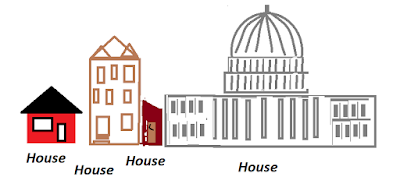
Here are a few online resources to build and polish your vocabulary.
Merriam-Webster: free dictionary and thesaurus from a leading dictionary publisher. The site has lots more, including games and a featured Word of the Day (today's is "heterodox"). Subscribe to get the word of the day sent to your inbox. A blog post today discussed several words that were used during the impeachment hearings this week, such as "nefarious," "smear," and "kneecapping."
Wordnik: online dictionary with definitions from many sources. You can create lists and add comments to words (even words that aren't yet defined!). And you can subscribe to a word of the day
(today's is "ingesta," which appeals to me for some reason).
Vocabulary.com: an online dictionary with multiple-choice quizzes to help you learn words. I have the app on my phone and sometimes play the game for a few minutes here and there. If you sign up you can accrue points and win "badges" for different achievements. It's satisfying to have a perfect round! (See this post.)
Garner's Usage Tip of the Day & LawProse Lessons. You can use Garner's Modern English Usage as a reference (highly recommended), read it cover to cover, or leaf through it and read what grabs you. This email subscription gives you a quick lesson each day—considerably less daunting than reading the whole book. (Today's usage tip discussed "brake" and "break.")
Graphic: mw
Even if you have one word that will get the job done, it's always useful to have a wider vocabulary so that you can get the job done a little better (or understand someone else's writing or speech a little better).

Here are a few online resources to build and polish your vocabulary.
Merriam-Webster: free dictionary and thesaurus from a leading dictionary publisher. The site has lots more, including games and a featured Word of the Day (today's is "heterodox"). Subscribe to get the word of the day sent to your inbox. A blog post today discussed several words that were used during the impeachment hearings this week, such as "nefarious," "smear," and "kneecapping."
Wordnik: online dictionary with definitions from many sources. You can create lists and add comments to words (even words that aren't yet defined!). And you can subscribe to a word of the day
(today's is "ingesta," which appeals to me for some reason).
Vocabulary.com: an online dictionary with multiple-choice quizzes to help you learn words. I have the app on my phone and sometimes play the game for a few minutes here and there. If you sign up you can accrue points and win "badges" for different achievements. It's satisfying to have a perfect round! (See this post.)
Garner's Usage Tip of the Day & LawProse Lessons. You can use Garner's Modern English Usage as a reference (highly recommended), read it cover to cover, or leaf through it and read what grabs you. This email subscription gives you a quick lesson each day—considerably less daunting than reading the whole book. (Today's usage tip discussed "brake" and "break.")
Graphic: mw
Friday, November 1, 2019
Celebrate LGBT History Month All Year Long
While yesterday was Halloween, it was also the last day of Lesbian, Gay, Bisexual, and Transgender (LGBT) History Month. However, that should not stop you from celebrating LGBT history all year long.
The University of Washington has several resources to help students learn about LGBT history. One is the LGBT Studies database, which contains hundreds of videos and thousands of books. One interesting item is American Experience: Stonewall Uprising, which interviews different members who took part in the Stonewall Riots in 1969.
If midterms and term papers have you avoiding all unnecessary database research, there are plenty of alternatives. Podcasts include Making Gay History Podcast and the PRIDE podcast, hosted by Levi Chambers. If current events are more your speed, try the humorous and irreverent Throwing Shade.
If midterms and term papers have you avoiding all unnecessary database research, there are plenty of alternatives. Podcasts include Making Gay History Podcast and the PRIDE podcast, hosted by Levi Chambers. If current events are more your speed, try the humorous and irreverent Throwing Shade.
But why just read and listen to histories when you can make your own history! The Human Rights Campaign, ACLU, and Lambda Legal all advocate and litigate LGBT rights nationally. Gay City and Legal Voice also provide resources and advocacy in the Seattle community. On campus, the UW Q Center, which provides mentorship, educational programming, and resources. What makes the Q Center particularly interesting is the Marsha P. Johnson Memorial Library, with over a thousand books, magazines, and films. All members can access the library by registering in person at the HUB, Room 315, and may check out items with their Husky Card.
Do not let October’s close slow you down from celebrating the rich, vibrant history of the LGBT community year-round!
 |
| Attendee at the Women's March in January 2018. photo credit: Elyssa Fahndrich on Unsplash |
Tuesday, October 29, 2019
90 Years Since #BlackTuesday
October 29, 1929, became known as Black Tuesday because of the shocking stock market crash that began that day; the market wouldn't reach its lowest point until July 8, 1932. HistoryLink.org, an online encyclopedia of Washington history, gives us includesnotes about the experience in Seattle and King County.
One of many consequences of the Crash was increased regulation of the securities markets, via the Securities Act of 1933 and the Securities Exchange Act of 1934, which created the Securities and Exchange Commission. Find these two laws and others at Investor.gov, a website aimed at the public.
The Securities and Exchange Commission Historical Society is an online museum. I've enjoyed sampling items from the Film, Radio and Television page.
If you'd like to explore legislative histories, government reports, and commentary, visit the Economic Reform section of HeinOnline's collection, Taxation & Economic Reform in America Parts I & II.
 |
| Crowd outside the New York Stock Exchange following the crash of 1929. Library of Congress Item 989471695 |
One of many consequences of the Crash was increased regulation of the securities markets, via the Securities Act of 1933 and the Securities Exchange Act of 1934, which created the Securities and Exchange Commission. Find these two laws and others at Investor.gov, a website aimed at the public.
The Securities and Exchange Commission Historical Society is an online museum. I've enjoyed sampling items from the Film, Radio and Television page.
If you'd like to explore legislative histories, government reports, and commentary, visit the Economic Reform section of HeinOnline's collection, Taxation & Economic Reform in America Parts I & II.
Subscribe to:
Posts (Atom)