
Sunday, February 5, 2017
Keeping up with Washington v. Trump
Washington State's case challenging President Trump's executive order banning travel by people from seven predominantly Muslim countries is moving fast. If you'd like to catch up and read some of the news coverage and court documents, see the Washington v. Trump page in our Presidential Power guide.


Friday, February 3, 2017
ACLU Papers Now Available Online
With the ACLU in the news recently and likely for the foreseeable future, you might be interested to learn more about the organization's history.
Papers from the collection of the American Civil Liberties Union are now available to researchers through a database provided by GaleCengage. American Civil Liberties Union Papers, 1912-1990 [UW Restricted], a collection of clippings, client and member correspondence, case files, legal briefs, and administrative documents, will be interesting to law students who want to dig deeper into the history of some of the most-studied constitutional law cases of the 20th century.

Papers from the collection of the American Civil Liberties Union are now available to researchers through a database provided by GaleCengage. American Civil Liberties Union Papers, 1912-1990 [UW Restricted], a collection of clippings, client and member correspondence, case files, legal briefs, and administrative documents, will be interesting to law students who want to dig deeper into the history of some of the most-studied constitutional law cases of the 20th century.

Sunday, January 15, 2017
Old News! Female Clerks in Treasury!
The Library of Congress jointly sponsors a historic newspaper database. Get your old news for the years 1789 through 1924. Free.

(Washington Territory)
Describing the general public's first impression of events adds another dimension to legal scholarship. Newspapers give context to events like reluctant progress in women's employment rights. Newspaper accounts also help complete the picture of the fourth branch of government's influence.
Available in old news: summaries of major historic cases, accounts of historic elections, reports of speeches from important figures, interpretations of economic developments, enthusiasm for then-new inventions. There are 318,605 results for pages published in Washington state.
This database has advanced search options: proximity terms, phrase searching, and Boolean logic. A researcher can limit by year or date range (m/d/y – m/d/y). Other limiters include publication location, newspaper title, and front page only/specific page.
Thursday, January 12, 2017
Preventing Nepotism in the Federal Civil Service
A June 2016 report by the U.S. Merit Systems Protection Board dealt with a very timely topic.
 Preventing Nepotism in the Federal Civil Service deals with criminal laws prohibiting nepotism in titles 5 and 18 of the U.S. Code, specifically:

The report analyzes these statutes and discusses significant cases under these laws.
For more information on how these laws might affect the incoming administration, here are just a few items from the Internet:
- Donald Trump's "First Attempt to Ignore the Law," Washington Post, Jan. 10, 2017
- Why Anti-Nepotism Law Might Not Apply to Kushner Appointment, New York Post, Jan. 10, 2017
- Some Thoughts on Jared Kushner and the Anti-Nepotism Law, Notice & Comment, Nov. 20, 2016
- No Consensus on Anti-Nepotism Law and Jared Kushner Appointment, Washington Post, Jan. 10, 2017
And for a historical take, see Presidential Nepotism Debate Goes Back to the Founders' Time, National Constitution Center Blog, Nov. 21, 2016
Tuesday, January 10, 2017
Presidential Power: Timely Course and Guide

Professors Knudsen and Watts couldn't let everyone into the class, but they could ask the library to help them share their reading list. Our new Presidential Power guide opens up their course readings to anyone who's interested, along with a few additional resources that will be useful to people studying the topic.
Graphic: Presidential Seal from Wikipedia
Monday, January 9, 2017
More for the Minimum
Although we are in the doldrums of winter, Washington workers can expect a little more silver lining their pockets this year. Washington's new minimum wage law went into effect on January 1, 2017, raising wages from $9.47 to $11.00. This increase was a result of Initiative 1433 which passed with over 57% of the vote in November. The law provides for a gradual increase to $13.50 by 2021, then there will be a yearly cost of living adjustment based on the National Consumer Price Index for Urban Wage Earners and Clerical Workers (CPI-W).

The City of Seattle guarantees even higher wages for workers. Minimum wage for Seattle is based primarily on two factors: size of the company and whether the employer pays towards medical benefits. For example, a worker at a company with over 500 employees where the employer does not contribute $2 towards medical benefits will earn $15/hr in 2017. This is one of the highest minimum wages in the country; but is it enough? Many argue it's not even close, while others predict dire consequences with high minimum wages. How did we get here and has anything changed in the last 80 years since the first minimum wage?

The City of Seattle guarantees even higher wages for workers. Minimum wage for Seattle is based primarily on two factors: size of the company and whether the employer pays towards medical benefits. For example, a worker at a company with over 500 employees where the employer does not contribute $2 towards medical benefits will earn $15/hr in 2017. This is one of the highest minimum wages in the country; but is it enough? Many argue it's not even close, while others predict dire consequences with high minimum wages. How did we get here and has anything changed in the last 80 years since the first minimum wage?
Social Justice Organizations; Campus Speech Discussion
Tomorrow afternoon Prof. Ron Collins is hosting Speech and Counter Speech: Rights & Responsibilities. Sponsored by the UW's Race & Equity Initiative, the discussion will feature Nadine Strossen, a professor from New York Law School and long-time president of the ACLU, and Michele Storms, assistant director of the ACLU of Washington, formerly assistant dean here at UW Law.
To complement the program, Prof. Collins asked the library to compile a selected list of local social justice organizations. Some of the organizations, like the ACLU of Washington, Legal Voice, and the Northwest Immigrant Rights Project, use the tools of the law to further their missions. Others are more grassroots. We hope the list will be useful to the campus community.
To complement the program, Prof. Collins asked the library to compile a selected list of local social justice organizations. Some of the organizations, like the ACLU of Washington, Legal Voice, and the Northwest Immigrant Rights Project, use the tools of the law to further their missions. Others are more grassroots. We hope the list will be useful to the campus community.
Speech & Counter Speech: Rights & Responsibilities
Tuesday, Jan. 10, 2017, 4-6 pm
Light refreshments 4-4:30
Program 4:30-6
wǝɫǝbʔaltxʷ – Intellectual House
Thursday, December 29, 2016
Prof. Ziff Reflects on The Bluebook
 Maybe you're a little scared of The Bluebook. Nothing to be ashamed of: lots of people are.
But you can conquer your fear. One step toward that might be understanding it better. To that end, check out David Ziff's thoughtful (and entertaining!) review essay, The Worst System of Citation Except for All the Others, forthcoming in the Journal of Legal Education.
One of the authors of The Complete Legal Writer blog gave Prof. Ziff's review a big thumbs up yesterday. She also insightfully observed:
I’d argue that the hardest part of learning legal citation is not mastering The Bluebook, not learning the italics and the abbreviations and the periods. Rather, it’s learning the judgment required to know what to cite, and when, and for what purpose. After all, as a system of communication that is built upon precedent, legal writing in the Anglo-American legal system depends on citation in ways that other fields do not and never will. Citation is integral to how our meaning gets made.Amen to that. Sure, you need to figure out the rules for citing law review articles, treatises, cases, and the rest. But that's just a matter of looking up the rules and following examples. The harder task if figuring out when to cite a law review article, a treatise, or a case.
For some help with The Bluebook, check out our guide, Bluebook 101.
Graphic by Mary Whisner
Law Professors & Other Law School Folks Meet in SF
The Association of American Law Schools is the professional association for law teachers and administrators. It's been around a long time: next week (Jan. 3-7) it hold its 111th annual meeting, in San Francisco, led by this year's president, Dean Kellye Y. Testy of UW Law.
UW Law activities at the meeting include:
UW Law activities at the meeting include:
- Helen A. Anderson, William S. Bailey, Benjamin S. Halasz, and Kathleen McGinnis will speak on experiential learning in legal writing programs.
- Jennifer S. Fan will speak on corporate venture capital; Prof. Fan is also participating in a discussion on why transactional law matters.
- Anita K. Krug is the chair-elect of the Section on Securities Regulation.
- Aline Carton Listfjeld and Hugh Spitzer will participate in a discussion on leadership in the law school curriculum.
- Emily McReynolds will speak on a panel about using technology to increase access to justice and law school engagement. Michele Storms, now at the ACLU of Washington, will moderate that panel; she's finishing up her term as chair-elect of the Section on Pro-Bono and Public Service Opportunities.
- Peter Nicolas will speak on LGBT legal issues after Obergefell.
- Dean Testy is all over the meeting in her role as president. She's also speaking on a panel on the future of corporate governance.
Wednesday, December 21, 2016
Indian Fishing in the Northwest
Some members of the Yakama Nation still fish for salmon using traditional 30-foot-long dip nets at Lyle Falls in the Columbia River Gorge (KUOW, Dec. 16, 2016). To learn more about that history, check out a book coauthored by Prof. Bill Rodgers that chronicles the legal battles around the centuries-old Indian fishery at Celilo Falls, lost when a dam destroyed the waterfall:
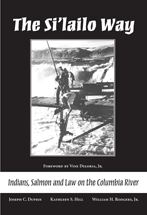 The Si'lailo Way: Indians, Salmon and Law on the Columbia River, by Joseph C. Dupris, Kathleen S. Hill &William H. Rodgers Jr. See publisher's page.
For more on fishing controversies in the Northwest, see:
Messages from Frank's Landing: A Story of Salmon, Treaties, and the Indian Way, by Charles F. Wilkinson (2000)
Where the Salmon Run: The Life and Legacy of Billy Frank Jr. , by Trova Heffernan (2012)
Empty Nets: Indians, Dams, and the Columbia River, by Roberta Ulrich (1999) The nature of borders : salmon, boundaries, and bandits on the Salish Sea, by Lissa K. Wadewitz (2012)
You can also stream a documentary through UW Libraries subscriptions: River People: Behind the Case of David Sohappy (1991)

For more on fishing controversies in the Northwest, see:
Messages from Frank's Landing: A Story of Salmon, Treaties, and the Indian Way, by Charles F. Wilkinson (2000)
Where the Salmon Run: The Life and Legacy of Billy Frank Jr. , by Trova Heffernan (2012)
Empty Nets: Indians, Dams, and the Columbia River, by Roberta Ulrich (1999) The nature of borders : salmon, boundaries, and bandits on the Salish Sea, by Lissa K. Wadewitz (2012)
You can also stream a documentary through UW Libraries subscriptions: River People: Behind the Case of David Sohappy (1991)
Friday, December 16, 2016
Interim and Holiday Library Hours
Fall Quarter ends today, December 16. Winter Quarter begins Tuesday, January 3.
The library is on interim hours between now and January 3. This means that the library will be closed on the weekends and Monday, and open 8-5 Tuesday to Friday.
Please visit our hours page for more information.
Tuesday, December 13, 2016
A bruised Georgia Peach: the legal and ethical concerns surrounding football players' health
The Huskies are going to the Peach Bowl! As a long time sports fan, I find this a very exciting time to be in the Seattle area. Football to me is family, either bundled up and braving the cold to witness a game in person or gathered around the television, enjoying warm chili from the comforts of home.

But recent revelations in the medical community regarding players' health and well-being have raised ethical and legal considerations around the sport I love. You may have seen the Will Smith driven biopic Concussion this time last year, or noticed the Congressional hearings held this past March.

But recent revelations in the medical community regarding players' health and well-being have raised ethical and legal considerations around the sport I love. You may have seen the Will Smith driven biopic Concussion this time last year, or noticed the Congressional hearings held this past March.
Wednesday, November 30, 2016
Mark Twain's Birthday, Huckleberry Finn, IP, and the Nevada Constitution
Mark Twain (Nov. 30, 1835—April 21, 1910) was a prolific writer and social critic. This blog post from HeinOnline in honor of his birthday shows how to find Twain references in HeinOnline's vast resources. It also mentions a book published by Hein: Mark Twain vs. Lawyers, Lawmakers, and Lawbreakers: Humorous Observations (Kenneth Bresler ed. 2014).
A number of the recent law review articles discuss Twain in the context of race and education. What does it do to children of color and to white children to tell them that Huckleberry Finn is a literary classic? Is the book racist? How should it be taught? Should it be taught?
 |
| Samuel L. Clemens (Mark Twain) postage stamp, 1940. Hi-res scan of postage stamp by Gwillhickers. Wikipedia. |
Toni Morrison said her 8th grade experience with the book "provoked a feeling I can only describe now as muffled rage, as though appreciation of the work required my complicity in and sanction of something shaming." Ernest Hemingway praised the book so highly that he claimed "all modern American literature comes from Huckleberry Finn."Sharon E. Rush, Emotional Segregation: Huckleberry Finn in the Modern Classroom, 36 U. Mich. J.L. Reform 305, 305-06 (2003) (footnotes omitted). That juxtaposition of comments from two American Nobel laureates sums up the conflict. For further discussion, see:
Thursday, November 17, 2016
The Electoral College and its Possible Alternatives
You may have heard that Donald Trump won the Electoral College on Tuesday, but most likely lost the national popular vote. It is the fifth time in history that this has happened. This has sparked a renewed interest in the merits of the electoral college and possible alternatives to it. For example, see this November 17, 2016 NPR article.
You might not know how the Electoral College works. Article II, Section 1 of the United States Constitution requires each state to appoint a number of electors equal to that state’s congressional delegation. The state can appoint those electors however it sees fit. When a person votes for president, she is not actually voting for the president. Instead, she is voting for the electors chosen by the state that she voted in. Those electors then vote for president, overwhelmingly voting according to the popular vote of the state that they represent. If you want to know more about electors, you might find this National Archives site helpful.
Some have expressed dissatisfaction with the Electoral College and have made efforts to align it more closely with the popular vote. One approach would be to amend the constitution to remove the Electoral College. This would be very difficult, as Article Five of the United States Constitution requires 3/4 of the states to ratify any amendment. The process is so onerous that Justice Antonin Scalia once listed it as the one thing that he would change about the United States Constitution in a C-Span interview. With that said, attempts at amendment are not unheard of. This CQ Almanac article recounts a 1969 attempt to replace the Electoral College with a plurality system with a runoff for elections in which no candidate received 40% of the vote that passed the house but failed to pass the Senate.
Barring a constitutional amendment, any change in the system will occur at the state level. Two states, Nebraska and Maine, divide their electoral votes proportionately, with the state winner receiving two electors and the winner of each congressional district receiving one elector.
A third option is the National Popular Vote Interstate Compact, discussed by its founders here. Article 1, Section 10 of the United States Constitution allows states to enter agreements or compacts with other states so long as they have Congressional approval. The Court has deemed congressional approval necessary when those agreements increase the power of the states at the expense of the federal government (Virginia v. Tennessee, 148 U.S. 503 (1893)). The Compact would require each member state to allocate its electoral votes according to the national popular vote, rather than the popular vote of their state. The Compact would not become binding until states containing 270 electoral votes had joined. Currently only states representing 168 Electoral Votes have joined the compact.
Efforts to challenge the Electoral College are almost as old as the College itself, and these new attempts are unlikely to succeed on a national level given the increasingly partisan nature of the electoral college debate, as discussed here on FiveThirtyEight. Still, it is worth thinking about these sorts of institutions and what sort of alternatives may exist to them.
You might not know how the Electoral College works. Article II, Section 1 of the United States Constitution requires each state to appoint a number of electors equal to that state’s congressional delegation. The state can appoint those electors however it sees fit. When a person votes for president, she is not actually voting for the president. Instead, she is voting for the electors chosen by the state that she voted in. Those electors then vote for president, overwhelmingly voting according to the popular vote of the state that they represent. If you want to know more about electors, you might find this National Archives site helpful.
Some have expressed dissatisfaction with the Electoral College and have made efforts to align it more closely with the popular vote. One approach would be to amend the constitution to remove the Electoral College. This would be very difficult, as Article Five of the United States Constitution requires 3/4 of the states to ratify any amendment. The process is so onerous that Justice Antonin Scalia once listed it as the one thing that he would change about the United States Constitution in a C-Span interview. With that said, attempts at amendment are not unheard of. This CQ Almanac article recounts a 1969 attempt to replace the Electoral College with a plurality system with a runoff for elections in which no candidate received 40% of the vote that passed the house but failed to pass the Senate.
Barring a constitutional amendment, any change in the system will occur at the state level. Two states, Nebraska and Maine, divide their electoral votes proportionately, with the state winner receiving two electors and the winner of each congressional district receiving one elector.
A third option is the National Popular Vote Interstate Compact, discussed by its founders here. Article 1, Section 10 of the United States Constitution allows states to enter agreements or compacts with other states so long as they have Congressional approval. The Court has deemed congressional approval necessary when those agreements increase the power of the states at the expense of the federal government (Virginia v. Tennessee, 148 U.S. 503 (1893)). The Compact would require each member state to allocate its electoral votes according to the national popular vote, rather than the popular vote of their state. The Compact would not become binding until states containing 270 electoral votes had joined. Currently only states representing 168 Electoral Votes have joined the compact.
Efforts to challenge the Electoral College are almost as old as the College itself, and these new attempts are unlikely to succeed on a national level given the increasingly partisan nature of the electoral college debate, as discussed here on FiveThirtyEight. Still, it is worth thinking about these sorts of institutions and what sort of alternatives may exist to them.
Wednesday, November 9, 2016
Presidential Clemency
You might have heard: Obama Commutes Sentences For 72 More Federal Inmates, All Things Considered, NPR, Nov. 5, 2016. But you might be a little shaky on the whole commutation thing. Is Obama's action unusual? What's the difference between commutation and pardon? How does it all work?
President Obama has commuted more sentences than all the presidents since Truman, combined.
President Obama has commuted more sentences than all the presidents since Truman, combined.
 |
| Graph comparing commutations by 12 presidents. Source: https://www.whitehouse.gov/issues/clemency |
Wednesday, September 28, 2016
A Public Reading of the U.S. Constitution
 For the eleventh year in a row, the UW Suzzallo & Allen Libraries are hosting a campus-wide, 75-minute public reading of the U.S.Constitution. Please consider joining in as a reader (of just a few sentences)
or as a listener. It’s inspirational and educational, solemn yet spirited. No
need to stay for the entire event – you may come and go as need be. Readers and
listeners alike are also welcome to take a small, folding pocket Constitution.
For the eleventh year in a row, the UW Suzzallo & Allen Libraries are hosting a campus-wide, 75-minute public reading of the U.S.Constitution. Please consider joining in as a reader (of just a few sentences)
or as a listener. It’s inspirational and educational, solemn yet spirited. No
need to stay for the entire event – you may come and go as need be. Readers and
listeners alike are also welcome to take a small, folding pocket Constitution.What: Constitution Read-Aloud.
When: Friday, October 7, 2016, 12:00 - 1:15pm.
Where: Outside the Suzzallo Library Main Reading Room (3rd Floor).
Sign up to read here!
Monday, September 26, 2016
In Memoriam: Professor Marjorie Rombauer, 1929 - 2016
Professor Marjorie D. Rombauer, who served on the UW Law faculty for 30 years, died on Friday. She was widely heralded as the "Mother of the Field of Legal Writing Education."

Prof. Rombauer was a Husky through and through. She earned both her B.A. and her J.D. at the University of Washington and spent her entire professional career here. She began working at UW Law as an instructor, hired for a single year. But her appointment was renewed several times and she moved up the ladder until she became the first female tenured faculty member *. She was the Acting Dean in 1991, again the first woman to hold that position.
Her book on Legal Problem Solving: Analysis, Research, and Writing was the first of its kind, written at a time before most law schools even offered courses on those subjects. She published the first edition locally, after West Publishing declined to publish it because they didn't believe there was a market for books on that topic. West, however, went on to publish the book from the 2d through the 5th editions.
Among her other contributions were serving on the Washington Law Revision Commission for ten years and writing more books and articles (including three editions of Legal Writing in a Nutshell). Her efforts were recognized with awards and honors from organizations such as the Association of American Law Schools, Association of Legal Writing Directors, UW Law, and the Washington State Bar Association.
You can learn more about Prof. Rombauer at the Law Library's memorial page.
* Note: Prof. Rombauer was the first tenured woman on the teaching faculty. The first tenured woman at the University of Washington School of Law in any capacity was Marian Gould Gallagher, who served as director of the Law Library.
Wednesday, September 21, 2016
Slips of the Pen in the Constitution
Have you ever wondered about the scribe who wrote out the famous parchment copy of the Constitution? It was a Jacob Shallus, assistant clerk of the Pennsylvania legislature, who had a weekend to make a good copy of what the Constitutional Convention had hammered out. It was a hard weekend's work, with quill pens and no spellcheck.
Jacob Shallus, being only human, made a few mistakes. He corrected many of them with insertions. Sometimes he scraped the ink off the parchment to make a change (a bit more laborious than the ctrl-x I routinely employ).
After the handwritten copy, there were a number of privately printed versions, which had their own variants. In 1847, 60 years after the Constitutional Convention, there was finally a printed Consitution certified by the Secretary of State (James Buchanan) to be "correct, in text, letter, & punctuation."
You can read more in Henry Bain, Errors in the Constitution—Typographical and Congressional, Prologue (the magazine of the National Archives), Fall 2012.
Hat tip to Orin Kerr (@OrinKerr) who tweeted the link on Sept. 18. Like Prof. Kerr, we don't think that celebrations of the Constitution should be limited to Constitution Day (Sept. 17). We hope you enjoyed living under the Constitution on Sunday and continue to value our founding document.
 |
| Constitution, from National Archives |
After the handwritten copy, there were a number of privately printed versions, which had their own variants. In 1847, 60 years after the Constitutional Convention, there was finally a printed Consitution certified by the Secretary of State (James Buchanan) to be "correct, in text, letter, & punctuation."
You can read more in Henry Bain, Errors in the Constitution—Typographical and Congressional, Prologue (the magazine of the National Archives), Fall 2012.
Hat tip to Orin Kerr (@OrinKerr) who tweeted the link on Sept. 18. Like Prof. Kerr, we don't think that celebrations of the Constitution should be limited to Constitution Day (Sept. 17). We hope you enjoyed living under the Constitution on Sunday and continue to value our founding document.
Tuesday, September 13, 2016
Roald Dahl in the law
Author Roald Dahl was born 100 years ago today. To learn more about the author and his work, check out the official Roald Dahl website.


In 1965 an elementary school student wrote to Dahl's literary agent asking for permission for her sixth grade class to put on a play based on Charlie and the Chocolate Factory. The agent's stuffy reply led to a marvelous response by their attorney, who took the case pro bono ("as a matter of principle, and in no snese because my daughter sits in the third row center"). See Re: Charlie and the Chocolate Factory, 14 Green Bag 2d. 171 (2011).
See also Sarah Segal, Note, Keeping It in the Kitchen: An Analysis of Intellectual Property Protection Through Trade Secrets in the Restaurant Industry, 37 Cardozo L. Rev. 1534 (2016), which begins with a discussion of Willy Wonka's fierce protection of his secret recipes.
Thursday, September 8, 2016
Star Trek Turns 50: #LLAP50
Since today marks the 50th anniversary of Star Trek, I took a few minutes to check out Star Trek scholarship on HeinOnline. You might be surprised that there's a fair amount. See, e.g.:
John G. Browning, To Boldly Go Where Few Judges Have Gone before: How the Bench Is Using a Pop-Culture Sci-Fi Classic to Explain Its Decisions, 76 Tex. B.J. 765 (2013)
Paul Joseph & Sharon Carton, The Law of the Federation: Images of Law, Lawyers, and the Legal System in Star Trek, the Next Generation, 24 U. Tol. L. Rev. 43 (1992)
Richard J. Peltz, On a Wagon Train to Afghanistan: Limitations on Star Trek's Prime Directive,
25 UALR L. Rev. 635 (2003)
Lawrence D. Roberts, The Interstellar Relations of the Federation: International Law and Star Trek - The Next Generation, , 25 U. Tol. L. Rev. 577 (1994)
Thomas C. Wingfield, Lillich on Interstellar Law: U.S. Naval Regulations, Star Trek, and the Use of Force in Space, 46 S.D. L. Rev. 72 (2001)
What are the property rights of a global entertainment franchise like Star Trek or Harry Potter? See Kathy Bowrey, The New Intellectual Property: Celebrity, Fans and the Properties of the Entertainment Franchise, 20 Griffith L. Rev. 188 (2011)
And if you read French, see:
Fabrice Defferrard, Star Trek: Paradigme Juridique et Laboratoire du Droit
45 Rev. Gen. 613 (2015)
We librarians can't beam you up from a sticky situation or pilot a starship at warp speed. But we do provide you with lots of great resources (like HeinOnline) and we can help you explore the information universe.
(The hash tag #LLAP50 evokes to the classic salutation "Live long and prosper."
 |
| Star Trek 50 logo from StarTrek.com |
John G. Browning, To Boldly Go Where Few Judges Have Gone before: How the Bench Is Using a Pop-Culture Sci-Fi Classic to Explain Its Decisions, 76 Tex. B.J. 765 (2013)
Paul Joseph & Sharon Carton, The Law of the Federation: Images of Law, Lawyers, and the Legal System in Star Trek, the Next Generation, 24 U. Tol. L. Rev. 43 (1992)
Richard J. Peltz, On a Wagon Train to Afghanistan: Limitations on Star Trek's Prime Directive,
25 UALR L. Rev. 635 (2003)
Lawrence D. Roberts, The Interstellar Relations of the Federation: International Law and Star Trek - The Next Generation, , 25 U. Tol. L. Rev. 577 (1994)
Thomas C. Wingfield, Lillich on Interstellar Law: U.S. Naval Regulations, Star Trek, and the Use of Force in Space, 46 S.D. L. Rev. 72 (2001)
What are the property rights of a global entertainment franchise like Star Trek or Harry Potter? See Kathy Bowrey, The New Intellectual Property: Celebrity, Fans and the Properties of the Entertainment Franchise, 20 Griffith L. Rev. 188 (2011)
And if you read French, see:
Fabrice Defferrard, Star Trek: Paradigme Juridique et Laboratoire du Droit
45 Rev. Gen. 613 (2015)
We librarians can't beam you up from a sticky situation or pilot a starship at warp speed. But we do provide you with lots of great resources (like HeinOnline) and we can help you explore the information universe.
(The hash tag #LLAP50 evokes to the classic salutation "Live long and prosper."
Tuesday, September 6, 2016
Keeping up is hard to do. The library can help!
Keeping up with new developments in law (and related fields) might be hard, but we have lots of tools to help. To learn about them, see our guide, Staying Current.
This summer we set up "GallagherFYI" lists to help us send out current awareness items to groups of people. We have lists for children's issues, criminal justice, environmental law, health law, IP and technology, international development, legal profession, social justice, and writing.
The lists aren't meant to be comprehensive; they're just a convenient way for us to share information that we think will be interesting and useful to you. Each message is clearly labeled with the list name--e.g., [GallagherFYI-SocialJustice]--to help you triage your inbox. If you're interested, we'll be happy to subscribe you.
This summer we set up "GallagherFYI" lists to help us send out current awareness items to groups of people. We have lists for children's issues, criminal justice, environmental law, health law, IP and technology, international development, legal profession, social justice, and writing.
The lists aren't meant to be comprehensive; they're just a convenient way for us to share information that we think will be interesting and useful to you. Each message is clearly labeled with the list name--e.g., [GallagherFYI-SocialJustice]--to help you triage your inbox. If you're interested, we'll be happy to subscribe you.
Wednesday, August 31, 2016
Justice Charles Z. Smith Memorial Page
Former Justice of the Washington State Supreme Court, Charles Z. Smith passed away on August 29,2016.

During his long and distinguished career Justice Smith worked as a Superior Court judge, a prosecuting attorney, and professor and associate dean of the University of Washington School of Law.
Learn more about Justice Smith at the Gallagher Law Library's memorial page.

During his long and distinguished career Justice Smith worked as a Superior Court judge, a prosecuting attorney, and professor and associate dean of the University of Washington School of Law.
Learn more about Justice Smith at the Gallagher Law Library's memorial page.
Monday, August 15, 2016
Of Local Interest: Justice Department Report on the Seattle Police Department
Actually, it is a report submitted by three academics and a member of the Police Foundation. The report is called:
Promoting Officer Integrity Through Early Engagements and Procedural Justice in the Seattle Police Department (May 2016, 149 pages).
From the abstract:


Promoting Officer Integrity Through Early Engagements and Procedural Justice in the Seattle Police Department (May 2016, 149 pages).
From the abstract:


Sunday, August 14, 2016
Miranda at 50
Marking Miranda v. Arizona's anniversary, ABAJournal.com has a slideshow, 50 Years of Miranda in Popular Culture, compiled by Brenan Sharp.
For an overview, see the pages on Miranda in the U.S. Courts' materials for schools.
Here are some of our recent books on confessions:
How could you choose which law review articles to start with?
Here's a neat trick in HeinOnline. I searched for articles with confess* in the title (the asterisk makes the search include variants, like "confessing" and "confessions"). Result: 1,207 items.
I sorted them to show the articles that have been cited the most at the top of the list.
The most cited was Developments in the Law: Confessions, 79 Harv. L. Rev. 935 (1966), a big survey (nearly 200 pages!) published in March 1966, three months before the Supreme Court decided Miranda.
Next are a couple of works looking at false confessions: Steven A. Drizin & Richard A. Leo, The Problem of False Confessions in the Post-DNA World, 82 N.C. L. Rev. 891 (2004); Richard A. Leo & Richard J. Ofshe, Consequences of False Confessions: Deprivations of Liberty and Miscarriages of Justice in the Age of Psychological Interrogation, 88 J. Crim. L. & Criminology 429 (1998).
If you want to know the latest developments, you can sort to see the most recent article first: John C. Sheldon, Common Sense and the Law of Voluntary Confessions: An Essay, 68 Me. L. Rev. 119 (2016).
Searching for "confess*" in the title was very simple. You can put together more complex searches, too. E.g., if you search for "McMurtrie" as an author and "false" within five words of "confession*" in the text, you'll find Jacqueline McMurtrie, The Role of the Social Sciences in Preventing Wrongful Convictions, 42 Am. Crim. L. Rev. 1271 (2005).
 |
| Photo collage by Brenan Sharp |
For an overview, see the pages on Miranda in the U.S. Courts' materials for schools.
Here are some of our recent books on confessions:
- Richard Rogers & Eric York Drogin, Mirandized Statements: Successfully Navigating the Legal and Psychological Issues (2014) (ABA)
- Barry C. Feld, Kids, Cops, and Confessions Inside the Interrogation Room (2012) (e-book)
- Lawrence S. Wrightsman & Mary L. Pitman, The Miranda Ruling: Its Past, Present, and Future (2012)
- Alan M. Goldstein & Naomi E. Sevin Goldstein, Evaluating Capacity to Waive Miranda Rights (2010)
- Rob Warden & Steven A. Drizin, True Stories of False Confessions (2009)
- Gary L. Stuart, Miranda: The Story of America's Right to Remain Silent (2004) (also available as e-book).
- Richard A. Leo, Police Interrogation and American Justice (2008) (also available as e-book)
How could you choose which law review articles to start with?
Here's a neat trick in HeinOnline. I searched for articles with confess* in the title (the asterisk makes the search include variants, like "confessing" and "confessions"). Result: 1,207 items.
I sorted them to show the articles that have been cited the most at the top of the list.
The most cited was Developments in the Law: Confessions, 79 Harv. L. Rev. 935 (1966), a big survey (nearly 200 pages!) published in March 1966, three months before the Supreme Court decided Miranda.
Next are a couple of works looking at false confessions: Steven A. Drizin & Richard A. Leo, The Problem of False Confessions in the Post-DNA World, 82 N.C. L. Rev. 891 (2004); Richard A. Leo & Richard J. Ofshe, Consequences of False Confessions: Deprivations of Liberty and Miscarriages of Justice in the Age of Psychological Interrogation, 88 J. Crim. L. & Criminology 429 (1998).
If you want to know the latest developments, you can sort to see the most recent article first: John C. Sheldon, Common Sense and the Law of Voluntary Confessions: An Essay, 68 Me. L. Rev. 119 (2016).
Searching for "confess*" in the title was very simple. You can put together more complex searches, too. E.g., if you search for "McMurtrie" as an author and "false" within five words of "confession*" in the text, you'll find Jacqueline McMurtrie, The Role of the Social Sciences in Preventing Wrongful Convictions, 42 Am. Crim. L. Rev. 1271 (2005).
Monday, August 1, 2016
Interactive Online Exhibits on U.S. Presidential Elections
The National Archives and Records Administration has teamed up with Google to present 13 online exhibits on U.S. Presidential elections in Google Arts & Culture.

According to a NARA blog post:
Other exhibits in this collection include:

According to a NARA blog post:
These specially curated exhibits feature historic photos, documents, videos, and stories related to the history and evolution of elections, how we amend the Constitution, political cartoons and campaign memorabilia.Those of you who just can't get enough of the Democratic and Republican political conventions might enjoy Stories from American Political Conventions. It features photos and interviews with reporters who covered the conventions.
Other exhibits in this collection include:
- Abraham Lincoln and the 1860 Election
- Every Four Years: Presidential Campaigns and the Press
- Voting and Elections in Early America
Hat tip to the ResearchBuzz blog.
Subscribe to:
Posts (Atom)