Tuesday, February 23, 2021

Diverse Voices - Social Justice Research Guides


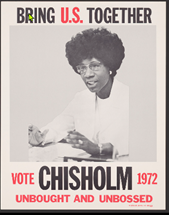
Election poster shows Black woman with headline "Bring U.S. Together." Below photo: "Vote Chisholm Unbought and Unbossed"
Presidential candidate and U.S. Rep.
Shirley Chisholm in 1972

Library research guides are always an incredible source of collected resources on a topic that you are interested in or just getting to know.

With the Web, you can access library research guides not only from your local library, but from around the world!  (Try using the Google Translate function on Chrome if you find a webpage that is not in a language you can read.)

The American Association of Libraries Research Instruction & Patron Services Special Interest Section recently created a webpage with links to research guides on diversity, equity, and inclusion and related topics.  These research guides provide information on legal and non-legal resources on anti-racism, critical studies, protest rights, social justice, and more.

Some research guides that I found useful were:

Please take a browse and see what interests you!  It’s also great to revisit the webpage periodically because research guides continue to be added as they are developed!

As we all know, people who are fortunate enough to be trained in the law have a unique ability to contribute to social change.

This post is part of the Gallagher Law Library's Diverse Voices Series for DEI Week at UW Law.

Image description: 1972 poster of presidential candidate and U.S. Representative Shirley Chisholm. 

Image from: Library of Congress Free to Use and Reuse collection (Images of African American Women Changemakers).


Monday, February 22, 2021

Diverse Voices - Databases for Social Justice Topics on HeinOnline

HeinOnline has some excellent curated collections for researchers interested in different social justice issues in American legal history. 

page of text in Cherokee alphabet
Page of Cherokee laws, in
Cherokee. The Cherokee syllabary
(not exactly an alphabet) was
developed by Sequoyah
(without using any other
writing system!) and introduced
to the Cherokee people in 1821.
Sequoyah Birthplace

Museum. The syllabary is still used.
See Cherokee Nation's Language page.


The American Indian Law Collection has thousands of documents from a variety of sources. Some are from the perspective of the federal government—the government reports, legislation, and treaties. But there are also tribal documents that Hein's editors have found, such as Acts of the Cherokee Nation from 1870-72, in Cherokee, as well as hundreds of other tribal constitutions, bylaws, and acts.  

Exploring further, you can find non-legal material, like Cry of the Thunderbird: The American Indian's Own Story, a collection edited by Charles Hamilton in 1950, and the recent collection, Why You Can't Teach United States History Without American Indians (2015).

The Civil Rights and Social Justice collection brings together scholarly articles, hearings, government reports, and briefs. Browsing the briefs, I saw many topics, including fair housing, marriage equality, affirmative action, health care, and employment discrimination. With one search you can pull up books, law review articles, briefs, and more.

Did you know that Langston Hughes wrote an illustrated history of the NAACP? I didn't. But Fight for Freedom: The Story of the NAACP (1962) is on HeinOnline!

Are you interested in slavery, which has been so important in shaping American law and society? Then make use of HeinOnline's collection, Slavery in America and the World: History, Culture & Law. Edited by legal historian Paul Finkelman, this collection has statutes, cases, scholarly articles, books (from University of North Carolina Press), and an extensive bibliography. 

cover art - Florynce "Flo" Kennedy - shows Black woman in cowboy hat and tank top, laughing


The Women and the Law collection (nicknamed Peggy, after a developer's mother) also has a wide variety of materials, from briefs to scholarly articles. It includes proceedings of a feminist legal theory conference that was held each year, 1985-2018. You can browse topics, such as abortion or suffrage. And it has a collection of biographies, from well-starched ladies from the nineteenth century to Florynce "Flo" Kennedy: The Life of a Black Feminist Radical, by Sherrie M. Randolph (2015).


Tip: When you follow a link to HeinOnline and are asked for authentication, choose Off-Campus/Remote Access. You'll want "University of Washington Gallagher Law Library," after which you'll be prompted for your UW NetID. I usually search for "gallagher" because that's faster than searching for "washington." (There's only one Gallagher in HeinOnline's list of subscribers, but there are several universities and law schools with "Washington" in their names.)


This post is part of the Gallagher Law Library’s Diverse Voices Series.


Diverse Voices Series

Presumption of Law by a Barrister &
a Lady (1891). Available from the
British Library's Flickr stream.
Leafing through a casebook or skimming a law journal, you could see a lot of upper-class white men of Northern European descent. But look again, and you might find much more diversity in the legal profession and in legal scholarship.

This week, we're going to highlight diverse voices in a series of blog posts, looking at books, databases, research guides, YouTube, and more!

Friday, February 19, 2021

Civil Liberties Day of Remembrance

Today is Civil Liberties Day of Remembrance, commemorating the anniversary of Executive Order 9066, which led to the removal and incarceration of over 110,000 Japanese Americans. 

To learn more, visit the Densho Encyclopedia, "a free and publicly accessible website that provides concise, accurate, and balanced information on many aspects of the Japanese American story during World War II." For thousands of photographs, letters, interviews, and other materials, pop over to the Densho Digital Repository. If you want to start locally, browse under Seattle. 

What happened to the hundreds of Japanese-American students at the University of Washington when the order was issued? You've probably heard of Gordon Hirabayashi, who challenged the curfew and then relocation, all the way to the Supreme Court.  (The injustice of the curfew struck him one night when he was studying late in Suzzallo Library. Why should he have to leave the library when his classmates didn't?) For more about the UW experience, see Interrupted Lives: Japanese American Students at the University of Washington, 1941-1942 from UW Libraries.

Last year's post on Civil Liberties Day of Remembrance highlighted a few books in our collection. Since Covid restrictions make it impossible to wander through the library, I updated the post to add links to ebook editions. Take a look! (One day, you'll be able to browse in the library again. We just don't know when.)

Friday, January 15, 2021

Gallagher Law Library Quarterly Newsletter (Winter 2021)

Although the Gallagher Law Library might be physically closed, librarians and library staff are still available to support you! Have a research question? Need help finding a source? Have a citation question? Have a question about your library account? Contact the Gallagher law Library! If you don't know where to start, or just want to see what the library has to offer check out our quarterly newsletter. We list some of our most recent ebooks (available for UW Community), topical blog posts, and resource guides. To help get to know our library staff, we have also included a library staff highlight section where you can read about the amazing work they are doing. This Winter 2021 edition features our very own Public Services Librarian, Mary Whisner!


This is a thumbnail picture of our Winter 2021 newsletter


Check out the full Winter 2021 newsletter here.

Missed our first newsletter? Review our Fall 2020 newsletter here. 


Want to contact us? Ask us!

Law Students

Law Faculty and Staff

UW & Seattle Community, Ask Us! or view our Library Visitors page for more information. 


Tuesday, November 24, 2020

Exam Prep Resources

Feel unready for exams? The library can help! 
little dog with big eyes looking puzzled


The Gallagher Law Library maintains an archive of exams (and some model answers) from dozens of classes and professors. All you need is this link and your UW login. Happy studying!


Photo by Michelle Tresemer on Unsplash

Thursday, October 22, 2020

United Nations Day — #UN75

This Saturday is a special UN Day: it's the 75th anniversary of the international body, which was founded as World War II was ending. The Charter was signed in June 1945, just after fighting had ceased in Europe and two months before Japan surrendered. It came into force October 24, 1945.

Graphic with white "75" against blue background. "United Nations: Shaping Our Future Together" UN.org/UN75
Graphic from UN Card.
The other half of the "card"
lists 11 UN actions, illustrating
the organization's wide
impact.

For a walk through the UN's history, visit 75 Years, 75 Documents, an online exhibit prepared by the Dag Hammarskjold Library. (Maybe you never thought about the United Nations having its own library, but it does, and it's a cool one!)

The United States has had a strong role in the United Nations, serving as a permanent member of the Security Council and hosting the headquarters in New York City.

But the relationship has sometimes had strains. Most recently, the Administration announced withdrawal from the World Health Organization, one of the UN's specialized agencies. A CRS report reviews the issues: Blyther et al., Cong. Research Serv. R46575U.S. Withdrawal from the World Health Organization: Process and Implications (Oct. 21, 2020). (Following the  Bluebook, I'd only give the publication year, but I want to show that this was published just yesterday!)

The US is the single largest financial contributor to the UN. The Administration has sought to reduce US funding. See Luisa Blanchfield, Cong. Research Serv. IF 10354, United Nations Issues: U.S. Funding to the U.N. System (March 10, 2020). 

Want to do some research? Try these databases:

Tuesday, October 20, 2020

National Day on Writing

The National Council of Teachers of English has declared October 20 the National Day on Writing "to help writers from all walks of life recognize how important writing is to their lives." Law students and lawyers might not need much of a reminder, since putting words on paper (or onto a computer screen) is one of their key activities, but why not celebrate the day anyway?

To hear a lot of interesting people talk about writing, visit Bryan Garner's LawProse website, where you can choose "Judges, Lawyers, Writers on Writing" or "Supreme Court Interviews." The first collection includes law professors, judges, and one person from outside the law—the novelist and essayist David Foster Wallace.

You can also watch Bryan Garner's Writing Lessons on YouTube.

You probably already know a lot about writing sentences, but this short video, "6 Ways to Start a Sentence" can help prepare you for Halloween (just eleven days away!) as well as help you think about, well, different ways to start a sentence.

Are you tired of watching videos on your computer screen? Yeah, me too. I think a lot of us are Zoom-weary. So why not observe this National Day on Writing by picking up a pen or pencil and writing something on paper?

3 pens on table


Wednesday, September 30, 2020

International Translation Day #ITD2020

 In honor of International Translation Day, take a look at the UW Language Learning Center's site.  I'm intrigued by the streaming video options, particularly SCOLA, a non-profit educational organization that receives and re-transmits television and radio programming from around the world in native languages.

In the section for on-demand video, you can search by language and by genre. Just for fun, I tuned in to a children's program in Farsi. I don't know any Farsi, but it was interesting to see some cute Iranian kids, puppets, a woman dressed up in colorful robes, and a cartoon. Of course, if you know another language (or are learning it), these videos would be even more interesting!

cartoon of boyriding paper airplane, sun, rainbow
Image from the opening credits of فرزندان ایران originally broadcast 3/5/20.
Google Translate tells me the title means "Children of Iran." 


Monday, September 28, 2020

Access to Information - There's a Day for That?

The United Nations has declared September 28 to be the International Day for Universal Access to Information. Even before UNESCO made that announcement in 2015, an international group has been marking International Right to Know Day since 2002. I'm afraid I've been too busy to plan a party, so let me just mark the occasion with a couple of notes about access to government information. 

The Freedom of Information Act (FOIA) gives everyone the right to request information from the federal government. The Department of Justice set up FOIA.gov as a central site to learn about FOIA procedures. 

Each agency has an Electronic Reading Room where it posts frequently requested records. So you don't have to start from scratch requesting CIA materials relating to Ethel and Julius Rosenberg  or the FBI's file about Muhammad Ali's relationship with the Nation of Islam, because they're already posted. To browse, just search for an agency name and FOIA reading room.

But what if what you want hasn't been posted already? You can submit your own FOIA request. To help you, Emily Willard from the UW's Center for Human Rights wrote How to FOIA: A Guide to Filing Freedom of Information Act Requests (2019).

In Washington, use the Public Records Act, RCW 42.56. For guidance, see Eric M. Stahl & Michael J. Killeen, Washington Open Government Guide, from the Reporters Committee for Freedom of the Press. UW users also have online access to WSBA's Public Records Act Deskbook: Washington's Public Disclosure and Open Meetings Laws (2d ed., with 2020 supp.). 

Our subscription to WSBA deskbooks is a site license, so the servers need to recognize you as a UW user. If you aren’t on campus (and most of us aren’t, these days!), use Husky OnNet. Then, on the library’s homepage, look under Selected Databases for Washington State > Deskbooks.


Wednesday, September 16, 2020

Newsletter Interview #2: Interview with Head of Public Services, Alena Wolotira


This is our latest interview in a series of UW Law School faculty and staff interviews. Each interview will be highlighted in the Gallagher Law Library's *new* Newsletter. Keep your eyes out for our new back-to-school edition coming out soon!

Interview #2 Alena Wolotira, Head of Public Services        

photo of Alena Wolotira
Alena Wolotira


Can you introduce yourself and your role as Head of Public Services at Gallagher Law Library?      

I am Alena Wolotira, Head of Public Services at Gallagher Law Library. I oversee the operations of the reference and circulation functions of the library. I supervise all of the reference librarians and am in charge of the facility. Overseeing the policies and the people of the front-facing side of the library is probably the best way to put it. 
So, how can the library help students? Has anything changed now that UW Law has gone virtual? 
There are a few things that have changed. Obviously, there isn’t the facility available. Which really stinks because our library was a really wonderful space to get work done in. It’s quiet, there’s lots of great seating. And so it’s a bummer that we don’t have that right now, but we’re going to open it up as soon as we can. 

As for the rest of our services, they’re totally the same! We’re still available to help people find information. We’re still available to get people access to books. We’ve shifted our recent collection expenditures to acquire more eBooks since the pandemic hit, so that’s great. We’re there for research help and that’s totally do-able remotely. So, that’s good, too! 


Are there specific services that would be helpful for students working on law journals?  
There are! This summer I actually started a liaison program. Basically, I reached out to all of our law journals and asked them how the library can better help them in their work. So, we’ve opened up really good channels of communication between the library and the journals. 
I’ve been doing Bluebooking office hours for when they’re in their QA Process, which is quality assurance: double checking Bluebooking citations in articles they are trying to prepare for publication. That’s been really successful! We’ve had a lot of student editors attend and try and stump me. So far, I’ve only had one or two stumpers but I’ve been able to handle everything else. I’ve also been working with them on how they can do source gathering in a remote environment. So, it’s been good!

I would also like to add that any time a student has a question about the Bluebook or source gathering, lawref is there to help them. They can just email lawref and anybody on my team would be happy to help! 

A new edition of The Bluebook came out this year. Are there any new changes or specific updates that stick out to you? 

Yeah, there are! Check out the video I made for the full scoop.. But the big ones are that you are no longer required to use the year in citations to the US Code. And then T-6 and T-13.2 have combined. Big Stuff! And the final thing is that T-2, Foreign Jurisdictions, is now online on the Bluebook’s website. 


When was the first time you used The Bluebook? How do your blue booking skills now compare?  

I first used the Bluebook when I was a 1L in LRW, or LARW is what it’s called at UW, and I found it really confusing and difficult. I pretty much had no idea what I was doing. I would write my papers and then go in with, you know, 15 minutes to spare before the deadline and quickly and inaccurately approximate what a citation should look like. Then I was on two journals later in my law school career and that’s when I really learned the beauty of the Bluebook. I came to understand that the rules are there for a reason and the point of the Bluebook is to help your reader find the source that you’re citing and evaluate the accuracy and determine whether or not the author has accurately characterized it. Uniformity in citations helps readers understand the types of sources that are being cited, and helps them easily locate the source themselves. 


So, would you say that your Bluebooking skills are a little bit sharper now, than they were then?  

Yes, definitely! After I finished law school, I also was the Bluebook editor for the Journal of Legal Education for a year. So, I did all of the work that a law student editorial team would do just by myself for that journal. I think I did three issues and that definitely sharpened my skills as well. So now, I would say… I don’t know if there is ever a Bluebook expert because there are so many rules, but I would say I’m coming close.  

The Bluebook and legal citations can be intimidating. Can you help students get used to the format and develop their own blue booking skills? 

Yes. So, we have the Bluebook 101 Guide. It is designed to help people get their training wheels and learn the underlying spirit of The Bluebook. Then, you know, librarians spend a lot more time with The Bluebook than the average student. So, we are here to help with those tougher questions.  


This month sees a new class of students entering UW Law. Is there something you wish someone told you when you were first starting law school? 

Get in a study group! Don’t be shy! I know it’s harder with the pandemic when you’re not seeing people in person, but these are difficult concepts that you’re learning. The casebook method is very confusing at the beginning because you’re learning how to to think like a lawyer. But having other people who are the same level of expertise as you to talk to, talk through concepts, bandy about the terminology, and get used to talking like a lawyer is really really beneficial. And there are a lot of studies showing that students are a lot more successful when they are able to work in student groups to get through assignments and concepts. I didn’t join a study group because I was too shy, and I had a lot of Imposter Syndrome in law school and so I didn’t want to bring anybody down with my “inferior legal mind”. And that was stupid because I could have benefitted so much from working with other people. I would even go so far as to say they could have benefitted from working with me.   


Finally, as this blog post by Mary Whisner explains, reading for fun can help folks improve their writing, stay informed and motivated on issues they find important, and bring some pleasure to their days. As a librarian, is there a book you’ve read for fun recently and would like to recommend?  
 
I recently read The Ninth House by Leigh Bardugo. It’s about, you know, all of the secret houses at Yale like “Skull and Bones”, well this imagines that there is a ninth house and that magic exists. So, the ninth house’s job is to keep all of the other houses from misusing their magic. It talks a lot about New Haven and what it’s like to be a student at Yale because the author did go to Yale. It’s fun and very dark but good. 

I’m also taking a course on anti-racism in libraries. There’s a PhD student, Samantha Hines, at Peninsula College who has put together a four week online course for Pacific Northwest librarians who are supervisors to learn more about anti-racism in a library setting. The book that’s assigned for the course is How to be an Anti-Racist (by Ibram X. Kendi).  So, I’m working my way through that. 

There’s another one I’ve read. The Last Tribe (Brad Manuel). It’s about a pandemic and a family finding each other. It’s a positive pandemic apocalypse story with a happy ending.


Is there anything else you would like to mention? 

The library is here to help. Even if you don’t know if it’s a library-appropriate question, just ask it. We’ll tell you if we can’t help you but there are a lot of ways. Librarians are resourceful! We know a lot of things about how law school works, how UW Law works, how libraries work, about the legal system. So, we can connect people with the resources they need. They just need to ask us! And it’s our favorite thing to help students!

Monday, August 17, 2020

How Law Students Are Helping During COVID-19

Illustration of Computer Screen

Illustration by Alondra Pulido


The pandemic has put a halt on many people’s lives, but legal assistance is still an essential need and numerous communities have been made vulnerable due to COVID-19. Due to these urgent needs, Law students around the country are actively providing legal research during the COVID-19 crisis. For instance, the ABA Journal reports “more than 300 law students, paralegals, and student paralegals have offered to provide remote pro-bono support for coronavirus-related matters." At the UW Law School's Entrepreneurial Law Clinic, students and advisors are working to help small businesses and non-profits find and leverage the right opportunities and application information during the pandemic. The People’s Parity Project, a national organization, even gives you a chance to volunteer for research projects via a web form!


While many of the work requires immediate assistance, clinics and faculty from law schools have also been looking ahead to long-term systemic problems and researching policy improvements. Gallagher Law Library provides an extensive collection of topics and online databases useful for research during this time. Below is a list of high-demand topics that students can learn more about by accessing the many databases and resources available from our website.


  • Wills and Estate Planning

  • Research regarding paid leave

  • Drafting bail motions

  • Immigration Needs

  • Release from Immigration custody

  • Emergency Unemployment Expansion

  • Cash Transfers

  • Paid sick leave and paid medical/caregiving leave

  • Create Know Your Rights materials

  • Support legal action and advocacy for the release of incarcerated people 


Since the COVID-19 crisis has affected so much of our daily lives—and therefore impacts legal issues—you might find some useful resources in our Law in the Time of COVID-19 guide.


Whatever you’re doing during this time—externships, pro bono work, or paid work—remember that you can still ask for research help from the library, via phone or email. Check out this page for information about online access to Bloomberg Law, Lexis, and Westlaw.


For more information on this subject check out these websites:

COVID Legal Research Natural Disaster Aid

How can Law students help in the midst of COVID-19

For some law students, clinic work during COVID-19 feels more real than ever before


Wednesday, July 29, 2020

UW Libraries Reopening Plans


Vice Provost for Digital Initiatives and Dean of University Libraries Betsy Wilson released this statement today about our current plans for reopening library facilities and in-person services. Please take a look at the full letter here:


Thursday, July 2, 2020

Newsletter Interview #1: Interview with Public Services Librarian, Mary Whisner


This is our first interview in a series of UW Law School faculty and staff interviews. Each interview will be highlighted in the Gallagher Law Library's *new* Newsletter. Our Summer 2020 edition will be coming out soon!

Interview #1 Mary Whisner, Public Services Librarian
Photo of Mary Whisner


Can you introduce yourself and your role at Gallagher Law Library?


Since 1988, I’ve been helping students, faculty, staff, and the public find information. The tools have changed, but the mission is the same. We help you find individual items and we teach you research skills you can use on your own.

Current book of choice, or book you would like to recommend?


Ijeoma Oluo, So You Want to Talk About Race -- a very accessible book addressing many important issues.

Abdi Nor Iftin, Call Me American -- a memoir by a Somali refugee


What is your favorite recreational activity or hobby during this time?


Practicing the trumpet, which I started learning several years ago. It is very humbling to take up a difficult instrument at my age--but it’s too late for me to have learned it in middle school (when I was playing the clarinet).

How have you adjusted to working as a librarian during Covid-19?

I’m used to a good bit of interaction with people, from talking to students at the Information Desk to sticking my head into a colleague’s office doorway. I miss that, but at least Zoom has enabled me to see my coworkers’ faces.


What are some ways that you stay connected with students/patrons?


I wish I had more opportunity to interact with students--answering occasional email messages isn’t the same as saying hi as they come into the library. I feel pretty well connected with faculty through email and Zoom.

Wouldn’t it be nice to share coffee at the Supreme Cup?

Can you describe Libguides and your work producing LibGuides? Specific recommendations? 


LibGuides is a platform used by all of the UW libraries (and thousands of other libraries around the world) that makes it easy to post text, links, videos, information about books, and more, in a consistent, attractive layout. Some of our LibGuides grew out of presentations for specific classes. Others help with common research tasks (like looking up the legislative history of a Washington statute). I’m proud of my Staying Current guide, because we all need to figure out efficient ways to keep up with our fields, and I think the guide can be very helpful.

One challenge with LibGuides is making sure they are up to date enough to be useful, so we have to go in to check links, look for new publications, and so on.

What are some of the more recent tutorial videos you have been working on? Are there more coming soon?


My latest video shows how to find magazine articles in University Libraries databases. I’d like to make some more to help journal students. We’re happy to take suggestions, too--readers, are there any topics you’d like to see explained?


Are there any upcoming collections/titles you would like to highlight to patrons? Or updates to collection development policies and purchases?


I’ve been working with Peggy Jarrett and Maya Swanes to select new ebooks. This is part of what libraries call “collection development” -- figuring out what should be in the library’s collection. Up until COVID, our library tended to buy books in print (in addition to our big databases, like Lexis, Westlaw, Bloomberg Law, and HeinOnline). Now that the library is closed and people can’t check out print books, we’ve been expanding our ebook collection. Ebooks are challenging, for a lot of reasons--including that they’re usually a lot more expensive than print books! This is a little surprising if you’re used to shopping as an individual when a Kindle book is cheaper than a hardback. But publishers charge a premium to license ebooks to libraries.

Do you have any remarks for law students/patrons during this time or in anticipation of the next year? 


Please remember that we’re still here for you. You can ask us questions by telephone or email. And if you’d like to talk through a problem, we can Zoom with you and share our screen so you see how we’re searching.