Yes, you read that right, recently 85,000 videos from British Pathé’s collection of historic film footage has been uploaded to
their YouTube account. British Pathé, known for its historic newsreels had digitized its collection back in 2002 and, earlier this month, has made its entire collection freely available for viewing on its four YouTube channels.
Regarding the decision to release the footage, Alastair White, General Manager of British Pathé explains “Our hope is that everyone, everywhere who has a computer will see these films and enjoy them,” and “this
archive is a treasure trove unrivalled in historical and cultural significance that should never be forgotten. Uploading the films to YouTube seemed like the best way to make sure of that.”

Tuesday, May 13, 2014


A Study in Copyright: Sherlock Holmes, Arthur Conan Doyle, and the Public Domain
 |
| Photo Credit: Wikimedia Commons |

Conan Doyle’s novels and short stories of Sherlock Holmes were
published in the United States prior to 1923.
According to copyright law, works published prior to January 1, 1923 in
the U.S. are considered to be in the public domain. However, the argument made by the Conan Doyle
estate is that the characters did not enter into the public domain because
there were ten short stories which were published after the January 1, 1923
cutoff date.
Monday, May 12, 2014
Shiny Silver Sculpture
During last week's fire drill, many evacuees gathered by the shiny silver sculpture on Parrington Lawn, south of Gates Hall.
 The Department of Forensic Morphology Annex is its name. You can read more about it to gather trivia that will amaze and entertain your friends and family.
[Photo credit: Kurt Kiefer, UW News from Across the Campus and Across the World, Columns, Mar. 2004.]
[Photo credit: Kurt Kiefer, UW News from Across the Campus and Across the World, Columns, Mar. 2004.]
Legal Research Tune-Up for Summer Employment
The Seattle University law library is offering a legal research workshop to help prepare students for summer employment or to brush up on their legal research skills. The workshop will cover state and federal legislative history, regulations, and practice materials using a problem-based approach. Students will have hands-on practice working through research scenarios. Please bring your laptop.
UW law students are invited. The workshop is free and will be held on Wednesday May 21st from 9:30 – 11:30 am in Sullivan Hall room 109. Coffee and snacks will be provided.
Please RSVP by May 19th.
If you have any questions please contact Barbara Swatt Engstrom.
Wednesday, May 7, 2014
International Response to Syrian Conflict
If you're interested in the international legal issues raised by the Syrian conflict, a great place to start is: International Responses to Syrian Conflict, Military Intervention, and Chemical Weapons. This research guide from Florida State University's law library includes arguments for and against intervention, information about the UN and international law, and information about the responses from the US and other nations.
The guide's author just won the law library publications award, nonprint division, from the American Association of Law Libraries. Congratulations, Margaret Clark!
 |
| Syrian flag, from CIA World Factbook |
The guide's author just won the law library publications award, nonprint division, from the American Association of Law Libraries. Congratulations, Margaret Clark!
Monday, May 5, 2014
Updated Education Law Research Guides
A symphony in three parts, the updated Education Law Research Guide covers:

Photo credit: blog.oxforddictionaries.com
- Primary Sources (federal and state laws and regulations)
- Secondary Sources (treatises, legal encyclopedias, journals, newsletters, and other content on Lexis Advance and Westlaw Next
- Additional Sources (government publications, nonlaw databases, statistics, and organizational websites)
Photo credit: blog.oxforddictionaries.com
Friday, May 2, 2014
Updated Korean Legal Research Guide
Korean Legal Research Guide | Online Journals | EALD
The Gallagher Law Library's Korean Legal Research Guide was extensively updated recently. Originally created by Bill McCloy in 2006, Kelly Kang and Rob Britt have collaborated on bringing it up-to-date. Ms. Kang holds an LLM degree from Indiana University's Maurer School of Law.
The KLR Guide (see link above) includes information about and access to a wide variety of Korean legal resources, both print and online. One highlight is "Online Journals," which lists the many online full-text Korean legal periodicals in English and Korean available to University of Washington researchers through subscription services such as DBPIA and KISS. The KLR Guide also includes links to the online collection of English translations of Korean law, KLRI Statutes of the Republic of Korea, and to the comprehensive Korean language legal database, Law&b.
For more information about the KLR Guide, or questions about East Asian legal research, contact Rob Britt of the Gallagher Law Library's East Asian Law Department (EALD), rrbritt@uw.edu.
The Gallagher Law Library's Korean Legal Research Guide was extensively updated recently. Originally created by Bill McCloy in 2006, Kelly Kang and Rob Britt have collaborated on bringing it up-to-date. Ms. Kang holds an LLM degree from Indiana University's Maurer School of Law.
 | ||
| Gallagher Law Library Korean Legal Research Guide |
The KLR Guide (see link above) includes information about and access to a wide variety of Korean legal resources, both print and online. One highlight is "Online Journals," which lists the many online full-text Korean legal periodicals in English and Korean available to University of Washington researchers through subscription services such as DBPIA and KISS. The KLR Guide also includes links to the online collection of English translations of Korean law, KLRI Statutes of the Republic of Korea, and to the comprehensive Korean language legal database, Law&b.
For more information about the KLR Guide, or questions about East Asian legal research, contact Rob Britt of the Gallagher Law Library's East Asian Law Department (EALD), rrbritt@uw.edu.
Tuesday, April 29, 2014
Visualize the Law
How do you visualize the law? The current ABA Journal profiles a number of people who are working on it. Robert Ambrogi, Visual Law Services Are Worth a Thousand Words—and Big Money.
The article leads with the recent Stanford grads who are developing Ravel (see our post here). Also featured is the creator of Law Dojo, a series of games to help learn the law. (Law Dojo was one of the apps discussed in our post on video games in legal education.)
Bob Ambrogi, the article's author, states: "it is in the area of legal research that it could have its most direct impact on the day-to-day work of lawyers and law students." He highlights Fastcase, an online research system that features visualization tools, such as an interactive timeline that shows cases' influence and weight.
For more of our posts on visualization tools for law (and related topics), see
 |
| ABA Journal cover May 2014 |
The article leads with the recent Stanford grads who are developing Ravel (see our post here). Also featured is the creator of Law Dojo, a series of games to help learn the law. (Law Dojo was one of the apps discussed in our post on video games in legal education.)
Bob Ambrogi, the article's author, states: "it is in the area of legal research that it could have its most direct impact on the day-to-day work of lawyers and law students." He highlights Fastcase, an online research system that features visualization tools, such as an interactive timeline that shows cases' influence and weight.
 |
| Fastcase interactive timeline, from Fastcase User Guide (2013 ed.), available here. (The Gallagher Law Library does not subscribe to Fastcase, but anyone can look around the website.) |
For more of our posts on visualization tools for law (and related topics), see
Monday, April 28, 2014
Checking out Jurors on Social Media
Is it permissible for a lawyer to look for information about jurors on social media? A new ABA ethics opinion (Formal Opinion 466) says yes (subject to local rules and court orders)—but lawyers shouldn't ask to connect with the jurors. See this article from ABA Journal online (April 24, 2014).
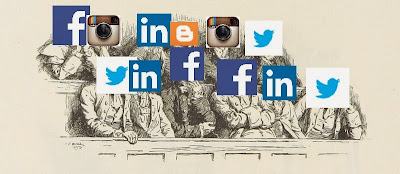
Graphic: Drawing of jury by Charles Edmund Brock taken from: Thomas Hood, Humorous Poems ... With a preface by A. Ainger, and ... illustrations by C. E. Brock. L.P (1893); available in the British Library's Photostream here. Blogger, Facebook, Instagram, LinkedIn, and Twitter logos added by Mary Whisner.

Graphic: Drawing of jury by Charles Edmund Brock taken from: Thomas Hood, Humorous Poems ... With a preface by A. Ainger, and ... illustrations by C. E. Brock. L.P (1893); available in the British Library's Photostream here. Blogger, Facebook, Instagram, LinkedIn, and Twitter logos added by Mary Whisner.
Thursday, April 24, 2014
Happy Birthday, Library of Congress!
It was 214 years ago today that President Adams taught the band to play...
I mean, signed a bill providing for the establishment of the Library of Congress.

Indeed, on April 24, 1800, President John Adams signed a law providing $5,000 (close to $100,000 in present-day U.S. dollars) "for the purchase of such books as may be necessary for the use of Congress . . . and for fitting up a suitable apartment for containing them." 2 Stat. 56.
These books were originally housed in the Capitol building itself, but eventually moved to a separate building. Quite a "suitable apartment," wouldn't you say?
While President Adams got the ball rolling on the Library, it was really President Thomas Jefferson who got serious about making the collection of books into a library. In 1802, President Jefferson signed a law providing for presidential appointment of a Librarian of Congress (who is to be paid "a sum not exceeding two dollars per diem"), a committee for developing regulations governing the Library, a committee for purchasing materials, and a home for the Library's collection. 2 Stat. 128. Thus, it is not surprising that the beautiful building shown above is named the Jefferson Building, while this rather bland annex is called the Adams Building:
Just another piece of trivia in the always interesting Adams-Jefferson rivalry.
And in case you were wondering, it was President Andrew Jackson who established a separate law department within the Library of Congress on July 14, 1832. 4 Stat. 579.
For more information on the fascinating history of the Library of Congress, check out Jefferson's Legacy: A Brief History of the Library of Congress.
And the Library of Congress is so much more than just some big buildings in that other Washington with a bunch of books in them. They have a lot of interesting collections to peruse on their website, including maps, photographs and prints, sound recordings, and the vast American Memory collection (among others). Check it out. Make them feel special on their birthday.
Images courtesy of HeinOnline, Wikipedia, and loc.gov, respectively.
I mean, signed a bill providing for the establishment of the Library of Congress.
Indeed, on April 24, 1800, President John Adams signed a law providing $5,000 (close to $100,000 in present-day U.S. dollars) "for the purchase of such books as may be necessary for the use of Congress . . . and for fitting up a suitable apartment for containing them." 2 Stat. 56.
These books were originally housed in the Capitol building itself, but eventually moved to a separate building. Quite a "suitable apartment," wouldn't you say?
 |
| The Thomas Jefferson Building in Washington, DC, the oldest of the Library of Congress buildings. |
 |
| The Adams Building in Washington, DC. |
And in case you were wondering, it was President Andrew Jackson who established a separate law department within the Library of Congress on July 14, 1832. 4 Stat. 579.
For more information on the fascinating history of the Library of Congress, check out Jefferson's Legacy: A Brief History of the Library of Congress.
And the Library of Congress is so much more than just some big buildings in that other Washington with a bunch of books in them. They have a lot of interesting collections to peruse on their website, including maps, photographs and prints, sound recordings, and the vast American Memory collection (among others). Check it out. Make them feel special on their birthday.
Images courtesy of HeinOnline, Wikipedia, and loc.gov, respectively.
Wednesday, April 23, 2014
Happy 450th Birthday, Will!
Today is the day we celebrate the 450th anniversary of
William Shakespeare's birth. To mark the occasion, check out these books in the Gallagher Law Library collection.
Our most recent titles:
- Shakespeare and the Law: A Conversation Among Disciplines and Professions, edited by Bradin Cormack, Martha Craven Nussbaum & Richard Strier. Classified Stacks, PR3028 .S53 2013
- A Thousand Times More Fair: What Shakespeare's Plays Teach Us About Justice, by Kenji Yoshino. Classified Stacks, PR3028 .Y67 2011
- Shakespeare and the Law, by Paul Raffield & Gary Watt. Classified Stacks, KD612 .S53 2008
- The Law in Shakespeare, by Constance Jordan & Karen Cunningham. Classified Stacks, PR3028 .L39 2007

And our oldest title:
- Shakespeare's Legal Acquirements Considered, by John Campbell, Baron, & John Payne Collier. Classified Stacks, PR3028 .C3 1859
To find even more, just go to the catalog, and type in the
keyword shakespeare. To find books located here, use the facets on the left hand side and limit to Gallagher Law Library.
Happy Birthday to the Bard!
Tuesday, April 22, 2014
Results from National Library Week Candy Jar Contest
We had great turnout for the National Library Week Candy Jar Contest this year with a total of 22 submissions. Thanks to everyone for participating!
The total pieces of wrapped candy in the jar was 143. There was an errant jellybean at the bottom of the jar, so the grand total was 144 pieces of candy. The winning guess was a very close 147. He won all of the candy and the jar!
Thank you again to everyone for making National Library Week such a success!
The total pieces of wrapped candy in the jar was 143. There was an errant jellybean at the bottom of the jar, so the grand total was 144 pieces of candy. The winning guess was a very close 147. He won all of the candy and the jar!
Thank you again to everyone for making National Library Week such a success!
Monday, April 21, 2014
French Change Civil Code to Recognize Animal Feelings—Almost
The ABA Journal online reported Pets in France get legal status as ‘living beings capable of feelings’ (April 18, 2014). What an interesting development! I decided to track down the actual law.

Friday, April 18, 2014
Listmania
We've all seen the "Top Ten" titles, scrawled like sirens across webpages and magazine covers, inviting us to view the best-dressed stars, worst movies, most-promising performers, or lowest-cost-of-living cities. Turns out, lawyers aren't immune from naming their favs. Before reading farther for some fab favs from the ABA and WSBA, check out the favorite-reads lists compiled by your Gallagher Law Library staff and by your law school faculty and staff in celebration of National Library Week. You can find some of the items right here at Gallagher; check out our "Good Reads" section, and take home an awesome option like:
|
|
The Lincoln Lawyer |
The Clone Age | |
Who Makes Model Laws?
You've heard of the Uniform Commercial Code and the Model Penal Code, but how much do you know about model laws? You could learn more by reading this short article: Mary Whisner, There Oughta Be a Law—a Model Law, 106 Law Libr. J. 125 (2014). Here's an abstract:
Model legislation can be proposed by anyone, from large organizations with layers of process (like the Uniform Law Commission and the American Law Institute) to individuals. Awareness of model laws is important for drafters and also for advocates, as they try to influence legislation or to interpret it once it has been enacted. In this article, I discuss the sources of model laws in both senses of "source" - the drafters and the research tools.
I begin with the Uniform Law Commission, the American Law Institute, and the American Bar Association: organizations that are familiar to many legal researchers. But I also discuss less familiar sources of model laws. For example, I had never heard of the Specialty Equipment Market Association, but twenty-two states have adopted its model law for registration of custom cars and hot rods. That group has only a few model laws in a very narrow field. In contrast, the American Legislative Exchange Council (ALEC), a group of conservative legislators and business leaders, has proposed hundreds of laws - often with success - on dozens of topics. Few people need to know about registration of custom cars and hot rods, but ALEC's work affects so many areas of the law that it deserves more attention from lawyers and other legal researchers.
Thursday, April 17, 2014
Crowdsourcing Legal Research
If you have a tough case, does it make sense to post your issue on a website and see what other lawyers will say? Legal Technology News looks at this new practice: John Edwards, Legal Research: Send in the Crowds?, LTN, April 16, 2014. The short answer:
"Crowdsourcing is a powerful way of engaging legal research, but some lawyers feel it's useless, perhaps even harmful."
The article mentions two crowdsourcing websites aimed at lawyers:
The article mentions two crowdsourcing websites aimed at lawyers:
Monday, April 14, 2014
What Are We Reading?
To celebrate National Library Week, the Gallagher Law
Library staff was again asked "what are you reading? What's on your nightstand,
in your backpack, on your e-reader right now?"
It's no surprise that people who work in libraries tend to be people who read outside of work. What may be a surprise is the diversity of what the law library staff reads (or is reading at the moment). We're reading fiction, nonfiction, memoirs, mysteries,
sci-fi, and classics. We're reading politics, history, education, sports, and books about animal behavior. And more than one of us likes dogs.
Take a look!


For a list of titles and authors, click on read more . . .
It's National Library Week!
We have some fun activities planned for law students this week!
TGIT
The Library is hosting TGIT on April 17th from 5:30-7:30 in Room 115 or on the terrace if it's nice. Don't forget to bring your IDs!
SHELFIES
Submit a picture of yourself in the library or your favorite part of the law library on Instagram and tag it with #lawlibraryshelfies. At the end of National Library Week, we will select the winners of some awesome prizes!

CANDY CONTEST
Come by the Reference Office and guess how many pieces of candy are in the jar. You get to keep the jar and it's delicious contents if you're the big winner! We also have a jar of candy available in the law student lounge (no contest for that one, just some free sugar courtesy of your friendly reference librarians).
.JPG)
TGIT
The Library is hosting TGIT on April 17th from 5:30-7:30 in Room 115 or on the terrace if it's nice. Don't forget to bring your IDs!
SHELFIES
Submit a picture of yourself in the library or your favorite part of the law library on Instagram and tag it with #lawlibraryshelfies. At the end of National Library Week, we will select the winners of some awesome prizes!
CANDY CONTEST
Come by the Reference Office and guess how many pieces of candy are in the jar. You get to keep the jar and it's delicious contents if you're the big winner! We also have a jar of candy available in the law student lounge (no contest for that one, just some free sugar courtesy of your friendly reference librarians).
Sunday, April 13, 2014
UW Journals Publishing New Scholarship
Current journal issues from UW Law have a high dose of high tech, mixed with constitutional law and public policy.
The new issue of the Washington Law Review features five articles about different aspects of big data and artificial intelligence:
The new issue of the Washington Law Review features five articles about different aspects of big data and artificial intelligence:
- Danielle Keats Citron & Frank Pasquale, The Scored Society: Due Process for Automated Predictions, 89 Wash. L. Rev. 1 (2014)
- Elizabeth E. Joh, Policing by Numbers: Big Data and the Fourth Amendment, 89 Wash. L. Rev. 35 (2014)
- Lawrence B. Solum, Artificial Meaning, 89 Wash. L. Rev. 69 (2014)
- Harry Surden, Machine Learning and the Law, 89 Wash. L. Rev. 87 (2014)
- David C. Vladeck, Machines Without Principals: Liability Rules and Artificial Intelligence, 89 Wash. L. Rev. 117 (2014)
- Laura J. Powell, Comment, The Parcel as a Whole: Defining the Relevant Parcel in Temporary Regulatory Takings Cases, 89 Wash. L. Rev. 151 (2014)
- Lauren Watts, Comment, Reexamining Crawford: Poll Worker Error as a Burden on Voters, 89 Wash. L. Rev. 175 (2014)
- Andrea Woods, Comment, The Undersigned Attorney Hereby Certifies: Ensuring Reasonable Caseloads for Washington Defenders and Clients, 89 Wash. L. Rev. 217 (2014)
- M. Margaret McKeown, The Internet and the Constitution: A Selective Retrospective, 9 Wash. J.L. Tech. & Arts 133 (2014)
- John Morgan & Veronica Sandoval, Pacific Northwest Perspective: The Impact of the America Invents Act on Nonprofit Global Health Organizations, 9 Wash. J.L. Tech. & Arts 177 (2014)
- Pedro Celis, When Is a YouTube Video a "True Threat"?, 9 Wash. J.L. Tech. & Arts 227 (2014)
- Sam Méndez, Aereo and Cablevision: How Courts Are Struggling to Harmonize the Public Performance Right with Online Retransmission of Broadcast Television, 9 Wash. J.L. Tech. & Arts 239 (2014)
Friday, April 11, 2014
Vote for your Favorite 2014 Peeps in Law Diorama!
Voting is open for the ABA's annual Peeps in Law contest! You have until 11:59 p.m. April 21 to vote for your favorite diorama.
And who can forget this masterpiece from our own Peeps contest last year? You can see past winners here and here. Enjoy!

(Photo credit: Fernando Gonzalez; Peep placement by Anna Endter)
And who can forget this masterpiece from our own Peeps contest last year? You can see past winners here and here. Enjoy!
(Photo credit: Fernando Gonzalez; Peep placement by Anna Endter)
Thursday, April 10, 2014
New HeinOnline Collection--Women and the Law
Although it is no longer Women's History month, continue your celebration by
browsing HeinOnline’s new collection, Women and the Law (Peggy) [UW Restricted]. The collection is dedicated to Ilene N. Hein, who passed away in 2012 and was co-founder of William S. Hein & Co., Inc., and
to Margaret (“Peggy”) Marmion, the late mother of Kevin Marmion, William S.
Hein & Co.’s current president.

The collection, which includes books, biographies, and periodicals discussing women’s roles in law and society, contains over 800 fully-searchable titles. Since the oldest publication in the collection was published in 1609 and the most recent was published in 2014, the materials in this collection demonstrate the evolution of gender roles in society as a whole and in the legal system.
The Women and the Law collection is divided into subject-specific sections like:
- Works on Abortion
- Biographies of Famous Women
- Legal Rights and Suffrage
- Women & Education
- Women & Employment
Women and the Law is located in HeinOnline’s alphabetical list of collections and is fully searchable. More information is available here.
More resources related to women and the law may be located by using the subject headings listed below to search the Gallagher catalog.
Feminist jurisprudence
Suffrage--United States
Women lawyers
Women--legal status--United States
Women--law--United States
Women's rights--United States
Civil Rights Act of 1964
This year marks the 50th anniversary of the Civil Rights Act of 1964.
CNN has produced a short video, 5 Things You Didn't Know About the 1964 Civil Rights Act:
There's terrific footage, including President Johnson's speech when he signed the law on July 2. The accompanying article is Many Doubt 1964 Civil Rights Act Could Pass Today, April 9, 2014.
New books
Todd S. Purdum, An Idea Whose Time Has Come: Two Presidents, Two Parties, and the Battle for the Civil Rights Act of 1964, Classified Stacks (KF4744.5151964 .P87 2014)

The LBJ Presidential Library is hosting The Civil Rights Summit: We Shall Overcome, April 8-10. See also (or hear also): Don Gonyea, LBJ Legacy: Vietnam War Often Overshadows Civil Rights Feat, NPR Morning Edition, April 9, 2014.
There's terrific footage, including President Johnson's speech when he signed the law on July 2. The accompanying article is Many Doubt 1964 Civil Rights Act Could Pass Today, April 9, 2014.
New books
Todd S. Purdum, An Idea Whose Time Has Come: Two Presidents, Two Parties, and the Battle for the Civil Rights Act of 1964, Classified Stacks (KF4744.5151964 .P87 2014)
- Publisher's page
- Author interview on Fresh Air: The Politics of Passing 1964's Civil Rights Act, Jan. 20, 2014
The LBJ Presidential Library is hosting The Civil Rights Summit: We Shall Overcome, April 8-10. See also (or hear also): Don Gonyea, LBJ Legacy: Vietnam War Often Overshadows Civil Rights Feat, NPR Morning Edition, April 9, 2014.
Thursday, April 3, 2014
The Law of America's Favorite Pastime
It's spring, and you know what that means! No, not the return of seasonal allergies. Baseball! Yes, America's (once) favorite pastime is back, so what better time than now to take a look at the law of baseball?
We here at the Gallagher Law Library have two great books on the law of baseball. First, The Baseball Trust: A History of Baseball's Antitrust Exemption, by Stuart Banner, as the name implies, tells the story of how Major League Baseball gained its exemption from American antitrust laws (an exemption no other sport enjoys).

In 1922, in Federal Baseball Club of Baltimore, Inc. v. National League of Professional Baseball Clubs, et al., the Supreme Court ruled that baseball is not subject to federal antitrust law because it is not a form of interstate commerce. The great Justice Oliver Wendell Holmes, writing for the court, stated, "The business is giving exhibitions of base ball, which are purely state affairs. It is true that, in order to attain for these exhibitions the great popularity that they have achieved, competitions must be arranged between clubs from different cities and States. But the fact that in order to give the exhibitions the Leagues must induce free persons to cross state lines and must arrange and pay for their doing so is not enough to change the character of the business." 259 U.S. 200, 208-09 (1922).
In 1972, the Court affirmed its holding in Federal Baseball, and also held that baseball is exempt from state antitrust laws as well because of the necessity for "national uniformity" in the regulation of the sport. Flood v. Kuhn, 407 U.S. 258, 284 (1972).
Stuart Banner contends that these rulings make no sense and that baseball's unique antitrust status results not from its special place as America's favorite pastime, but from MLB's clever maneuverings through the American legal system. The book is available in our Good Reads section at KF3989. B36 2013 - come check it out! [Note: Good Reads are located on the short stacks at the west end of the skylight opening on L1, just outside of the Law Student Lounge.]
If you're looking for a briefer discussion of baseball's antitrust exemption, check out Michael Mozes and Ben Glicksman, Adjusting the Stream? Analyzing Major League Baseball's Antitrust Exemption after American Needle, 2 Harv. J. Sports & Ent. L. 265 (2011).
Second, The Little White Book of Baseball Law, by John H. Minan and Kevin Cole, provides a number of stories in which baseball has intersected with the law.

Each chapter tells the story of a different court case, on issues ranging from whether liability exists when a batter is hit by a pitch (Avila v. Citrus Community College District, 131 P.3d 383 (Cal. 2006)), to the legality of fantasy baseball's use of player names and information (CBC Distribution & Marketing, Inc. v. Major League Baseball, 505 F.3d 818 (8th Cir. 2007)), to stadium liability for spectator injuries (Benejam v. Detroit Tigers, Inc., 635 N.W.2d 219 (Mich. Ct. App. 2001)). This book is also available in our Good Reads Section at KF3989. M563 2009.
Or if you're actually looking for the law of baseball - i.e., the rules governing the game - you can find them here. As an exercise in statutory interpretation, try to parse Rule 2.00's definition of "infield fly" or Rule 8.05's explanation of the "balk."
And if you're looking for a way to kill hours of time, do some baseball research at baseball-reference.com.
With your new found knowledge, get out there and watch some baseball! You can get $10 tickets with your Husky Card on "College Nights," April 25, May 30, June 13, and September 20. Or better yet, you can catch UW baseball games at the newly renovated Husky Ballpark for free with your Husky Card! You can find the schedule here.
We here at the Gallagher Law Library have two great books on the law of baseball. First, The Baseball Trust: A History of Baseball's Antitrust Exemption, by Stuart Banner, as the name implies, tells the story of how Major League Baseball gained its exemption from American antitrust laws (an exemption no other sport enjoys).
In 1922, in Federal Baseball Club of Baltimore, Inc. v. National League of Professional Baseball Clubs, et al., the Supreme Court ruled that baseball is not subject to federal antitrust law because it is not a form of interstate commerce. The great Justice Oliver Wendell Holmes, writing for the court, stated, "The business is giving exhibitions of base ball, which are purely state affairs. It is true that, in order to attain for these exhibitions the great popularity that they have achieved, competitions must be arranged between clubs from different cities and States. But the fact that in order to give the exhibitions the Leagues must induce free persons to cross state lines and must arrange and pay for their doing so is not enough to change the character of the business." 259 U.S. 200, 208-09 (1922).
In 1972, the Court affirmed its holding in Federal Baseball, and also held that baseball is exempt from state antitrust laws as well because of the necessity for "national uniformity" in the regulation of the sport. Flood v. Kuhn, 407 U.S. 258, 284 (1972).
Stuart Banner contends that these rulings make no sense and that baseball's unique antitrust status results not from its special place as America's favorite pastime, but from MLB's clever maneuverings through the American legal system. The book is available in our Good Reads section at KF3989. B36 2013 - come check it out! [Note: Good Reads are located on the short stacks at the west end of the skylight opening on L1, just outside of the Law Student Lounge.]
If you're looking for a briefer discussion of baseball's antitrust exemption, check out Michael Mozes and Ben Glicksman, Adjusting the Stream? Analyzing Major League Baseball's Antitrust Exemption after American Needle, 2 Harv. J. Sports & Ent. L. 265 (2011).
Second, The Little White Book of Baseball Law, by John H. Minan and Kevin Cole, provides a number of stories in which baseball has intersected with the law.
Each chapter tells the story of a different court case, on issues ranging from whether liability exists when a batter is hit by a pitch (Avila v. Citrus Community College District, 131 P.3d 383 (Cal. 2006)), to the legality of fantasy baseball's use of player names and information (CBC Distribution & Marketing, Inc. v. Major League Baseball, 505 F.3d 818 (8th Cir. 2007)), to stadium liability for spectator injuries (Benejam v. Detroit Tigers, Inc., 635 N.W.2d 219 (Mich. Ct. App. 2001)). This book is also available in our Good Reads Section at KF3989. M563 2009.
Or if you're actually looking for the law of baseball - i.e., the rules governing the game - you can find them here. As an exercise in statutory interpretation, try to parse Rule 2.00's definition of "infield fly" or Rule 8.05's explanation of the "balk."
And if you're looking for a way to kill hours of time, do some baseball research at baseball-reference.com.
With your new found knowledge, get out there and watch some baseball! You can get $10 tickets with your Husky Card on "College Nights," April 25, May 30, June 13, and September 20. Or better yet, you can catch UW baseball games at the newly renovated Husky Ballpark for free with your Husky Card! You can find the schedule here.
Tuesday, April 1, 2014
University of Idaho Issues Kittens to Entering Students
The University of Idaho plans to improve undergraduate life by issuing kittens to all first-year students. There will be alternative pets for students who are allergic to cats.
It's such an exciting project, the university even highlights it with a student video:
Expanded Services in the Law Library
The Gallagher Law Library is always striving to exceed our users' high expectations for service. Today we are pleased to announce some exciting innovations.
Mercedes is now embedding hot stone massage in the seats of its cars, so we thought: why restrict that experience to luxury cars? Starting this month, selected library chairs will also have several massage settings to ease the tension that long hours studying can inflict on shoulders and backs.
Drawing inspiration from the hotel industry, we will make our library patrons users guests feel more welcome by offering fresh-baked chocolate chip cookies in the L1 lounge and the L2 student collaborative space each afternoon.
Says Associate Dean Hazel Pennington, "Nothing says 'We're glad you're here' like warm cookies!" Sensitive to students' dietary preferences and needs, of course we will offer snacks that are (variously) vegan, low-sugar, gluten-free, kosher, halal, lactose-free, and made without contact with tree nuts.
The Law Library already provides students with access to half a million books and extensive online subscriptions, including Bloomberg Law, HeinOnline, LexisNexis, and Westlaw. In addition, we have staff who will borrow materials for students through interlibrary loan and reference librarians who will help students navigate the complex information landscape. We already help students do good work, so why not help the students look good too? To that end, we are converting a corner of the Reference Area to a salon where students can get their hair styled and nails done without having to leave the law school. A presser will even touch up your suit before a mock trial or interview if it got rumpled in your locker.
Our goal is to give you the very best service we can, throughout the year (as well as on April 1).
Mercedes is now embedding hot stone massage in the seats of its cars, so we thought: why restrict that experience to luxury cars? Starting this month, selected library chairs will also have several massage settings to ease the tension that long hours studying can inflict on shoulders and backs.
 |
| Mercedes massage seat (graphic from Tech Hive) |
 |
| Assoc.Dean Hazel Pennington |
The Law Library already provides students with access to half a million books and extensive online subscriptions, including Bloomberg Law, HeinOnline, LexisNexis, and Westlaw. In addition, we have staff who will borrow materials for students through interlibrary loan and reference librarians who will help students navigate the complex information landscape. We already help students do good work, so why not help the students look good too? To that end, we are converting a corner of the Reference Area to a salon where students can get their hair styled and nails done without having to leave the law school. A presser will even touch up your suit before a mock trial or interview if it got rumpled in your locker.
Our goal is to give you the very best service we can, throughout the year (as well as on April 1).
Subscribe to:
Posts (Atom)